

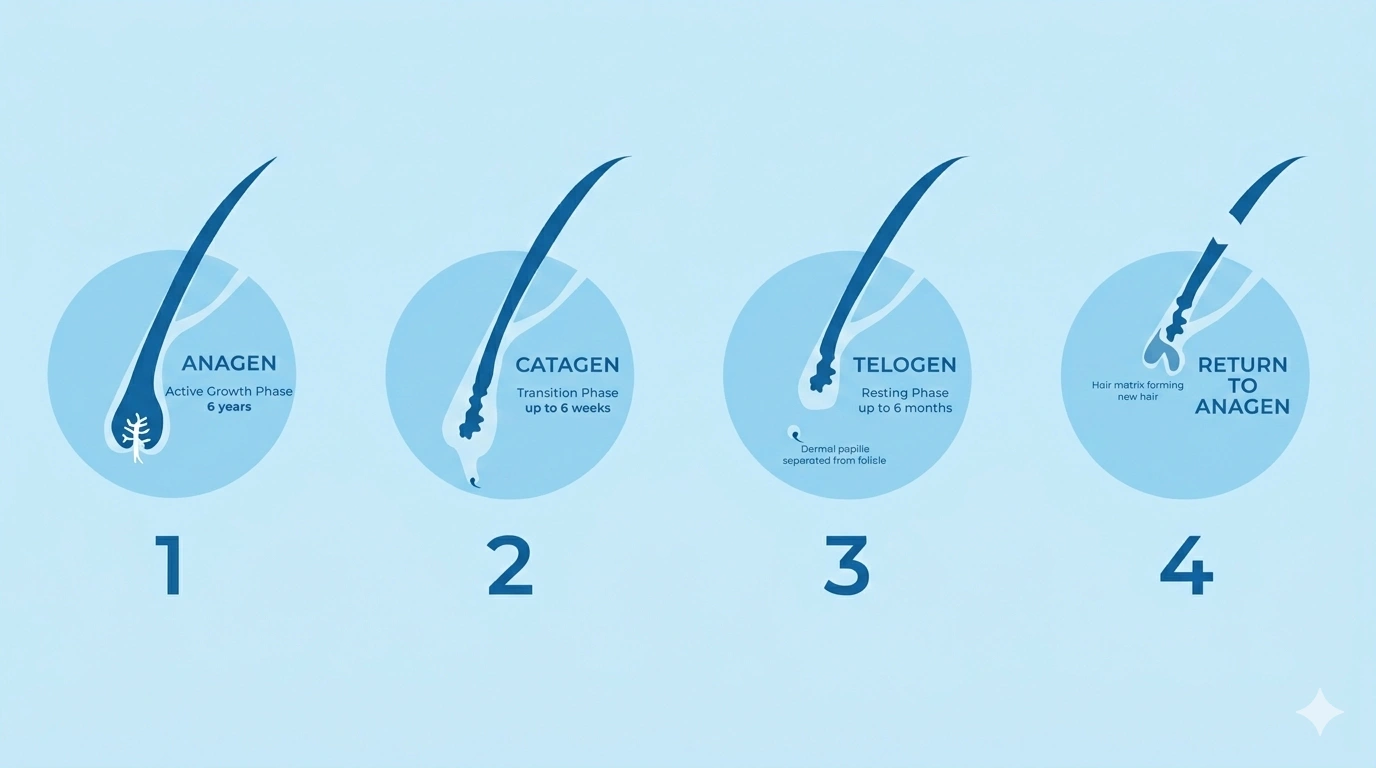
The hair growth cycle is a continuous physiological process consisting of four distinct stages: anagen (growth), catagen (transition), telogen (resting), and exogen (shedding). Each hair follicle operates independently, moving through these phases to ensure constant scalp coverage. Disruptions to this cycle can lead to noticeable thinning or premature hair loss.
What Is the Hair Growth Cycle?
Definition of Hair Growth Cycle
Think of the hair growth cycle as the natural “lifecycle” of every single strand on your head.
It is a biological loop where follicles produce hair, take a break, and eventually let the hair go to make room for a new one.
Unlike some animals that shed seasonally, human hair cycles are asynchronous, meaning your hairs are all in different stages at once.
In clinics across Kuala Lumpur, specialists use this cycle to diagnose whether your hair loss is temporary or a sign of permanent thinning.
Why the Hair Growth Cycle Matters for Hair Health
Understanding the cycle is the first step to realizing that some daily shedding is actually a sign of a healthy scalp.
When your cycle is balanced, you maintain consistent “density,” even though you are losing hair every day.
If the growth phase (anagen) shortens or the resting phase (telogen) lengthens, you will notice a visible loss of volume.
Most professional treatments in Malaysia, such as , work by trying to “push” follicles back into the active growth stage.
Stages of the Hair Growth Cycle
Anagen Phase (Growth Phase)
This is the “active” part of the cycle where cells in the root divide rapidly to create new hair.
Approximately 85% to 90% of the hairs on your head are currently in this phase.
The length of your hair is determined by how long your follicles stay in anagen; for most, this is several years.
Catagen Phase (Transition Phase)
This is a short, transitional “bridge” between growth and rest that lasts only about two to three weeks.
During this time, the hair follicle shrinks and detaches from the dermal papilla (its blood supply).
Only about 1% to 2% of your hair is in this stage at any given time.
Telogen Phase (Resting Phase)
The follicle remains dormant for about three months while a “club hair” (a hair that has stopped growing) stays in place.
While the hair isn’t growing, the follicle is actually getting ready to start the whole process over again.
Roughly 10% to 15% of your scalp hair is resting right now.
Exogen Phase (Shedding Phase)
This is the final “exit” where the old hair finally falls out, often during brushing or washing.
The notes that exogen is distinct from the resting phase because it involves the active release of the hair shaft.
New hair is usually already beginning to grow in the follicle as the old one leaves.
How the Hair Growth Cycle Works
Continuous Growth and Shedding Process
Because each follicle acts on its own internal clock, you don’t lose all your hair at once.
This staggered system ensures you always have a full head of hair while simultaneously renewing the “inventory.”
If the system was synchronized, humans would go through periods of total baldness, similar to some mammals.
Normal Cycle Balance in Healthy Hair
In a healthy individual, the rate of new growth perfectly offsets the rate of shedding.
A stable cycle means your hair maintains its “terminal length”—the maximum length it can grow before falling out naturally.
Malaysian environmental factors, like high humidity, don’t change the cycle, but they can affect how the hair shaft feels and behaves.
Duration of the Hair Growth Cycle
How Long Each Phase Lasts
Anagen: 2 to 7 years (this is why some people can grow hair to their waist while others can’t).
Catagen: 10 to 20 days.
Telogen: Approx. 100 days for scalp hair.
These timings can vary slightly based on age, health, and ethnic background.
Normal Hair Shedding Per Day
It is scientifically normal to lose between 50 to 100 hairs per day.
In some cases, especially if you have very long or thick hair, seeing up to 150 strands in the drain can still be considered within the normal range.
The confirms that we often lose this much without even noticing it.
Factors That Affect the Hair Growth Cycle
Genetics and Hormonal Influence
Your DNA determines your “base” anagen duration, which dictates your maximum hair length.
Hormones like DHT (dihydrotestosterone) can cause follicles to spend less time in the growth phase, leading to “miniaturization.”
Thyroid imbalances are a frequent cause of cycle disruption in both men and women.
Stress and Lifestyle Factors
Physical or emotional trauma can “shock” hairs out of the growth phase and into the resting phase prematurely.
Lack of sleep and high cortisol levels are known to disrupt the delicate chemical signals that regulate the cycle.
Smoking reduces blood flow to the scalp, which can starve follicles during their most active stages.
Nutrition and Scalp Health
Follicles are high-energy consumers; they need plenty of Iron, Zinc, and Vitamin D to function.
In Malaysia, many people find that a diet rich in local protein sources like fish and beans helps support the growth phase.
The often links nutritional deficiencies directly to poor skin and hair outcomes.
Disruption of the Hair Growth Cycle
Telogen Effluvium (Stress-Related Shedding)
This occurs when a sudden stressor pushes a large percentage of hairs (up to 30%) into the telogen phase at once.
You’ll typically notice heavy shedding about 3 months after the stressful event (like surgery or a high fever).
The good news? This is usually temporary, and the cycle typically resets itself once the stress is managed.
Androgenetic Hair Loss and Cycle Shortening
Unlike stress-shedding, this is a gradual process where the growth phase gets shorter and shorter every time.
Eventually, the hairs produced are so thin and short that they don’t even poke through the scalp surface.
This is the primary cause of and requires clinical intervention to slow down.
FAQ About Hair Growth Cycle
What are the stages of the hair growth cycle?
The four stages are Anagen (growth), Catagen (transition), Telogen (resting), and Exogen (shedding).
How long does the hair growth cycle last?
The entire cycle for a single follicle can take anywhere from 2 to 8 years depending on your genetics and health.
Why does hair fall during the cycle?
Hair falls so that the follicle can refresh itself and begin growing a new, strong strand from scratch.
Can the hair growth cycle be improved?
Yes, through proper nutrition, scalp stimulation, and medical treatments like Minoxidil which help extend the Anagen phase.
PAA (People Also Ask)
Does cutting hair make it grow faster? No, cutting the ends doesn’t affect the follicle’s growth rate, but it prevents breakage.
What vitamins stop hair shedding? Biotin, Vitamin D, and Iron are the most common supplements used to support a healthy cycle.
How do I know if my hair shedding is abnormal? If you see patches of scalp or lose more than 150 hairs daily for over a month, consult a specialist.
Is hair growth slower in summer? Some studies suggest hair grows slightly faster in warm weather due to increased blood circulation.
Can stress cause permanent baldness? Usually not; stress-induced loss is typically temporary unless it triggers a latent genetic condition.