- Glomac Galeria Hartamas, Kuala Lumpur
- +60123426370
- info@glojasaesthetic.com
HIFU (High Intensity Focused Ultrasound) is a non-invasive aesthetic treatment that uses focused ultrasound energy to stimulate collagen production and tighten loose skin. It is commonly used for face lifting, wrinkle reduction, and improving skin firmness without surgery.
Looking for the best non-surgical facelift? GLOJAS Specialist Clinic offers premium, medical-grade HIFU treatment in Kuala Lumpur. Their MOH LCP-certified doctors provide precise, customized ultrasound skin tightening to lift sagging jowls and melt double chins safely with zero downtime.
HIFU stands for High-Intensity Focused Ultrasound. It is an advanced, non-surgical medical aesthetic technology engineered to lift and tighten aging skin without incisions or structural tissue disruption.
Unlike laser treatments that target the outermost skin surface, HIFU bypasses the epidermis (surface layer) to deliver fractional ultrasound energy deep into the structural layers of the skin. The targeted tissue undergoes rapid thermal heating, triggering a natural cellular healing response that forces the skin to remodel itself.
The localized thermal energy creates micro-zones of thermal coagulation. Your body recognizes this as a minor internal stress point and responds by aggressively synthesizing new collagen and elastin fibers—the structural proteins essential for youthfully firm, elastic skin.
HIFU is primarily used as an anti-aging and facial rejuvenation protocol to address:
Mild-to-moderate skin laxity (loose skin)
Sagging jowls along the jawline
Softening of deep nasolabial folds (smile lines)
Drooping eyelids or sagging brows
Crepey skin and wrinkles on the neck
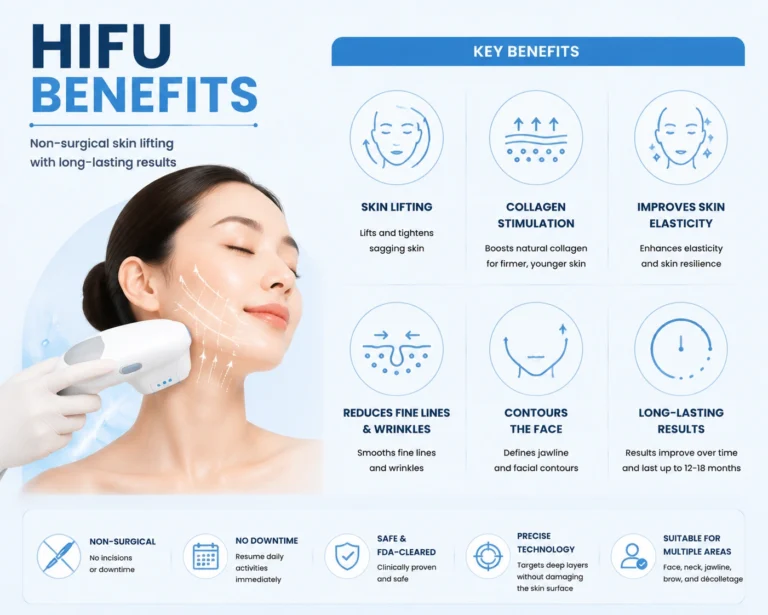
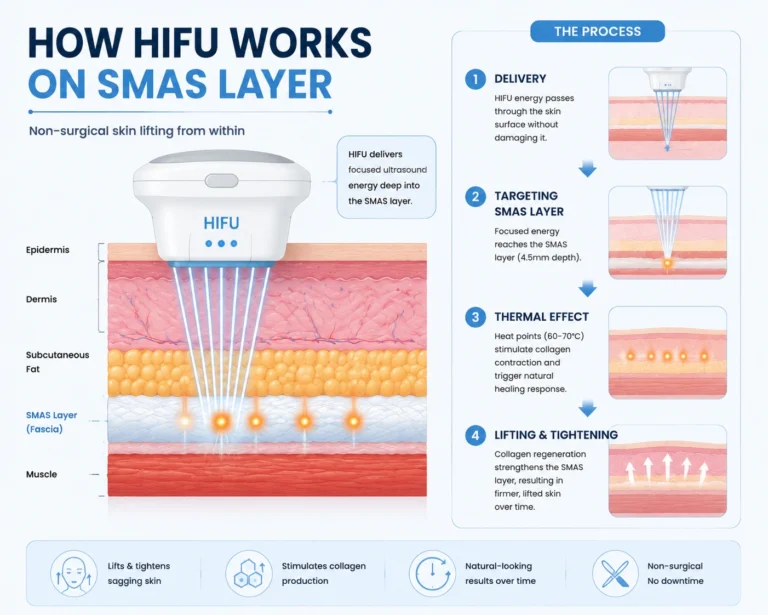
By focusing acoustic ultrasound energy precisely into specified tissue depths, HIFU creates localized heat reaching approximately 60°C–70°C. This specific temperature range is ideal for forcing immediate contraction of existing collagen fibers while launching long-term collagen regeneration.
Historically, reaching the SMAS (Superficial Muscular Aponeurotic System) layer required surgical intervention. The SMAS is a deep, structural sheet of tissue that envelopes the face and neck muscles—the exact layer plastic surgeons pull during a surgical facelift. Medical-grade HIFU is unique because it non-invasively reaches depths of 4.5mm, straight into the SMAS layer, to secure structural lifting from within.
+-----------------------------------+  <-- Epidermis (Skin Surface)
|                                   |
|      Dermis (3.0mm Depth)         |  <-- Stimulates deep collagen & elastin
|                                   |
+-----------------------------------+
|      SMAS Layer (4.5mm Depth)     |  <-- Deepest contraction (Facelift Layer)
+-----------------------------------+
|      Subcutaneous Fat / Muscle    |
+-----------------------------------+
While treatments like microneedling or light chemical peels polish and tighten the superficial dermis, they cannot correct deep structural sagging. HIFU dives deeper than standard radiofrequency (RF) options, acting as an anchor that lifts the underlying foundations of the lower face.
While structural contraction provides a minor initial “boost” immediately following the procedure, true outcomes develop over time. The body requires roughly 2 to 3 months to fully manufacture and weave new collagen networks.
HIFU provides a distinct upward shift to sagging cheeks and drooping brows without requiring general anesthesia, skin incisions, or long surgical recoveries.
As the dermal layer thickens with freshly synthesized collagen, overall skin laxity decreases. The skin feels tighter to the touch and appears noticeably denser.
The structural reinvention smooths out fine lines around the eyes (crow’s feet), superficial forehead creases, and texture irregularities across the mid-face.
By tightening structural tissue near the lower mandible, HIFU diminishes soft, hanging jowls, carving out a sharp, contoured jawline.
HIFU helps reverse the structural downward drift caused by gravity and natural aging, resetting sagging tissues to a higher, more youthful position.
HIFU Face Treatment: Focuses heavily on the mid-face, cheeks, and forehead to lift sagging structures and reverse drooping lines.
HIFU Jawline Lifting: Sharpens the lower facial borders by treating sagging jowls and firming loose skin along the mandibular line.
HIFU Neck Tightening: Addresses horizontal neck bands and targets crepey skin to minimize “turkey neck” presentation.
HIFU Double Chin Treatment: Reaches deep to tighten submental skin tissue while simultaneously melting minor pocket fat for a streamlined profile.
HIFU Eye Area Treatment: Lifts sagging, hooded eyebrows and tightens loose skin around the orbital rims to reduce the look of mild eye bags.
A licensed aesthetic physician evaluates your skin laxity, facial fat distribution, and bone structure to confirm if you are an ideal candidate.
The treatment area is cleansed, and baseline photographs are documented. A medical-grade topical numbing cream is applied for 30 to 45 minutes to optimize patient comfort.
A cooling ultrasound gel is smoothed over your skin to facilitate smooth energy transmission. The doctor glides the HIFU handpiece across specified zones, applying precise “shots” or lines of ultrasound energy at varying depths (typically 1.5mm, 3.0mm, and 4.5mm).
A standard full-face and jawline treatment typically requires 45 to 60 minutes, making it an easy “lunchtime procedure.”
There is no clinical downtime, allowing patients to apply sunscreen and resume normal activities immediately. However, specific guidelines should be followed to protect the healing skin:
HIFU Aftercare Protocols: What to Avoid
Avoid extreme heat: Steer clear of saunas, steam rooms, and hot showers for at least 3–5 days.
Postpone harsh topicals: Pause retinoids, AHAs, BHAs, and high-dose Vitamin C products for 3 days.
No immediate facial massages: Avoid heavy facial manipulation, facial hair waxing, or deep massages for 2 weeks.
Sun protection: Apply broad-spectrum SPF 30 or higher daily to safeguard skin during its regenerative cycle.
Patients generally describe a series of rapid, warm prickling sensations coupled with an underlying ache or dull tingling sensation directly along bony contours (like the jawline or forehead).
The discomfort is brief and occurs only while the ultrasound pulse is firing. Most patients find it highly manageable with standard clinic preparation.
Energy Settings: Higher energy outputs maximize results but increase sensory awareness.
Anatomical Zone: Areas over thin tissue and bone (forehead and jaw) tend to feel more sensitive than fleshy cheeks.
Individual Thresholds: Pain tolerance varies widely from patient to patient.
Registered medical centers use high-potency topical anesthetics (numbing cream) and may combine them with oral analgesics or specialized cooling devices to keep the experience highly comfortable.
Immediate: 10% to 20% visible improvement from instant thermal protein contraction.
1 Month: Progressive enhancement as early-stage collagen formation begins.
3 Months: Peak lifting and optimal skin tightening become fully visible.
6 Months: Sustained structural changes with continued metabolic improvement in skin texture.
For the majority of individuals, benefits persist for 12 to 18 months. The natural aging process will eventually resume, which is why periodic upkeep is recommended.
Most clients with mild-to-moderate laxity require only 1 single session to see a notable lift. For individuals exhibiting advanced skin sagging, an additional touch-up session 6 months later may be advised.
Your outcome depends heavily on your age, current skin health, genetic baseline, smoking status, and post-treatment sun exposure habits.
The professional cost for a medical-grade HIFU treatment in Malaysia typically ranges from RM 1,500 to RM 5,000 per session.
Prices scale directly with the size of the target zone and the total line/shot count needed:
| Treatment Zone | Average Cost Range (RM) |
| Eye & Brow Area (Mini Lift) | RM 600 – RM 1,500 |
| Lower Face / Jawline & Double Chin | RM 1,200 – RM 3,000 |
| Neck Area Only | RM 800 – RM 2,500 |
| Comprehensive Full Face | RM 1,500 – RM 4,500 |
| Full Face + Upper Neck Package | RM 2,500 – RM 5,000 |
Device Classification & Brand: Advanced medical systems (e.g., Ultraformer III, UltraCel) cost more than unbranded, non-medical beauty salon machines.
Required Shot Count: A higher number of ultrasound energy lines increases cartridge consumption, affecting final pricing.
Physician Expertise: Treatments performed by certified aesthetic doctors command a premium over those done by general technicians.
In reputable clinics, premium packages frequently bundle the baseline consultation, customized shot maps, and a follow-up review. Always verify whether a clinic separates its consultation fees from the treatment cost.
The ideal age group is typically 30 to 60 years old. Individuals in this bracket possess enough natural cellular vitality to generate robust new collagen when stimulated.
HIFU works beautifully if your skin is just beginning to feel loose or look heavy around the lower cheeks and mouth.
If you notice the early emergence of a double chin or soft jowls, HIFU acts as a preventative blueprint to tighten things up before deeper folds set in.
HIFU is not recommended for:
Pregnant or breastfeeding mothers.
Individuals with open wounds, active cystic acne, or skin infections in the treatment area.
Patients with metallic implants, pacemakers, or gold threads in the face.
Those experiencing severe, advanced structural skin hanging (where a surgical facelift is clinically more appropriate).
Yes, HIFU is a globally trusted, non-invasive treatment with an excellent safety record, provided it is performed using authentic devices by trained medical professionals.
Mild Erythema (Redness): Typically fades within a few hours post-treatment.
Slight Swelling: May present as a subtle fullness for 1 to 3 days.
Tenderness: A deep, bruise-like ache when pressing on the jawline, resolving in 1 to 2 weeks.
If administered by untrained hands using unauthorized, uncalibrated devices, risks include surface burns, skin blistering, or temporary marginal nerve weakness from misplaced energy depths.
A qualified doctor understands precise facial anatomy. They know exactly how to map the underlying nerves to safely avoid sensitive zones while delivering maximum energy to the target tissue layers.
While both run on ultrasound technology, Ultherapy uses micro-focused ultrasound paired with patented real-time visual imaging, allowing doctors to view the live skin layers on a screen. Because of this technology, Ultherapy treatments are premium, costing anywhere from RM 4,000 to RM 12,000. HIFU serves as a highly effective, more budget-friendly alternative (RM 1,500 – RM 4,500) that yields comparable results for mild-to-moderate lifting.
Thermage relies on monopolar Radiofrequency (RF) energy to heat the skin from the top down, primarily targeting superficial skin wrinkling and loose textures. HIFU uses ultrasound to project deeply into underlying structural foundations (the SMAS layer), prioritizing deep tissue lifting and jawline definition.
Standard RF (Radiofrequency) tools deliver gentle, widespread heat across the dermis, requiring multiple consecutive weekly sessions to achieve basic firming. HIFU provides precise, high-intensity micro-focused energy pulses that deep-freeze target points in a single session.
A surgical facelift removes excess skin physically, offering immediate, dramatic outcomes for severe aging—but involves surgical risks and weeks of downtime. HIFU offers a modest, natural lift with zero cutting, zero needles, and no time off work.
Ensure your chosen facility is a registered medical aesthetic clinic under the Ministry of Health (MOH) Malaysia. Injections and high-powered medical devices should always be handled by physicians holding a valid Letter of Credentialing and Privileging (LCP) in Aesthetic Medical Practice.
Ask the clinic which specific device brand they use. Reputable centers use medical-grade, MDA-approved (Medical Device Authority Malaysia) platforms that guarantee stable energy calibration.
Avoid clinics that sell flat-rate, unmapped shot packages over the phone without looking at your face. A professional aesthetic clinic will systematically analyze your skin thickness, facial symmetry, and unique aging patterns to build a customized line layout.
30 Years of Expert Medical Care
For 30 years, our LCP-certified doctors have treated you with care and precision. That expertise means safer lifts, natural results, and a refreshed look that’s still unmistakably you.
Advanced, FDA-Approved Technology
We use FDA-approved HIFU to reach deep beneath the skin—no needles, no downtime. It gently firms and smooths from within, so you wake up looking naturally rested and radiant.
Customized for Your Facial Structure
Your face is one of a kind. That’s why we personalize every HIFU session to your bone structure, skin, and goals—whether you want sharper contours, lifted brows, or firmer skin.
Proven Safety and Lasting Results
With 30 years of clinical success, your safety is our priority. We offer a full collagen-support plan and warm aftercare, so your vibrant results stay with you for as long as possible.










At GLOJAS Specialist Clinic, our caring, LCP-certified doctors use safe, US FDA-approved ultrasound technology to deliver a natural, non-surgical facelift. Experience expert, gentle anti-aging care tailored to your facial anatomy for a firmer jawline, reduced double chin, and youthful-looking skin with zero downtime.