

What Is the Donor Area?
The donor area is the specific region of your scalp or body where healthy hair follicles are harvested for transplantation. These follicles are genetically programmed to resist balding, making them the “seeds” for your new growth. It acts as the finite engine for any successful hair restoration journey.
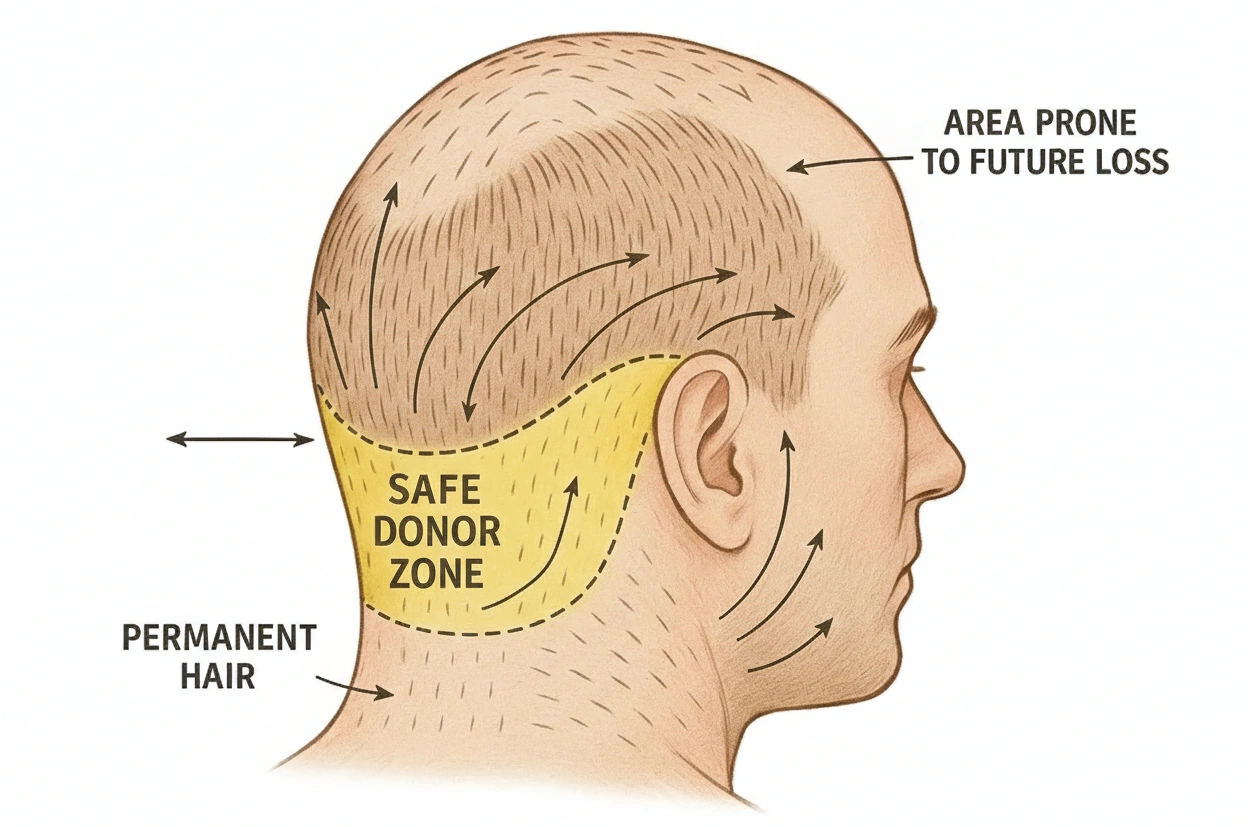
Where the Donor Area Is Located
Most commonly, the donor area is found at the occipital and temporal regions—the back and sides of the head. These areas are physiologically distinct because they lack the receptors for Dihydrotestosterone (DHT), the hormone primarily responsible for androgenetic alopecia, ensuring the transplanted hair lasts a lifetime.
Why Donor Area Is Critical for Hair Transplant Success
Think of the donor area as your “savings account.” Success depends on the quality and quantity of available grafts. If the donor site is handled poorly, you risk visible thinning or “moth-eaten” patches. Protecting this area ensures you have enough coverage for both current and future hair loss needs.
Types of Donor Areas
While the scalp is the primary source, modern science allows surgeons to look elsewhere. Depending on your needs, a surgeon might use a mix of locations to achieve natural density and texture.
Scalp Donor Area (Safe Zone Explained)
The “Safe Donor Zone” is the horseshoe-shaped area that remains even in advanced hair loss. According to the International Society of Hair Restoration Surgery (ISHRS), follicles here are naturally permanent. Using hairs from outside this zone increases the risk that transplanted hair will eventually fall out.
Body Hair Donor Area (Beard, Chest Use Cases)
When scalp hair is insufficient, surgeons utilize Body Hair Transplantation (BHT). Beard hair is the top choice due to its thick caliber and rapid growth cycles. Chest and back hair are also options, though they often have different textures and shorter growth phases compared to scalp hair.
Donor Area in Hair Transplant Techniques
The method of extraction significantly impacts how the donor site heals and how many follicles survive.
FUE Donor Area Extraction
In Follicular Unit Extraction (FUE), surgeons use a micro-punch (usually 0.7mm to 0.9mm) to harvest individual units. This creates tiny circular wounds that heal without a linear scar. It’s ideal for those who prefer short hairstyles and want a faster recovery for the donor region.
FUT Strip Method and Donor Impact
Follicular Unit Transplantation (FUT) involves removing a thin strip of skin. While it leaves a linear scar, it often yields a higher number of high-quality grafts in a single session. This method is highly efficient for patients requiring maximum coverage without thinning out the entire back of the head.
DHI Technique and Graft Handling
Direct Hair Implantation (DHI) focuses on minimizing the time follicles spend outside the body. While the extraction process is similar to FUE, the specialized tools allow for precise depth control, which helps preserve the integrity of the surrounding donor tissue and minimizes trauma to the scalp.
Donor Area Density and Graft Capacity
Managing your “hair budget” is a balancing act. You cannot take every hair; you must leave enough to maintain a natural, full appearance in the back.
How Many Grafts Can Be Safely Extracted
A healthy donor area typically contains 6,000 to 8,000 grafts in total. However, a surgeon usually extracts only 2,500 to 4,000 grafts in one session. Overstepping this limit risks permanent thinning. Standard density is often measured in follicular units per square centimeter ($FU/cm^2$).
Donor Area Limitations and Planning
If you have a “tight” scalp or low density, your options are limited. Surgeons use trichoscopy to measure your $FU/cm^2$ before surgery. Planning for potential future hair loss is vital so you don’t exhaust your supply too early in life.
| Feature | FUE Donor Impact | FUT Donor Impact |
| Scarring | Tiny white dots (diffuse) | Single linear scar |
| Healing Time | 7–10 days | 14–21 days |
| Graft Quality | High (if handled well) | Superior (due to strip) |
| Max Harvest | Higher risk of thinning | High yield, leaves density |
Donor Area Healing and Recovery
Healing is a biological process that requires patience. While the front (recipient area) gets the glory, the back needs the most care during the first week.
Healing Timeline After Extraction
Days 1–3: Small scabs form; slight swelling and redness.
Days 4–7: Itching begins as skin heals; scabs start to flake off.
Week 2: Redness fades; hair begins to grow around the extraction sites.
Month 1: The area usually looks completely normal to the naked eye.
Scarring, Regrowth and Appearance
With FUE, “scarring” refers to hypopigmented dots that are usually invisible unless you shave your head. With FUT, the scar can be hidden by hair as short as a grade 2 or 3. Proper post-operative wound care is essential to minimize scar widening or visibility.
Factors Affecting Donor Area Quality
Not all donor areas are created equal. Genetics, age, and lifestyle play huge roles in whether you are a “Grade A” candidate.
Hair Density, Thickness and Elasticity
High density (more hairs per $cm^2$) allows for more harvesting. Thickness (shaft diameter) provides better “visual coverage.” For FUT, scalp elasticity—how much the skin stretches—determines how wide a strip can be taken safely without causing tension in the closure.
DHT Resistance and Long-Term Stability
The “Safe Zone” must be truly resistant to DHT. If a patient has DUPA (Diffuse Unpatterned Alopecia), the donor area itself is thinning. In such cases, a transplant is usually not recommended because the moved hair will eventually fall out, just like the hair on top.
Previous Transplants and Overharvesting Risk
Every surgery leaves scar tissue (fibrosis). If you’ve had multiple procedures, the donor area becomes tougher and the blood supply may be slightly reduced. A skilled surgeon must navigate these “used” areas carefully to avoid “overharvesting,” which results in a transparent, patchy look.
Donor Area Care After Hair Transplant
Proper maintenance prevents infection and speeds up the return to normalcy. Your clinic will provide a specific protocol, but general rules apply to everyone.
Post-Procedure Care Tips
Keep the area clean by gently dabbing with sterile saline or a prescribed wash. Sleeping on a travel pillow can prevent the donor area from rubbing harshly against bedsheets. Applying antibiotic ointment for the first few days helps prevent crusting and infection.
What to Avoid During Recovery
Avoid scratching, even if it itches intensely. Don’t submerge the head in swimming pools or hot tubs for at least two weeks to avoid chemicals and bacteria. Steer clear of heavy exercise that causes excessive sweating or “scalp tension” (like heavy neck lifting) for 14 days.
Risks and Complications
While generally safe, hair transplant are surgeries with potential side effects. Being aware helps you spot issues early.
Overharvesting and Patchy Appearance
Overharvesting occurs when a surgeon takes too many grafts too close together. This leaves the back of the head looking thin or “moth-eaten.” It is difficult to fix, often requiring Scalp Micropigmentation (SMP) to camouflage the exposed skin.
Infection, Shock Loss or Poor Healing
“Donor Shock Loss” is a temporary thinning caused by the trauma of surgery. The surrounding hair “shocks” into a resting phase but typically grows back within 3–4 months. Infections are rare but characterized by increasing pain, pus, or spreading redness that requires immediate medical attention.
How to Choose a Clinic for Donor Area Management
Don’t just look at the “before and after” of the hairline. Look at the back of the head. A great surgeon treats the donor area with the same respect as the recipient site.
Surgeon Experience in Graft Extraction
Experience matters because extraction is a “blind” process once the punch enters the skin. An expert surgeon feels the resistance and adjusts the angle to avoid “transection”—accidentally cutting the hair bulb. Ask to see photos of donor areas one month after surgery.
Techniques to Preserve Donor Area Density
Top-tier clinics use “randomized” extraction patterns to ensure no single spot is stripped of hair. They also monitor the Total Harvest Ratio. Using high-magnification loupes ensures that only the healthiest, multi-hair units are selected while leaving enough behind to maintain a lush appearance.
GLOJAS Specialist Clinic offers expert hair transplant Malaysia trusts. Our ABHRS-certified surgeons deliver natural, permanent results using advanced FUE techniques. Book your consultation today.
Frequently Asked Questions (FAQs)
Does donor area hair grow back?
No, once a follicle is removed, it does not grow back in the donor site. It is permanently moved to the new location. However, because only a percentage of hair is taken, the surrounding hair covers the tiny gaps.
Can donor area run out of hair?
Yes. It is a finite resource. If you have extensive baldness and low donor density, you may “run out” of hair before achieving full coverage. This is why long-term planning with a qualified specialist is vital.
How many grafts can be taken safely?
Generally, up to 25% to 30% of the total donor density can be harvested without a noticeable change in appearance. For most people, this translates to roughly 3,500 to 4,500 grafts across multiple sessions.
Is donor area extraction painful?
The process is performed under local anesthesia, so you shouldn’t feel pain during the surgery. Afterward, the area may feel like a mild sunburn or “tight” for a few days, which is easily managed with standard over-the-counter pain relief.
How long does donor area take to heal?
The surface wounds usually close within 48 to 72 hours. Complete redness resolution and the “settling” of the skin typically take 7 to 10 days for FUE and about 2 to 3 weeks for FUT.