
What Is Androgenetic Alopecia?
Androgenetic alopecia is a genetically determined, progressive form of hair loss. It is the most common cause of thinning worldwide, characterized by the shrinking of hair follicles. In Malaysia, clinical data suggests it affects up to 63% of the male population at some point in their lives.
Causes of Androgenetic Alopecia
The primary drivers are a mix of internal biology and hereditary luck. While many blame stress or local humidity, the real culprits are usually microscopic. Understanding these triggers helps in choosing FDA-approved hair loss treatments that actually work for your specific scalp biology.
Genetic Factors
You can thank your family tree for this one. AGA is polygenic, meaning it involves multiple genes inherited from both parents. If your father or maternal grandfather experienced balding, your risk increases. This genetic blueprint dictates how sensitive your hair follicles are to certain circulating hormones.
Hormonal (DHT) Sensitivity
The main antagonist is Dihydrotestosterone (DHT), a byproduct of testosterone. An enzyme called 5-alpha reductase converts testosterone into DHT, which then binds to follicles. Over time, this causes “miniaturization,” where hair grows back thinner until the follicle eventually stops producing hair entirely.
Androgenetic Alopecia in Men
For Malaysian men, hair loss often starts as a subtle shift in the mirror. It is frequently associated with metabolic syndrome in local clinical studies. Early intervention is key, as hair loss prevention strategies are generally more successful than trying to regrow hair.
Male Pattern Hair Loss Progression
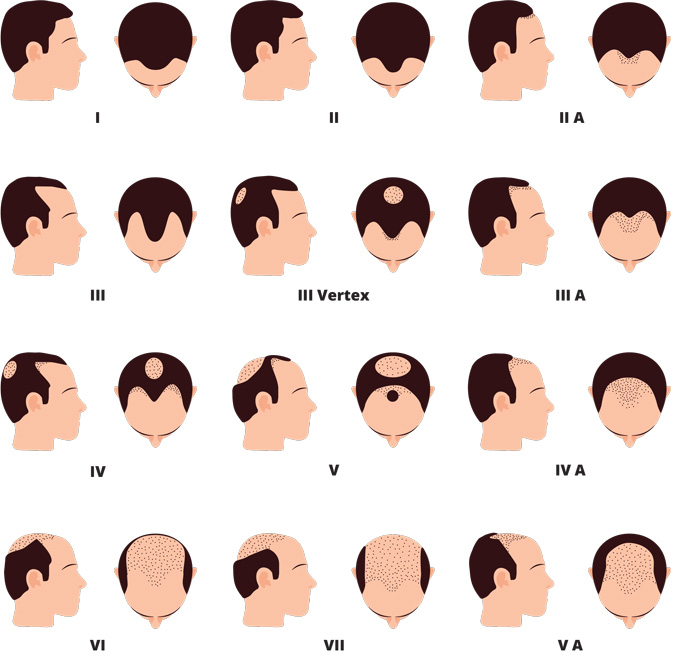
Men typically follow the Norwood-Hamilton Scale, tracking recession from the temples and thinning at the crown. It usually begins with a receding “M-shaped” hairline. Without treatment, the frontal recession and crown balding eventually meet, leaving only a horseshoe-shaped ring of hair around the sides.
Androgenetic Alopecia in Women
Women experience AGA differently, often retaining their frontal hairline while losing volume elsewhere. In Malaysia, it is estimated that roughly 6% to 10% of women face this, with prevalence increasing after menopause. It can be emotionally taxing, making early diagnosis by a dermatologist essential.
Female Pattern Hair Thinning
Unlike men, women use the Ludwig Scale to measure progression. Instead of a receding hairline, they notice a widening of the center part. This diffuse thinning occurs across the top and vertex. Total baldness is rare in women, but the loss of density can be quite significant.
Stages of Androgenetic Alopecia
Identifying your stage helps determine the best course of action. Treatment efficacy often depends on how much “active” foliage is left to save.
| Stage | Description | Common Recommendation |
| Early | Slight recession or wider part | Topical Minoxidil / Low-Level Laser |
| Moderate | Visible thinning; “M” shape | Oral Finasteride / PRP Therapy |
| Advanced | Significant bald patches | Hair Transplant / SMP |
Early Stage
At this point, hair loss is barely noticeable to others. You might see more strands in the shower or a higher forehead. According to official pharmaceutical guidelines, topical solutions like 5% Minoxidil are the frontline defense to prolong the hair’s growth phase.
Moderate Stage
Thinning becomes more apparent, and the scalp may be visible under bright lights. Hair follicles are actively miniaturizing but are still alive. This is often when Malaysians seek professional help, such as Platelet-Rich Plasma (PRP) or prescription-strength oral medications to block DHT production effectively.
Advanced Stage
The “bridge” of hair between the front and the back may disappear. At this level, follicles in bald areas have often become dormant. For those at Norwood Stage 6 or 7, surgical hair restoration is usually the most reliable way to achieve coverage.
Frequently Asked Questions About Androgenetic Alopecia
What causes androgenetic alopecia?
It is caused by a combination of genetics and androgens. Specifically, the hormone DHT causes hair follicles to shrink. While environmental factors like smoking or poor nutrition can accelerate the process, the underlying cause is almost always your genetic sensitivity to male sex hormones.
Can androgenetic alopecia be reversed?
Management and regrowth are more accurate terms. While you cannot change your DNA, treatments can wake up thinning follicles. Clinical trials show that over 60% of men experience visible regrowth when staying consistent with a medically-backed hair restoration regimen.
At what age does androgenetic alopecia usually start?
It can begin anytime after puberty. Some Malaysian men notice changes in their late teens or early 20s. Statistics show that about 40% of men have noticeable loss by age 35. For women, it often peaks during hormonal shifts like menopause.
Is androgenetic alopecia permanent?
If left untreated, the miniaturization process is permanent. Once a follicle has completely shriveled and the skin becomes shiny, it cannot grow hair. However, if caught while thinning, the process can be halted for decades with proper maintenance.
What is the best treatment for androgenetic alopecia in Malaysia?
The “Gold Standard” in Malaysia remains a combination of Topical Minoxidil and Oral Finasteride. Many specialists also offer Regenera Activa. Always ensure your treatments are approved by the Ministry of Health Malaysia to guarantee safety and efficacy in your journey.