

Dihydrotestosterone (DHT) is a potent androgen sex hormone synthesized from testosterone through the 5-alpha reductase enzyme. While crucial for male physical development during puberty, elevated or highly sensitive DHT levels in adults are the primary biological driver behind male and female pattern baldness, stubborn adult acne, and prostate enlargement.
What is Dihydrotestosterone (DHT)?
Dihydrotestosterone, commonly abbreviated as DHT, belongs to the androgen family—a group of hormones responsible for producing male physical characteristics. Although often viewed as an unwanted hormone due to its link to hair thinning, it plays a vital role in early human biology, directing the development of male genitalia in the womb and driving secondary sexual characteristics like a deep voice and body hair during puberty.
The Difference Between Testosterone and DHT
While closely related, Testosterone and DHT function differently within the human endocrine system:
Testosterone: The primary male sex hormone. It is highly active in the bloodstream and is responsible for regulating sex drive, spermatogenesis, bone density, and muscle mass building.
Dihydrotestosterone (DHT): A metabolite of testosterone, converted locally within tissues by the 5-alpha reductase (5-AR) enzyme. DHT is significantly more potent than testosterone; it binds to androgen receptors in the skin, scalp, and prostate with up to five times greater affinity, causing a much stronger cellular response.
Normal DHT Levels in Men and Women
Hormone concentrations fluctuate based on age, gender, and overall health. Standard laboratory reference ranges generally look like this:
| Demographic | Normal DHT Range (Serum) | Key Biological Role |
| Adult Men | 10 to 85 ng/dL | Prostate function, facial/body hair growth |
| Adult Women | 4 to 22 ng/dL | Precursor for estrogen, maintaining tissue health |
How DHT Causes Hair Loss
The most talked-about impact of DHT is its destructive relationship with the hair follicles on your scalp, leading to androgenic alopecia.
The Science Behind Male Pattern Baldness
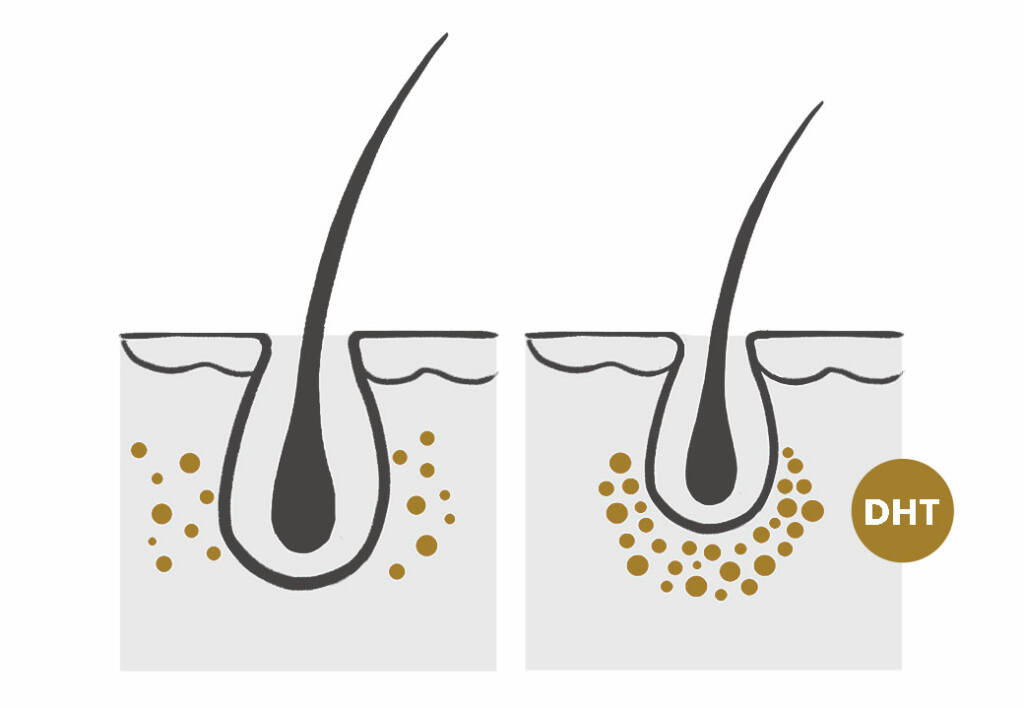
In men genetically predisposed to pattern baldness, hair follicles on the hairline, vertex, and crown possess a high concentration of androgen receptors. When DHT binds to these receptors, it triggers a progressive biological shutdown:
Follicle Miniaturization: The physical size of the hair follicle shrinks, restricting its blood and nutrient supply.
Anagen Phase Shortening: The active growth phase of the hair cycle drops from years down to months, while the resting phase expands.
Vellus Hair Transition: With every consecutive cycle, the hair strand grows back thinner, shorter, and more brittle, transitioning from thick terminal hair into fine, invisible vellus hair until the follicle shuts down entirely.
Does DHT Cause Female Pattern Hair Loss?
Yes. While women produce far less dihydrotestosterone (DHT) than men, they can still experience Female Pattern Hair Loss (FPHL). This occurs when a woman has a genetic sensitivity to androgens or experiences a drop in protective hormones like estrogen (such as during menopause). In women, this hormone causes diffuse thinning across the entire top of the scalp and a widening of the hair parting line, though the frontal hairline usually remains intact.
“Think of Dihydrotestosterone (DHT) like that one overzealous guest at a makan party who takes over the entire table and leaves no food for anyone else. In our bodies, too much DHT kicks our hair roots off the scalp, shrinking them until they can’t grow. By keeping this hormone in check, we pull back that unwanted guest, giving your hair follicles the space to thrive.” – Prof. Dato’ Dr. JasG, ABHRS-Certified Hair Transplant Doctor in Malaysia
Symptoms of Hormonal Imbalance: High vs. Low DHT
Imbalances in DHT levels can present noticeable physical symptoms across both genders.
Signs of High DHT (Acne, Body Hair, and Prostate Enlargement)
When your body produces an excess of DHT, or if your tissues are hypersensitive to it, you may experience:
Severe Acne: DHT stimulates the sebaceous (oil) glands in your skin, leading to overproduction of sebum, clogged pores, and painful cystic acne along the jawline and back.
Hirsutism: Paradoxically, while DHT shuts down hair on the scalp, it stimulates hair follicles on the body, leading to excess facial, chest, and back hair growth (especially noticeable in women with PCOS).
Benign Prostatic Hyperplasia (BPH): In aging men, elevated localized DHT causes the cells of the prostate gland to multiply, resulting in an enlarged prostate that compresses the urethra and causes urinary difficulties.
What Happens When DHT Levels Are Too Low?
Low DHT is rarely an issue for adult women, but in men, abnormally low levels can lead to:
Delayed or incomplete sexual development if it occurs during puberty.
Reduced facial and body hair density.
Increased risk of metabolic issues, though muscle mass usually remains unaffected since muscle tissue relies primarily on testosterone.
How to Lower DHT Levels Safely
Managing your DHT levels requires target-blocking the 5-alpha reductase enzyme to halt the conversion process.
Clinical Medications and DHT Blockers
Pharmaceutical treatments offer the most reliable, clinically proven method for reducing DHT activity:
Finasteride: An oral medication that selectively blocks the Type II 5-AR enzyme, reducing serum DHT levels by roughly 70%. It is highly effective at stopping hair loss and shrinking an enlarged prostate.
Dutasteride: A stronger dual-inhibitor that blocks both Type I and Type II enzymes, reducing circulating DHT by more than 90%. It is commonly prescribed for BPH and used off-label for severe hair thinning.
Topical Anti-Androgens: Serums containing medications like minoxidil or prescription topical finasteride can treat the scalp locally, protecting hair follicles without lowering systemic DHT levels in the blood.
Natural Remedies and Dietary Changes to Reduce DHT
For a more holistic approach, certain botanical ingredients and lifestyle changes can help balance your hormones naturally:
Saw Palmetto: A herbal extract that works similarly to finasteride, mildly inhibiting 5-AR to slow hair shedding.
Pumpkin Seed Oil & Green Tea: Consuming pumpkin seed oil or drinking EGCG-rich green tea helps slow the hormonal conversion pathway.
Lycopene-Rich Foods: Incorporating cooked tomatoes, carrots, and watermelon into your diet provides lycopene, an antioxidant that naturally regulates androgen activity.
Testing and Diagnosis
If you suspect your hair loss, acne, or urinary symptoms are tied to a hormonal imbalance, getting an accurate diagnosis is the first step.
How is a DHT Blood Test Performed?
A standard venous blood draw is used to check your systemic DHT levels. It is typically ordered as part of a comprehensive hormone panel that measures Total Testosterone, Free Testosterone, DHEA, and SHBG (Sex Hormone-Binding Globulin). For the most accurate results, doctors usually recommend scheduling the blood test early in the morning when androgen levels peak.
When Should You See a Doctor?
You should consult a physician or an endocrinologist if you notice rapid, unexplained hair thinning, sudden adult cystic acne, or if you are a man over 50 experiencing frequent nighttime urination. A professional can run the necessary blood work to pinpoint whether dihydrotestosterone (DHT) or another underlying health issue is causing your symptoms, allowing you to begin a safe, targeted treatment plan.
Frequently Asked Questions
Can you reverse DHT hair loss?
Yes, but timing is critical. If your hair follicles have only recently miniaturized and are still active, treatments like finasteride, dutasteride, or regenerative skin boosters can block DHT, revive the dormant root, and trigger hair regrowth. However, if a hair follicle has been completely inactive for years and replaced by scar tissue, a hair transplant is required to restore coverage.
Does blocking DHT affect muscle growth?
No. Skeletal muscle tissue contains very little 5-alpha reductase enzyme, meaning muscle development and strength rely almost entirely on baseline Testosterone, not dihydrotestosterone (DHT). Clinical studies show that patients taking standard DHT-blocking medications do not experience a loss of muscle mass or a reduction in athletic performance.