
A dht blocker is a medical treatment, topical serum, or dietary supplement designed to inhibit Dihydrotestosterone (DHT)—the primary androgen hormone behind genetic hair loss. By lowering systemic or localized DHT levels, these blockers stop follicle miniaturization, halt excessive hair shedding, and create an ideal environment for natural hair regrowth.
What is DHT and How Does It Cause Hair Loss?
To effectively stop progressive hair thinning, you must address its primary root cause: Dihydrotestosterone (DHT). DHT is a potent androgen male sex hormone synthesized from baseline testosterone via the 5-alpha reductase (5-AR) enzyme.
The Link Between DHT and Male Pattern Baldness
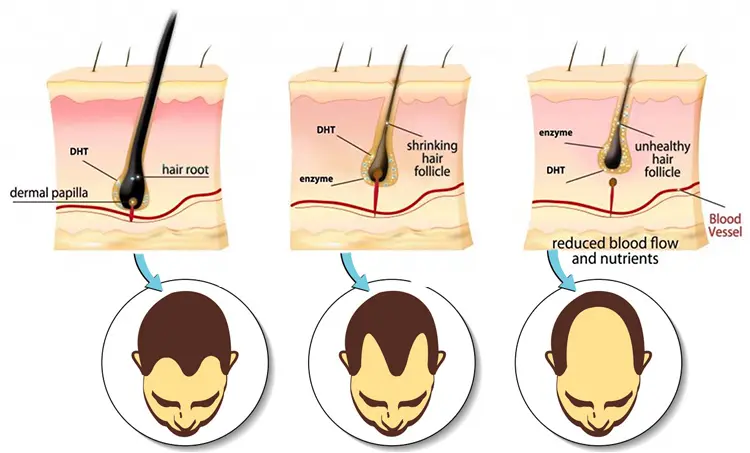
In individuals genetically prone to androgenic alopecia (male pattern baldness), hair follicles across the crown, vertex, and receding hairline possess heightened androgen receptor sensitivity.
When circulating DHT binds to these specific receptors, it triggers a destructive biological pathway:
Follicle Miniaturization: Active hair follicles progressively shrink and degrade.
Altered Hair Cycle: The growth (anagen) phase drastically shortens, while the resting (telogen) phase lengthens.
Hair Shedding: Thick terminal hairs transition into weak, translucent vellus hairs, eventually causing total follicular dormancy.
Can DHT Cause Hair Loss in Women?
Yes, DHT significantly influences Female Pattern Hair Loss (FPHL). Although women have lower baseline testosterone, hormonal shifts from menopause, stress, or Polycystic Ovary Syndrome (PCOS) can trigger elevated androgen activity. This results in diffuse thinning across the mid-scalp and parting line rather than a typical receding male hairline.
“Think of a DHT blocker like an elite guard at a federal tol booth, stopping excessive traffic before it congests your scalp. In Malaysia, genetics can make our hair roots overly sensitive to this hormone, causing them to shrink and weaken. By safely blocking DHT, we prevent that bottleneck, giving your hair follicles the clear path they need to breathe, rebuild their strength, and grow thick again.” – Prof. Dato’ Dr. JasG, ABHRS-Certified Hair Transplant Doctor in Malaysia
Types of DHT Blockers: Medical vs. Natural
An effective hair restoration regimen utilizes either clinically validated pharmaceutical compounds or plant-derived, natural organic alternatives.
Prescription DHT Blockers (Finasteride and Dutasteride)
Prescription medications are the most reliable systemic option to deactivate the 5-alpha reductase enzyme.
Finasteride (Propecia): An FDA-approved oral tablet that selectively blocks the Type II 5-AR enzyme. A standard 1mg daily dose lowers serum DHT levels by up to 70%, stabilizing pattern baldness in nearly 85% of male patients.
Dutasteride (Avodart): A dual-action inhibitor that blocks both Type I and Type II 5-AR enzymes. It decreases circulating DHT by more than 90%. It is typically used off-label when standard finasteride therapies underperform.
Natural DHT Blockers (Saw Palmetto, Rosemary Oil, and Supplements)
Patients seeking holistic hair loss remedies often turn to botanical extracts with mild, natural 5-AR inhibiting properties:
Saw Palmetto: Derived from Serenoa repens berries, this herbal supplement competitively inhibits 5-AR pathways to decrease scalp DHT binding.
Rosemary Oil: A popular topical hair serum that improves microcirculation and counters localized androgen activity without altering internal hormone levels.
Pumpkin Seed Oil & Green Tea: Pumpkin seed oil contains phytosterols that limit DHT synthesis, while green tea supplies Epigallocatechin Gallate (EGCG), an antioxidant that disrupts 5-AR enzyme conversion.
Topical vs. Oral DHT Blockers: Which Is Better?
The delivery system of your chosen hair loss treatment dictates its cellular efficacy and risk profile.
How DHT Blocker Shampoos and Serums Work
Topical hair loss solutions deliver active botanical or chemical ingredients directly to the scalp’s dermal papilla cells.
The Mechanism: Shampoos formulated with Ketoconazole, caffeine, or saw palmetto strip away excess sebum build-up containing concentrated DHT, while topically disrupting receptor binding.
The Benefit: Localized application minimizes systemic bloodstream absorption, practically eliminating systemic side effects. However, due to limited scalp contact time, shampoos are best used to support oral therapies.
The Pros and Cons of Oral DHT Supplements
The Pros: Systemic oral pills offer superior follicle protection. They stop 5-alpha reductase synthesis right at the root source inside the liver and bloodstream, offering maximum hair density improvements.
The Cons: Decreasing systemic DHT throughout the entire body increases the probability of experiencing biological side effects.
Side Effects and Safety Considerations
Altering reproductive hormone pathways requires a clear understanding of safety boundaries and patient contraindications.
Common Side Effects of Prescription DHT Blockers
While prescription 5-AR inhibitors are highly successful, they carry a small, documented incidence rate ($1\%$ to $2\%$) of adverse reactions in male users:
Decreased libido, erectile dysfunction, or lower ejaculatory volume.
Mild breast tissue swelling or tenderness (gynecomastia).
Crucial Safety Warning: A rare condition known as Post-Finasteride Syndrome (PFS) reports prolonged neurological and sexual symptoms after stopping treatment. Furthermore, oral finasteride and dutasteride are strictly contraindicated for women who are pregnant or planning to conceive due to severe risks of external genital birth defects in male fetuses.
Are Natural DHT Blockers Safer?
Yes, natural solutions like topical rosemary serums, zinc supplements, or saw palmetto pills carry a much lower risk profile. Because they do not aggressively shut down systemic androgen pathways, sexual side effects are exceptionally rare. Minor issues are usually limited to mild stomach discomfort or localized scalp redness.
Foods and Diet Habits That Block DHT Naturally
Optimizing your daily nutritional intake is an excellent, accessible way to support hair follicle health from home.
Best Vitamins and Minerals for Hair Growth
To reinforce the hair shaft structure while actively using a dht blocker, incorporate these cellular nutrients:
Zinc: A trace mineral that works as a natural 5-AR inhibitor while regulating cell division.
Biotin (Vitamin B7): Improves the body’s natural keratin infrastructure to boost tensile strength.
Vitamin D3: Activates dormant hair follicles and regulates hair cycle transitions.
Foods to Incorporate Into Your Daily Routine
Adjusting your diet can safely lower cellular sensitivity to androgens. Try incorporating these options:
| Food Group | Active Compound | Action on Hair |
| Pumpkin Seeds | Delta-7-sterols | Limits 5-AR conversion pathways. |
| Green Tea / Matcha | EGCG Catechins | Lowers DHT and stimulates human hair survival. |
| Tomatoes & Carrots | Lycopene | Naturally balances systemic androgen expression. |
| Onions & Kale | Quercetin | Decreases oxidative stress around thin hair roots. |
Frequently Asked Questions
How long does it take for a DHT blocker to work?
Because human hair growth operates on a slow biological timeline, it takes 3 to 6 months of continuous daily use to see reduced hair fall. Realizing visible hair regrowth, thicker coverage, and a reversed hairline requires 6 to 12 months, as miniaturized hair follicles need multiple shedding cycles to rebuild their physical thickness.
Does hair fall out after you stop taking DHT blockers?
Yes. If you stop taking an oral or topical dht blocker, your body will quickly restore its baseline 5-alpha reductase enzyme levels. Within 2 to 6 months of complete cessation, localized DHT accumulation will resume, triggering follicle miniaturization and returning your hair to its original genetic pattern of hair loss.