
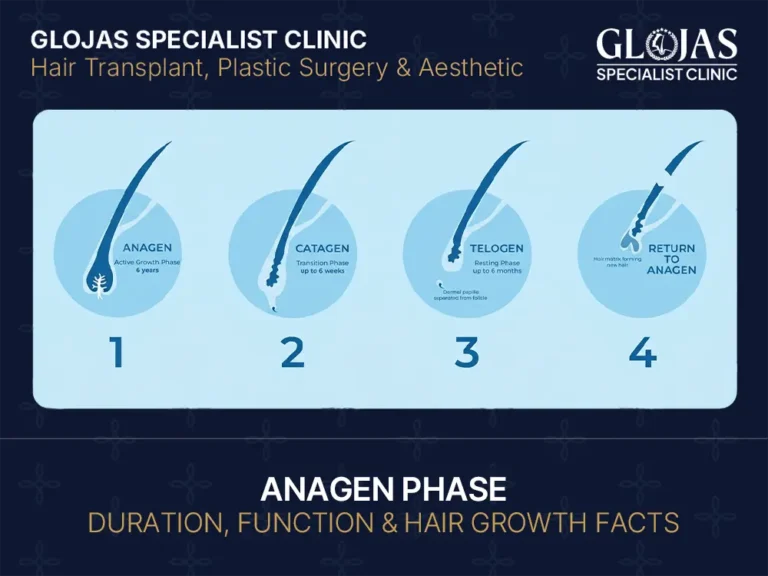
If you’ve ever wondered why some people can grow hair down to their waist while others hit a “terminal length” at their shoulders, the answer lies in your biology—specifically, the anagen phase. In the humid, tropical climate of Malaysia, factors like nutrition, genetics, and local health conditions play a massive role in how long your hair stays in this active growth state.
What Is the Anagen Phase?
Definition Within the Hair Growth Cycle
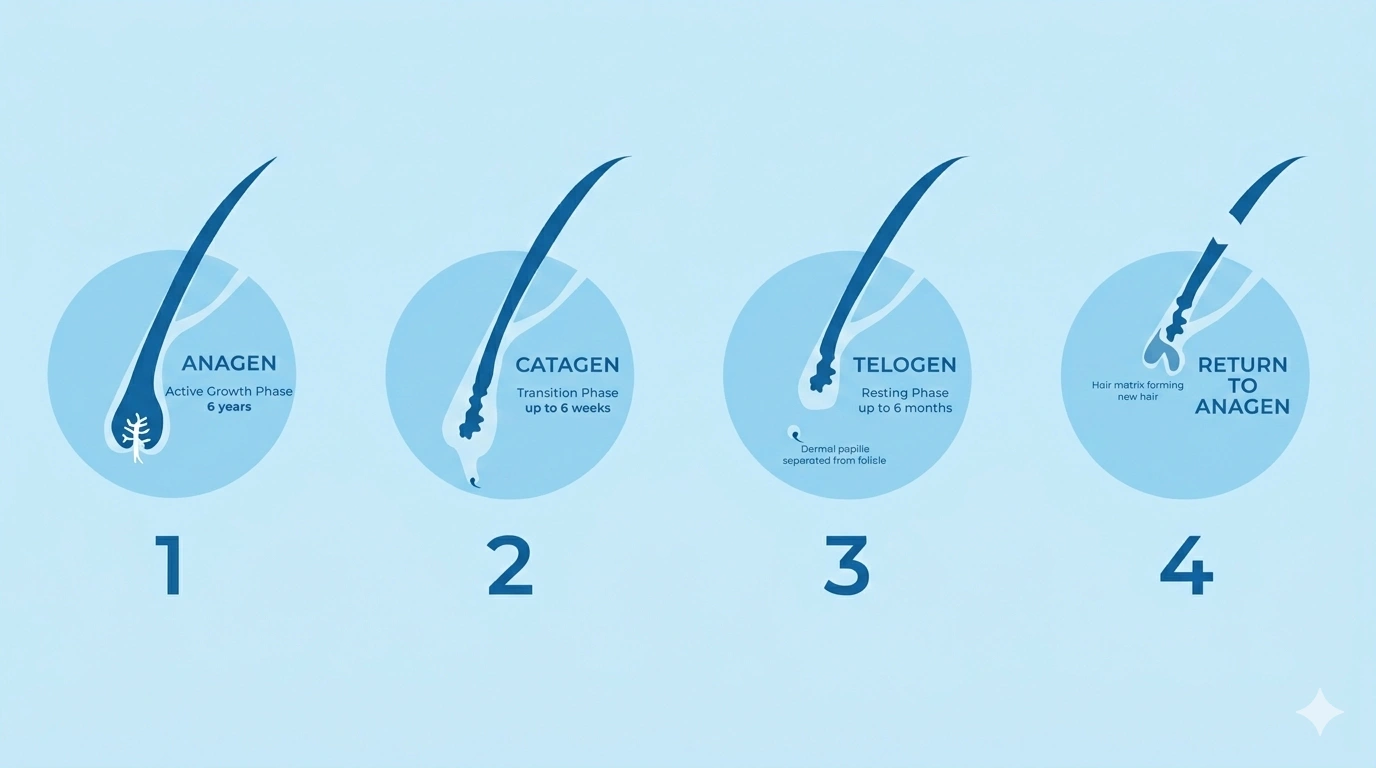
Anagen Phase is the active growth stage of the hair follicle cycle, lasting two to seven years. During this period, cells in the hair bulb divide rapidly, producing new hair that pushes up the follicle. Factors like genetics and nutrition determine its duration, ultimately influencing the maximum length and thickness of individual strands.
The anagen phase is essentially the “on” switch for your hair. It is the active growth stage where the hair bulb is deep within the dermis, continuously producing new hair cells. Unlike other stages where the hair rests or sheds, anagen is all about production.
Role of Anagen in Determining Hair Length and Density
Your maximum hair length is mathematically tied to the duration of this phase. Since hair grows at a relatively fixed speed, the longer your follicles stay in anagen, the longer your hair can physically become. High hair density also depends on having a high percentage of follicles in this phase simultaneously.
Differences Between Anagen, Catagen, and Telogen
Think of it as a relay race:
Anagen: The runner is sprinting (Growth).
Catagen: The runner slows down and stops (Transition).
Telogen: The runner rests before the next race (Resting/Shedding).
According to the American Academy of Dermatology, it is normal to shed between 50 and 100 hairs a day as follicles transition out of the anagen phase.
Biology of the Anagen Phase
Hair Follicle Structure and Dermal Papilla Function
The command center of the hair follicle is the dermal papilla. Located at the base, it supplies the nutrients and signals required to keep the hair growing. If the dermal papilla is compromised, the anagen phase can be cut short.
Cellular Proliferation and Keratin Production
During this stage, cells divide rapidly. These cells are then keratinized—essentially hardened—to form the hair shaft we see. This process requires a massive amount of metabolic energy.
Normal Hair Growth Rate During Anagen
On average, hair grows about 1.25 centimeters per month. This means in a year, you’re looking at roughly 15 centimeters of new growth, provided your follicles stay healthy.
Regulation by Growth Factors and Hormones
Complex signaling molecules, such as Insulin-like Growth Factor-1 (IGF-1), dictate when a follicle enters anagen. Conversely, hormones like Dihydrotestosterone (DHT) can signal the follicle to shut down prematurely.
Duration of the Anagen Phase
Average Length in Healthy Adults
For most people, the anagen phase lasts anywhere from 2 to 7 years. This wide range explains why hair length potential varies so drastically between individuals.
Age-Related Changes in Anagen Duration
As we age, the “biological clock” of the follicle tends to speed up. The growth phase often shortens, leading to hair that is finer, shorter, and less pigmented.
Genetic Influence on Anagen Length
Your DNA acts as a blueprint for your hair’s lifespan. Some ethnicities or family lineages naturally possess a longer anagen phase, allowing for “Rapunzel-like” hair growth.
When Shortened Anagen Is Clinically Significant
If your hair suddenly stops growing past a certain short length, or if you notice excessive shedding of short, thin hairs, it may indicate a shortened anagen phase, a condition that requires clinical attention.
Medical Conditions That Shorten the Anagen Phase
Androgenetic Alopecia
Often called male or female pattern baldness, this condition involves the “miniaturization” of follicles. The anagen phase becomes shorter and shorter until the hair produced is barely visible.
Telogen Effluvium with Reduced Anagen Ratio
Stress, illness, or surgery can shock the system, causing a massive shift of hairs from the anagen phase into the telogen (resting) phase prematurely.
Alopecia Areata
This is an autoimmune condition where the body’s immune system attacks the hair follicles during their active growth phase, causing them to shut down and fall out in patches. Research published by the National Institutes of Health highlights how the inflammatory environment disrupts the normal follicular cycle.
Thyroid Disorders and Hormonal Imbalance
Both hyperthyroidism and hypothyroidism can disrupt the metabolic rate of the dermal papilla, often leading to a diffuse thinning of the hair.
Nutritional Deficiencies Affecting Follicular Activity
In Malaysia, deficiencies in Iron, Vitamin D, or Zinc are common triggers. Without these building blocks, the follicle cannot sustain the high-energy demands of the anagen phase.
Diagnosing Anagen Phase Abnormalities in Malaysia
Clinical Evaluation by Dermatologists
A specialist will look at your scalp health and history. They check for signs of inflammation, scarring, or specific patterns of thinning that point to anagen dysfunction.
Trichoscopy and Hair Pull Test
Trichoscopy involves using a high-magnification lens to see the follicles up close. A “hair pull test” helps determine if hairs are coming out in the anagen or telogen stage.
Blood Investigations for Underlying Causes
Doctors often order blood tests to check ferritin (iron stores), thyroid hormones, and vitamin levels. Addressing these can often “reset” the growth cycle.
Indications for Scalp Biopsy
If the cause of hair loss is unclear, a small tissue sample (biopsy) may be taken to examine the follicles under a microscope to see exactly where the growth cycle is breaking down.
Evidence-Based Treatments That Influence the Anagen Phase
Topical Minoxidil and Anagen Prolongation
Minoxidil is a vasodilator that improves blood flow to the follicle. Its primary superpower is extending the duration of the anagen phase and “waking up” follicles from the resting phase.
Oral Therapies (Finasteride, Antiandrogens)
For those with hormonal hair loss, medications like Finasteride block DHT. By preventing DHT from attacking the follicle, the anagen phase is allowed to return to a more normal, healthy length.
Platelet-Rich Plasma (PRP) Therapy
PRP involves injecting your own concentrated growth factors into the scalp. This bio-stimulation can jumpstart cellular proliferation in the dermal papilla.
Low-Level Laser Therapy (LLLT)
LLLT uses specific wavelengths of light to stimulate ATP (energy) production in the cells. The U.S. Food and Drug Administration has cleared several LLLT devices for the treatment of androgenetic alopecia based on their ability to promote the growth phase.
Monitoring and Prognosis
Expected Treatment Timelines
Hair doesn’t grow overnight. It typically takes 3 to 6 months of consistent treatment to see a shift in the anagen-to-telogen ratio and noticeable new growth.
Measuring Anagen-to-Telogen Ratio
Clinically, a healthy scalp has about $85\%$ to $90\%$ of hairs in the anagen phase. Treatments aim to restore this balance from a depleted state.
Long-Term Management Strategies
Consistency is key. Since hair growth is a continuous cycle, stopping treatment often means the follicles will eventually return to their previous, shortened anagen state.
Frequently Asked Questions About the Anagen Phase
How Long Should the Anagen Phase Last?
In a healthy individual, it should last between 2 and 7 years. If yours seems significantly shorter (e.g., hair never grows past your chin), it’s worth investigating.
Can a Short Anagen Phase Be Reversed?
Yes! If the cause is nutritional, hormonal, or stress-related, correcting the underlying issue can often restore the natural length of the growth phase.
What Indicates an Abnormally Short Growth Phase?
Signs include hair that “stops growing” at short lengths, an increase in shedding of short/thin hairs, and a noticeable loss of hair volume over time. For more on the clinical classification of hair disorders, the World Health Organization provides standardized diagnostic codes for various types of alopecia.