
Thinking about fixing your hairline? You aren’t alone. The biggest question most people have is exactly how many hair grafts they’ll need to get that full, natural look back. Let’s dive into the math and science of hair restoration.
Looking for Hair Transplant Malaysia solutions? GLOJAS Specialist Clinic offers advanced, natural-looking hair transplant treatments performed by experienced specialists for lasting confidence and hair restoration.
What Are Hair Transplant Grafts?
What Is a Hair Graft in Hair Restoration?
In the world of surgery, a graft is simply a piece of living tissue moved from one part of your body to another. In hair restoration, it’s a tiny cylinder of skin containing the functional machinery needed to grow new hair in thinning areas.
How Many Hair Follicles Are in One Graft?
A single graft isn’t just one hair. Naturally, hair grows in follicular units consisting of one to four individual hairs. On average, most patients see about two hairs per graft, which helps create a dense, realistic appearance once transplanted.
Difference Between Grafts and Hair Strands
Don’t get these confused! If a surgeon says you need 2,000 grafts, you’re actually getting roughly 4,000 to 5,000 hair strands. This distinction is vital for understanding density and how much coverage you can realistically expect from your procedure.
How Many Grafts Are Needed for Different Levels of Hair Loss?
Grafts Needed for a Receding Hairline
A minor touch-up to the temples usually requires a modest amount of work. To fill in those maturing “V” shapes at the corners, most surgeons recommend between 500 and 1,000 grafts to create a crisp, youthful frame for your face.
Grafts Required for Frontal Hair Loss
If the thinning has moved past the temples and into the mid-frontal scalp, the numbers climb. You’re likely looking at 1,500 to 2,500 grafts to ensure the front of your head looks thick and doesn’t appear “see-through” under bright lights.
Grafts for Crown or Vertex Baldness
The “monk’s spot” at the back is notoriously hungry for hair. Because of the swirl pattern (whorl), you often need 1,000 to 2,000 grafts just for the crown to prevent the scalp from peeking through.
Grafts for Full Scalp Coverage
If you’re thinning from front to back, coverage is a massive undertaking. Achieving a full look across the entire top of the head can require 4,000 to 6,000+ grafts, often split over multiple surgical sessions to protect the donor area.
Norwood Scale and Estimated Graft Requirements
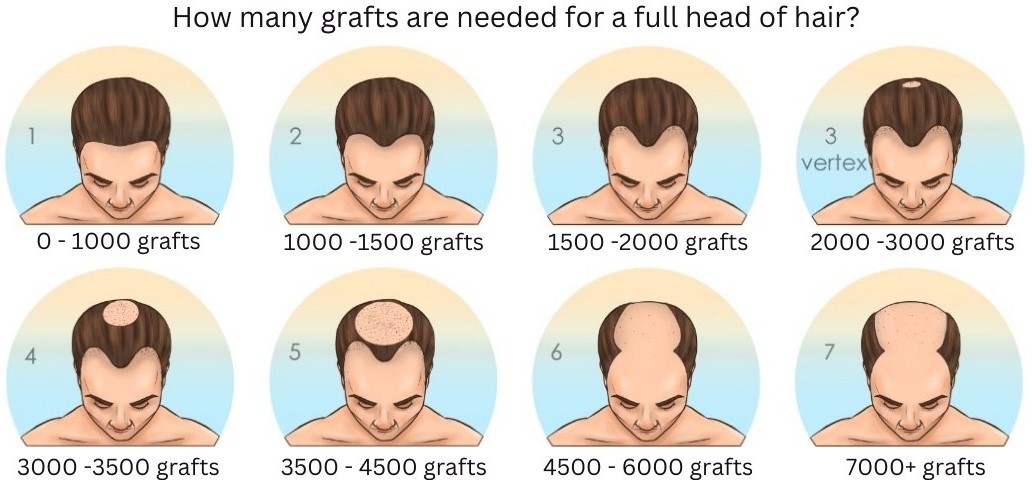
The Norwood Scale is the industry standard for measuring male pattern baldness. It ranges from Stage 1 (no loss) to Stage 7 (severe loss). Doctors use this scale to provide a baseline estimate for your surgical plan.
Average Hair Transplant Grafts by Norwood Stage
Norwood 2 Hair Loss
This is early-stage recession. You’ve still got most of your hair, but the temples are dipping back. Usually, 500 to 800 grafts are plenty to reinforce the hairline and stop the “widow’s peak” from becoming too prominent.
Norwood 3 Hair Loss
At this stage, the recession is deep enough to be considered “baldness.” To bring the hairline forward and fill in the significant gaps at the temples, you’ll typically need 1,000 to 1,500 grafts.
Norwood 4 Hair Loss
Now the thinning is visible on the crown and the front. To bridge these areas and provide decent coverage, surgeons generally suggest 2,000 to 3,000 grafts. This is one of the most common stages for a first-time transplant.
Norwood 5 Hair Loss
The bridge of hair between the front and the crown is starting to disappear. You are looking at a “mega-session” territory here, usually requiring 3,000 to 4,000 grafts to restore a sense of continuity across the scalp.
Norwood 6–7 Hair Loss
These are advanced stages where the donor hair is limited. Total restoration is difficult, but 4,000 to 6,000 grafts can provide significant improvement. Some patients may prioritize the front and leave the crown thinner.
Factors That Determine How Many Grafts You Need
Size of the Bald Area
It’s simple math: the more surface area you need to cover, the more grafts you’ll need. A large, smooth scalp requires more “follicular seeds” than a small patch of thinning hair to achieve the same visual result.
Hair Density Goals
How thick do you want it? High-density “packed” hairlines look great but use up more grafts per square centimeter. Your surgeon will balance your desire for thickness with the limited supply of hair you have available.
Hair Thickness and Texture
Coarse, curly hair provides better “visual coverage” than fine, straight hair. If your hair is thick and wavy, you might actually need fewer grafts to achieve a full look compared to someone with very thin, limp strands.
Donor Area Strength
Your donor area—the back and sides of your head—isn’t an infinite resource. If your donor hair is sparse or thin, the surgeon must be careful not to over-harvest, which limits the total grafts available for the top.
Age and Future Hair Loss
If you’re in your 20s, you’ll likely lose more hair later. Surgeons must save some “grafts in the bank” for future procedures. Planning for the long term is just as important as fixing today’s hairline.
How Doctors Calculate Hair Transplant Grafts
Hair Density Measurement
Doctors use a tool called a trichoscope to count how many hairs you have per square centimeter in your donor zone. This helps them calculate the exact “harvesting capacity” of your scalp without causing visible thinning.
Donor Area Assessment
Before picking up a scalpel, the specialist checks the elasticity of your scalp and the health of the follicles. This ensures the moved grafts are robust enough to survive the trip to their new home.
Digital Hair Transplant Planning
Modern clinics use AI and digital imaging to map your scalp. These advanced diagnostic tools allow for precise calculations, showing exactly how many grafts are needed to hit a specific density target.
Personalized Hairline Design
Every face is different. A surgeon doesn’t just draw a straight line; they design a staggered, natural-looking boundary. This artistic process determines the placement and quantity of single-hair grafts used at the very front.
Hair Transplant Techniques and Graft Requirements
Grafts Required for FUE Hair Transplant
Follicular Unit Extraction (FUE) involves taking individual grafts one by one. It’s great for smaller to medium sessions (up to 3,000 grafts). It leaves tiny, dot-like scars that are virtually invisible, even with short hair.
Grafts Required for FUT Hair Transplant
Follicular Unit Transplantation (FUT), or “strip surgery,” involves removing a strip of skin. This is often used for massive graft counts (4,000+) because it can yield a high volume of high-quality grafts in a single session.
DHI Hair Transplant Graft Planning
Direct Hair Implantation (DHI) uses a specialized pen to “inject” grafts. While the graft count is similar to FUE, DHI allows for extreme precision in placement and density, often used for smaller, high-density areas.
Hair Transplant Graft Cost in Malaysia
Average Cost Per Graft in Malaysia
Malaysia is a hub for medical tourism due to its high standards and lower costs. Generally, you can expect to pay between RM 5 and RM 12 per graft, depending on the clinic’s reputation and the technology used.
Total Cost Based on Number of Grafts
For a standard 2,000-graft procedure, the total price in Malaysia often lands between RM 10,000 and RM 20,000. This is significantly more affordable than similar procedures in the US, UK, or Australia.
What Influences Hair Transplant Pricing
The complexity of the case, the surgeon’s experience, and the specific technique (FUE vs. DHI) all play a role. Premium clinics might charge more for “no-shave” options or advanced robotic-assisted surgeries.
How Many Grafts Can Be Transplanted in One Session?
Maximum Grafts in a Single Procedure
While technology has improved, there’s a limit. Most experts cap a single day’s work at 3,000 to 4,000 grafts. Pushing beyond this can risk “graft death” as the tissue is outside the body for too long.
Mega Sessions vs Multiple Sessions
A “Mega Session” refers to anything over 3,000 grafts. While convenient, some patients prefer splitting the work into two sessions over two days to ensure the highest possible survival rate for the follicles.
Recovery and Healing After Large Graft Sessions
Large sessions mean more “micro-wounds.” You might experience more swelling in the first 48 hours. However, with proper aftercare, the tiny puncture marks from an FUE procedure typically heal within 7 to 10 days.
Before and After Results by Graft Numbers
1000 Grafts Hair Transplant Results
This is the “subtle refinement” level. It’s perfect for filling in the temple notches or lowering a hairline by a centimeter. Friends might notice you look better, but they won’t realize you had “work done.”
2000 Grafts Hair Transplant Results
This provides a transformative change for those with moderate thinning. It can fully restore a receding front and significantly thicken the mid-scalp, giving you enough hair to style with gel or wax again.
3000 Grafts Hair Transplant Results
At 3,000 grafts, you’re looking at major restoration. This can cover a significant portion of a bald scalp, taking someone from a Norwood 4 or 5 back to a much more youthful appearance.
4000+ Grafts Hair Transplant Results
These are life-changing results for patients with extensive hair loss. It requires a skilled surgeon to manage the donor supply, but it can successfully recreate a full head of hair from a state of near-total baldness.
Best Hair Transplant Clinics in Malaysia
What to Look for in a Hair Transplant Clinic
Check for cleanliness, modern equipment, and a transparent pricing model. The best clinics will show you long-term “after” photos of real patients, not just stock images or immediate post-op shots.
Questions to Ask During Your Consultation
Ask who is actually performing the extractions—is it the doctor or a technician? Also, ask about their “graft survival rate” and what their policy is if the results don’t meet the agreed-upon expectations.
Finding a Certified Hair Transplant Specialist in Malaysia
Ensure your doctor is registered with the Malaysian Medical Council (MMC) and ideally has credentials from international bodies like the ABHRS. Expertise is the one thing you should never “discount hunt” for.
Hair Transplant Consultation in Malaysia
How Doctors Estimate Your Graft Needs
During a consult, the doctor uses a “densitometer” to look at your scalp under high magnification. They’ll also draw a proposed hairline on your skin to help you visualize the final graft placement.
Hair and Scalp Evaluation Process
The specialist will check for signs of scalp conditions like dermatitis or alopecia areata, which could interfere with graft survival. A healthy scalp is the “soil” your new hair needs to grow.
Creating a Personalized Hair Restoration Plan
Your plan isn’t just about today; it’s a roadmap for the next 20 years. It includes medication like Finasteride or Minoxidil to maintain your existing hair while the new grafts grow in.
Frequently Asked Questions About Hair Transplant Grafts
How Many Grafts Do I Need for a Natural Hairline?
For a soft, natural look, most people need 600 to 1,200 grafts. The key is using “singles” (grafts with one hair) at the very front to avoid a “doll’s hair” look.
Is 3000 Grafts Enough for Hair Transplant?
For many, yes! 3,000 grafts can cover the entire front half of the head with good density. However, if you are completely bald on top, it may only provide partial coverage.
Can You Get 5000 Grafts in One Session?
It is possible but risky. Many surgeons prefer breaking 5,000 grafts into two sessions to ensure both the patient and the surgical team stay sharp and the grafts stay viable.
How Long Do Transplanted Grafts Last?
Transplanted hair is taken from the “permanent zone” at the back of the head. These follicles are genetically resistant to DHT, the hormone that causes balding, meaning they should last a lifetime.
Do Hair Transplant Grafts Grow Permanently?
Yes. Once the grafts “take” and begin their growth cycle (usually 3–4 months post-op), they behave just like your natural hair. You can cut them, dye them, and style them forever.