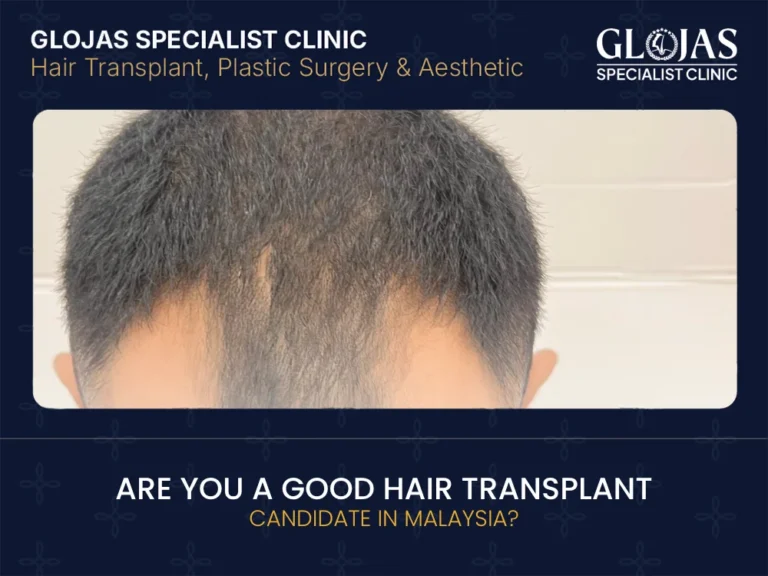
A hair transplant candidate is a person who possesses sufficient donor hair density, a stable hair loss pattern, and good overall health to undergo surgical restoration. Optimal candidates typically have androgenetic alopecia that has reached a measurable stage on the Norwood or Ludwig scales, ensuring that transplanted follicles remain permanent.
GLOJAS Specialist Clinic, led byย Prof. Datoโ Dr. JasG, offersย hairline transplant Malaysiaย treatments using advanced FUE techniques for natural-looking, safe, and medically guided hair restoration results.
What Is a Hair Transplant Candidate?
Medical Definition of Eligibility
Clinically, an eligible candidate is an individual whose hair loss is “patterned” and whose donor supply (usually from the occipital scalp) is genetically resistant to Dihydrotestosterone (DHT).
The primary medical requirement is a high ratio of donor hair to the recipient area to ensure adequate coverage and natural density.
In Malaysia, the Ministry of Health mandates that only practitioners with a Letter of Credentialing and Privileging (LCP) can legally evaluate and perform these procedures to ensure patient safety and ethical eligibility.
Guidance from the International Society of Hair Restoration Surgery (ISHRS) emphasizes that a thorough scalp examination is the first step in confirming candidacy.
How Doctors Assess Hair Transplant Suitability
Specialists use trichoscopy (digital scalp microscopy) to measure hair diameter and the number of follicular units per square centimeter.
A “pull test” or “wash test” may be conducted to determine if the current hair loss is active, telogen-driven (temporary), or permanent pattern baldness.
The surgeon also evaluates the scalp’s laxity and the presence of any inflammatory conditions that could compromise the “take” of the newly implanted grafts.
Who Is a Good Hair Transplant Candidate?
Male Pattern Hair Loss Candidates
Men between stages 2 and 5 on the Norwood Scale are generally the best candidates, as they have defined balding areas but still maintain a thick donor “fringe.”
Individuals who have used medical therapies like Finasteride for at least six months to stabilize their loss often see superior surgical outcomes.
Female Hair Loss Candidates
Women with Traction Alopecia (loss from tight styling) or those with a naturally high forehead seeking hairline lowering are considered top-tier candidates.
Unlike men, women must be screened for diffuse unpatterned hair loss (DUPA), which can sometimes disqualify them if the donor area is also thinning.
Stable Hair Loss Conditions
A good candidate has reached a “plateau” in their hair loss; operating on a rapidly receding hairline often leads to a “floating island” of hair as the native hair continues to disappear behind the transplant.
Donor Area Requirements for Hair Transplant Candidates
Hair Density and Donor Stability
Ideal candidates possess a donor density of at least 80 to 100 follicular units per cmยฒ; falling below 40 units per cmยฒ significantly limits the ability to achieve a full look.
The donor zone must be “stable,” meaning the hair in that region is not prone to thinning or miniaturization over time.
Scalp Health and Hair Quality
The caliber (thickness) of individual hair shafts matters; thicker hair provides better “visual volume” and coverage than fine, wispy hair.
A healthy, supple scalp without scarring or active dermatitis allows for smoother graft extraction and better vascularization of the recipient sites.
Medical Conditions Affecting Hair Transplant Eligibility
Active Hair Loss Conditions
Conditions like Alopecia Areata (an autoimmune disorder) usually disqualify candidates because the body’s immune system may attack the newly transplanted grafts.
Scarring alopecias, such as Lichen Planopilaris, require a biopsy and at least two years of documented remission before a transplant can be considered.
Autoimmune or Scalp Disorders
Patients with uncontrolled psoriasis or seborrheic dermatitis must resolve these flare-ups before surgery to prevent infection or poor wound healing.
The Mayo Clinic notes that certain autoimmune diseases can cause the body to reject the grafts if the condition is systemic and active.
Chronic Health Conditions
Diabetes: Candidates with uncontrolled blood sugar (high HbA1c levels) are often ineligible due to the high risk of scalp infections and poor micro-circulation.
Cardiovascular Health: Patients on heavy blood thinners or those with severe hypertension may need medical clearance from a cardiologist before proceeding.
Age and Timing for Hair Transplant Candidates
Ideal Age Range for Treatment
The “Golden Window” for a hair transplant is generally between ages 25 and 45.
By age 25, the adult hair loss pattern is usually predictable enough for a surgeon to create a long-term design that won’t look unnatural as the patient ages.
When to Delay Hair Transplant
Reputable clinics often advise patients under 21 to wait; early transplants can use up limited donor hair that might be needed more desperately for the crown or mid-scalp ten years later.
If you are currently experiencing high stress or nutritional deficiencies, it is better to resolve these factors first to ensure the transplant doesn’t coincide with a temporary shedding phase.
When You Are NOT a Suitable Hair Transplant Candidate
Insufficient Donor Hair
If the donor area is too sparse, attempting a transplant will only result in an overharvested “moth-eaten” look at the back of the head without providing enough coverage on top.
Patients with Stage 7 Norwood baldness often lack the required 5,000+ grafts needed for a full restoration and may be better suited for scalp micropigmentation.
Unstable or Progressive Hair Loss
Operating on a patient with aggressive, unstabilized loss is a recipe for aesthetic failure. The American Academy of Dermatology emphasizes that surgery does not stop the progression of natural hair loss.
Unrealistic Expectations
A transplant cannot return you to your 16-year-old density; it is a game of “redistribution.” Candidates must understand that the goal is improved coverage and a natural frame for the face, not total perfection.
Hair Transplant Candidate Evaluation Process in Malaysia
Consultation and Scalp Analysis
In Malaysia, an LCP-certified doctor will perform a physical exam to check for “miniaturization” in the donor zone.
Advanced clinics use specialized software to estimate the exact number of grafts available and the surface area of the balding zones.
Hair Density Measurement
The surgeon uses a densitometer to count the follicles per square centimeter; this metric is the “budget” that determines what is possible during the procedure.
Treatment Planning by Surgeon
A master plan is created, often involving a comparison table of different techniques like FUE vs. FUT based on your specific scalp laxity.
| Factor | FUE Suitability | FUT Suitability |
| Scalp Laxity | Irrelevant | High laxity preferred |
| Activity Level | Back to gym in 7 days | Back to gym in 21+ days |
| Hair Style | Short hair possible | Longer hair to hide scar |
Improving Eligibility as a Hair Transplant Candidate
Medical Hair Loss Treatments Before Surgery
Many clinics prescribe medications for 6โ12 months to strengthen the existing hair and potentially “convert” a borderline candidate into an ideal one.
PRP (Platelet-Rich Plasma) therapy can improve scalp vascularity, making the “soil” more fertile for the newly implanted grafts.
General information on these medical interventions can be found on Healthline.
Lifestyle and Scalp Health Optimization
Stopping smoking is mandatory; nicotine constricts blood vessels, which can lead to graft necrosis (death) and poor healing.
Nutritional optimizationโensuring adequate levels of Iron, Vitamin D, and Zincโsupports the high metabolic demands of the healing follicles.
Hair Transplant Candidate FAQs
How do I know if I am a candidate?
The best way is a physical exam. Generally, if you have visible thinning but a dense “horseshoe” of hair at the back and sides, you are likely a candidate.
Can young patients get a hair transplant?
While possible, most surgeons advise waiting until age 25. Younger patients should first stabilize their loss with FDA-approved medications.
What disqualifies a candidate?
Insufficient donor hair, active autoimmune diseases like Alopecia Areata, and unrealistic expectations are the most common disqualifiers.
Do women qualify as candidates?
Yes, but the criteria are stricter. Women with traction alopecia or defined thinning are excellent candidates, while those with “all-over” thinning are not, as noted by WebMD.
Is donor hair always required?
Yes. Modern hair transplants rely on autologous grafts (your own hair). Body hair transplants (BHT) using beard or chest hair can sometimes supplement scalp hair but cannot replace it entirely.