
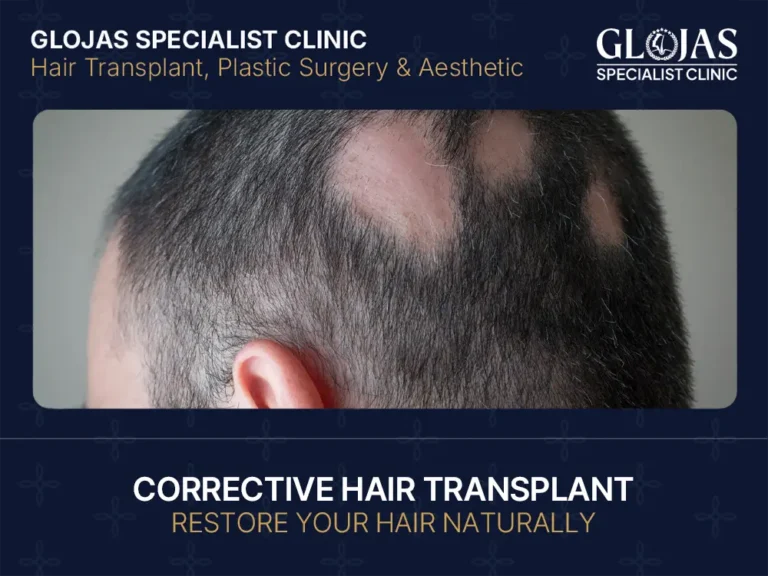
So, you’ve already taken the plunge into hair restoration, but the results aren’t exactly what you saw on the brochure? You aren’t alone. Whether it’s a “pluggy” doll-hair look from an outdated procedure or a botched job from a low-cost “hair mill,” a corrective hair transplant is the medical do-over designed to fix aesthetic errors and restore your confidence.
GLOJAS Specialist Clinic in Malaysia offers expert Corrective Hair Transplant services, restoring natural hairlines and fixing failed transplants with advanced techniques and certified surgeons.
What Is a Corrective Hair Transplant?

Definition and Purpose
A corrective hair transplant (also known as a revision hair transplant) is a secondary surgical procedure performed to rectify the poor outcomes of a previous hair restoration. The goal isn’t just to add more hair; it’s to camouflage scars, redirect poorly angled grafts, and create a more natural, age-appropriate appearance.
Common Indications for Corrective Procedures
The most common reasons patients seek a “fix-it” surgery include:
An unnatural, straight-line “Lego” hairline.
Visible scarring in the donor area (the back of the head).
Grafts placed at the wrong angle (hair growing straight up or sideways).
Depleted donor hair due to over-harvesting.
Who Is a Corrective Hair Transplant Candidate?
Failed Previous Hair Transplants
If your initial transplant didn’t “take” or resulted in low density, you might be a candidate. However, a surgeon must first evaluate why it failed—whether it was poor surgical technique or an underlying medical condition like alopecia areata.
Uneven Hairlines and Poor Graft Placement
Symmetry is key in facial aesthetics. If your hairline is too low, too high, or lopsided, corrective surgery can involve extracting those misplaced follicles and re-implanting them correctly. According to the International Society of Hair Restoration Surgery, repairing a hairline often requires “softening” the front with single-hair follicular units.
Scar and Hair Density Correction
Older methods like the “strip” technique often left linear scars. Corrective surgery can use newer methods to transplant hair directly into the scar tissue, making it virtually invisible even with short hair.
Corrective Hair Transplant Techniques
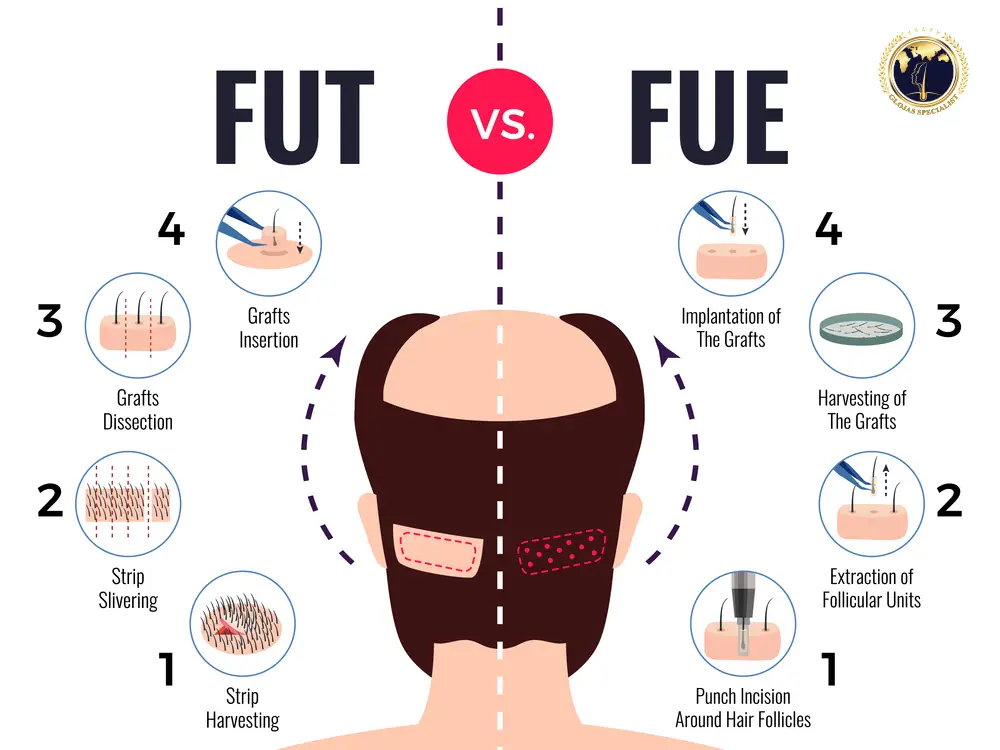
FUE (Follicular Unit Extraction)
FUE is the gold standard for most corrective work. Surgeons harvest individual follicles from the donor area and use them to fill in gaps or camouflage old scars. It is minimally invasive and leaves no linear scarring, which is crucial when donor hair is already limited.
FUT (Follicular Unit Transplantation)
While less common for repairs, FUT (the “strip” method) may still be used if a patient needs a large number of grafts and has enough scalp laxity. Often, a corrective surgeon will remove an old, wide FUT scar as part of the new strip extraction to leave the patient with a single, finer scar.
Combination and Advanced Techniques
In complex cases, surgeons might use Body Hair Transplant (BHT)—taking hair from the beard or chest—if the scalp donor area has been over-harvested by a previous clinic. This requires extreme precision to ensure the different hair textures blend seamlessly.
Choosing a Clinic and Surgeon in Malaysia
Accredited Clinics and Experienced Surgeons
Malaysia has strict medical regulations, but “grey market” clinics still exist. Ensure your surgeon is registered with the Malaysian Medical Council and carries a valid National Specialist Register (NSR) certification in Dermatology or Plastic Surgery.
What to Verify: Credentials, Reviews, and Safety Standards
Don’t just look at “Before & After” photos—those can be edited. Look for long-term reviews (1-2 years post-op) and ask the surgeon specifically about their experience with repairs, which are significantly more difficult than primary transplants.
Procedure and Recovery
Pre-Surgery Assessment and Planning
A corrective procedure starts with a “donor hair audit.” The surgeon must calculate exactly how many viable follicles are left. They will also map out the extraction of “pluggy” grafts that need to be removed and recycled.
Step-by-Step Surgical Process
Local Anesthesia: The scalp is numbed.
Extraction/Excision: Misplaced grafts are removed, and the donor area is harvested.
Site Creation: The surgeon creates new, tiny incisions at the correct angles.
Placement: Grafts are meticulously placed to ensure a natural flow.
Recovery Timeline and Aftercare
Recovery is similar to a standard transplant. Expect some swelling for 3-5 days and scabbing for about a week. In Malaysia’s heat, you’ll need to avoid direct sun exposure and heavy sweating for at least two weeks to protect the delicate new grafts.
Risks, Complications, and Success Rates
Common Risks and How They Are Managed
The primary risk in a repair is “reduced graft survival” because the scalp may have existing scar tissue and compromised blood flow. Surgeons manage this by using smaller incisions and sometimes recommending supportive therapies.
Factors Influencing Success Rates
Success depends heavily on the “donor-to-recipient” ratio. If a previous clinic over-harvested your hair, the surgeon has less material to work with. According to the U.S. Food and Drug Administration, the use of adjunct therapies like Low-Level Laser Therapy (LLLT) can sometimes assist in the healing process of the scalp tissue.
Realistic Outcome Expectations
It’s important to be honest: a corrective transplant might not give you the thick mane of a 16-year-old. The goal is “improvement” and “naturalness” rather than perfection.
Cost and Financing Options in Malaysia
Typical Price Range
In Malaysia, a corrective hair transplant is usually priced per graft or as a flat fee for the complexity of the repair. Prices often range from RM 8,000 to RM 25,000, depending on the extent of the damage being fixed.
Payment Plans and Value Considerations
Many top-tier clinics in Kuala Lumpur and Penang offer 0% interest installment plans through major banks. While it’s tempting to go for the cheapest option, remember that a “cheap” fix is often what leads to the need for a corrective procedure in the first place.
Frequently Asked Questions
Procedure Duration and Pain Levels
Most repairs take 4 to 8 hours. Thanks to local anesthesia, you won’t feel pain during the surgery, though your scalp might feel tight or tender for a few days afterward.
Expected Results Timeline
You’ll see the final results of a corrective hair transplant around the 12 to 18-month mark. Hair grows in cycles, and transplanted hair typically “sheds” before growing back permanently.
When to Seek Follow-Up or Correction
If you are past the one-year mark of your initial transplant and the hairline looks “clumpy,” the density is patchy, or you have painful scarring, it is time to consult a specialist. The National Library of Medicine emphasizes that early intervention in hair loss management is key, but for surgical repairs, waiting for the scalp to fully heal from the first surgery is essential.
How long does a corrective hair transplant take?
The procedure usually takes 4–8 hours, depending on the number of grafts and complexity of correcting previous transplant issues.
Is a corrective hair transplant painful?
Local anesthesia is used, so most patients feel minimal discomfort during the procedure, with mild soreness during the recovery period.
When will I see results from a corrective hair transplant?
Hair growth typically begins within 3–4 months, with full results visible between 9–12 months after the procedure.