
If you’ve been spending more time checking the mirror for a receding hairline than enjoying the sights at KLCC, you aren’t alone. In Malaysia, the FUE hair transplant has become the go-to solution for those looking to reclaim their confidence without the “surgical look.”
Let’s break down exactly how this tech-heavy procedure works, from the first punch to the final sprout.
FUE Hair Transplant in Malaysia: Complete Guide to Procedure & Results
Kuala Lumpur has evolved into a global hub for medical aesthetics, particularly for Follicular Unit Extraction (FUE). Unlike the old-school methods, modern FUE is about precision, artistry, and biological strategy.
What Is FUE Hair Transplant?
Definition of Follicular Unit Extraction (FUE)
FUE hair transplant is a surgical technique where individual hair follicles are harvested directly from the scalp—usually the back or sides—and moved to thinning areas. Think of it as “relocating” healthy trees to a barren patch of land.
How FUE Differs from FUT
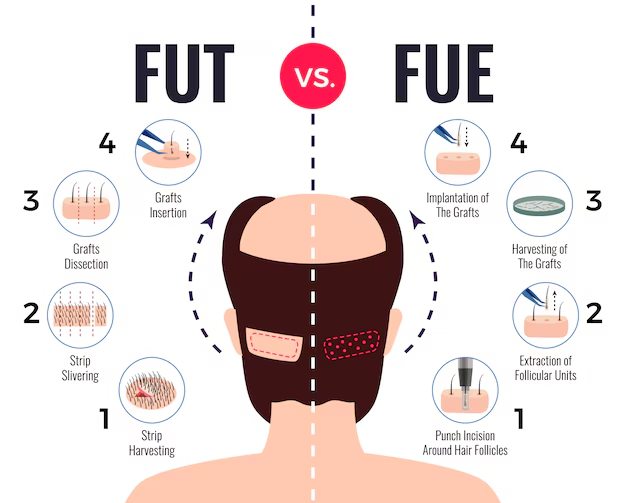
In the past, doctors used Follicular Unit Transplantation (FUT), which involved cutting a strip of skin from the back of the head. This left a long, linear scar. FUE, however, uses a micro-punch tool to take one graft at a time, leaving only tiny dots that are virtually invisible once healed.
Core Principles of the FUE Technique
The heart of FUE is protecting the dermal papilla—the life-giving part of the hair bulb. By using a punch smaller than 1.0mm, surgeons can extract the entire “follicular unit” (groups of 1 to 4 hairs) while minimizing trauma to the surrounding tissue.
How FUE Hair Transplant Works
Donor Area Selection and Preparation
Not all hair is created equal. The “permanent zone” at the back of your head is genetically resistant to dihydrotestosterone (DHT), the hormone responsible for male pattern baldness. According to the American Academy of Dermatology (AAD), this DHT-resistant hair is what makes a transplant permanent.
Individual Graft Extraction Process
The surgeon uses a specialized tool to “score” the skin around the follicle. Then, using micro-forceps, the graft is gently lifted out. This requires a steady hand to avoid “transection”—accidentally cutting the hair root.
Recipient Site Creation
This is where the artistry happens. The doctor creates thousands of tiny “slits” in the balding area. These sites determine the final density and flow of your new hair.
Graft Implantation Technique
Each graft is carefully placed into a recipient site. In Malaysia, many clinics now use high-magnification loops to ensure the follicular unit is seated at the perfect depth for blood supply.
Key Components of a Successful FUE Hair Transplant
Hairline Design and Planning
A “straight-line” hairline is a dead giveaway of a bad transplant. A hair transplant specialist designs a “macro-irregularity” pattern that mimics nature, accounting for your facial proportions and future aging.
Graft Survival and Handling
Once hair is out of the body, the clock is ticking. Grafts must be kept in a chilled, nutrient-rich holding solution to maintain cellular viability until they are replanted.
Angle, Density, and Direction Control
Hair doesn’t grow straight up; it grows at specific angles (shoveling forward at the hairline, whorling at the crown). A skilled surgeon mimics these angles perfectly.
Role of the FUE Surgeon
While technicians help with sorting, the Malaysian Medical Council (MMC) guidelines emphasize that the surgical steps—extractions and incisions—should be performed by a licensed doctor to ensure safety and ethical standards.
Types of FUE Hair Transplant Techniques
Manual FUE
The “artisan” approach. The doctor uses a hand-held punch tool. It’s slower but allows for the highest level of tactile feedback and precision.
Motorized FUE
A faster method using a rotating or oscillating power tool. This is great for large sessions (3,000+ grafts) but requires an expert hand to avoid over-heating the tissue.
Sapphire FUE
Instead of steel, the blades used for the incisions are made from Sapphire gemstones. This allows for a sharper, thinner edge, which results in smaller scabs and faster healing.
Direct Hair Implantation (DHI) Under FUE Method
Often called “The Choi Pen” method, DHI combines the “site creation” and “implantation” into one step. It’s popular for increasing density without shaving the entire head.
Candidacy for FUE Hair Transplant in Malaysia
Suitable Hair Loss Patterns
The best candidates are those with Androgenetic Alopecia (pattern baldness) who have stabilized their hair loss. If you are still actively losing large patches, the doctor might suggest medical therapy first.
Donor Hair Assessment
You need enough “supply” to meet the “demand.” A specialist uses a trichoscope to check your donor density (the number of hairs per square centimeter).
Scalp Condition Evaluation
A healthy scalp is like good soil. Conditions like scalp psoriasis or active dermatitis must be treated before surgery can proceed.
Medical Considerations
Patients should disclose any history of keloid scarring or use of blood thinners. Most clinics follow the International Society of Hair Restoration Surgery (ISHRS) safety protocols regarding patient health screenings.
Benefits of FUE Hair Transplant
Minimally Invasive Approach
No scalpels, no stitches. It is performed under local anesthesia, and most patients are chatting or watching Netflix during the procedure.
No Linear Scarring
Because the extractions are scattered, you can wear your hair very short (a #1 or #2 buzz cut) without anyone seeing a scar.
Faster Healing Time
Most people return to office work within 3 to 5 days. The tiny “red dots” in the donor area usually fade within a week.
Natural-Looking Results
Because individual units are used, the results are seamless. Even your barber won’t be able to tell if it’s done correctly.
FUE Hair Transplant Procedure Step-by-Step
Consultation and Hair Analysis
The journey starts with a deep dive into your hair history and a “graft math” session.
Graft Calculation
The doctor calculates the total area ($cm^2$) and the required density (usually 35-50 grafts per $cm^2$) to provide a transparent cost estimate.
Extraction Phase
You’ll lie face down or on your side while the donor grafts are harvested. This is often the longest part of the day.
Implantation Phase
While you sit upright, the surgeon meticulously “plants” each graft into the pre-made sites.
Recovery After FUE Hair Transplant
Immediate Post-Procedure Care
You’ll leave with a headband to prevent swelling and instructions on how to sleep at a 45-degree angle for the first few nights.
Scab Formation and Healing
Small crusts will form around each graft. These usually fall off by day 10. Crucial tip: Don’t pick them!
Shedding Phase (Shock Loss)
About 2 to 4 weeks in, the transplanted hairs will fall out. Don’t panic! This is a normal part of the hair growth cycle. The roots remain alive underground.
Hair Growth Timeline
Months 3-4: New “baby” hairs begin to sprout.
Month 6: You’ll see about 50% of the result.
Month 12-18: Full density and maturity are reached.
Risks and Limitations of FUE Hair Transplant
Overharvesting of Donor Area
If a surgeon takes too much hair from the back, it can look “see-through.” This is a permanent mistake, which is why choosing a specialist is vital.
Low Graft Survival Rate
If grafts are out of the body too long or handled roughly, they won’t “take.” Success rates should be above 90% in a top-tier clinic.
Temporary Swelling and Redness
“Forehead swelling” is common for 2-3 days as the local anesthesia drains away. It’s temporary and harmless.
Importance of Proper Technique
A “hair mill” might use untrained technicians for the whole process, leading to “multidirectional” growth that looks messy. According to the British Association of Hair Restoration Surgery (BAHRS), surgeon-led care is the best way to avoid complications.
Frequently Asked Questions About FUE Hair Transplant in Malaysia
Is FUE Hair Transplant Permanent?
Yes. The transplanted hair is taken from areas that are biologically programmed not to fall out. However, you still need to protect your existing non-transplanted hair.
How Many Grafts Are Needed?
It varies. A minor hairline touch-up might need 1,500 grafts, while a full crown-to-hairline restoration could require 4,000+.
Is FUE Painful?
The only “ouch” moment is the initial local anesthesia injections. After that, the scalp is completely numb.
How Long Does FUE Take?
A typical session takes 6 to 10 hours. It’s a marathon, not a sprint!