
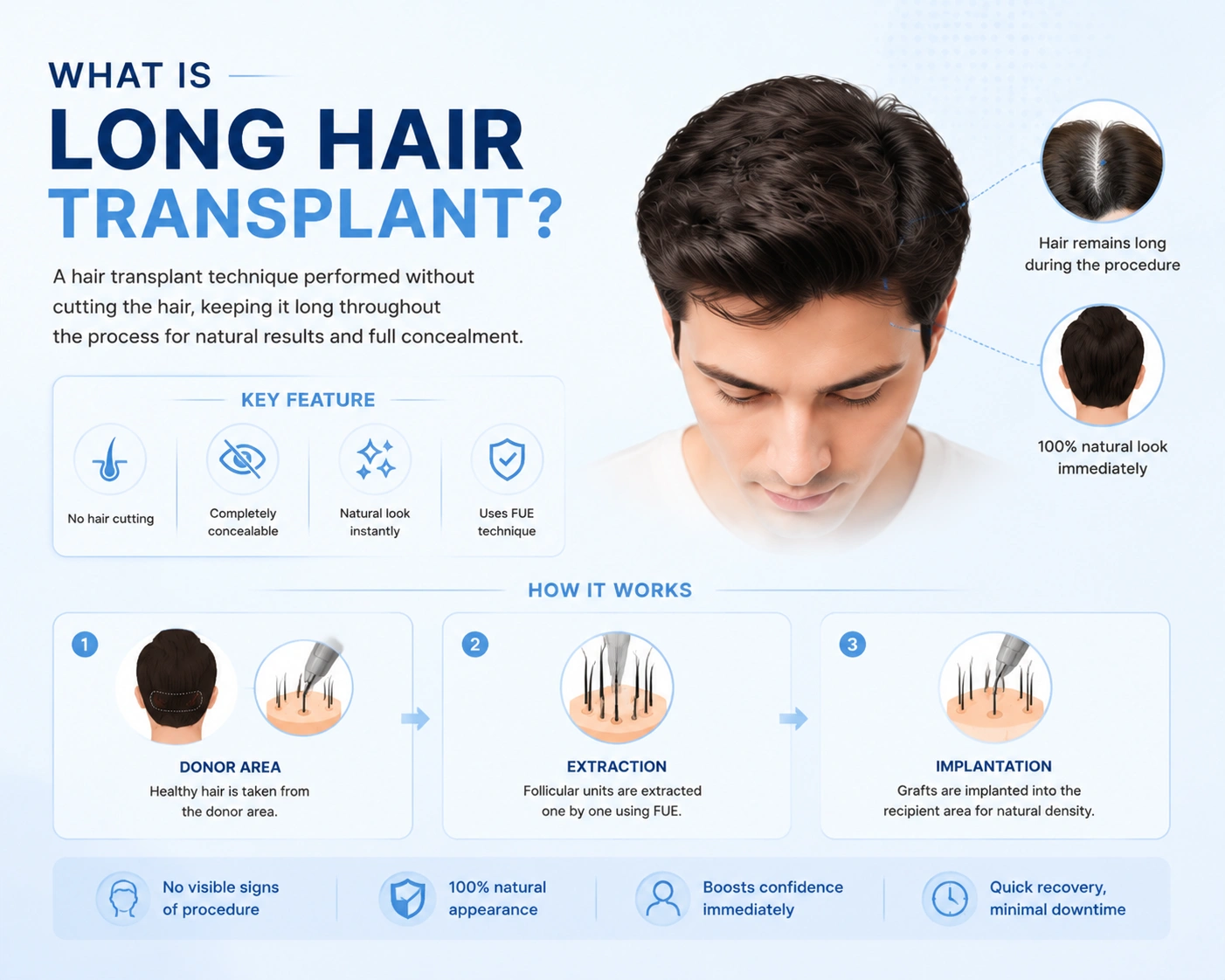
Unlike conventional hair transplantation, where transplanted hairs are trimmed short before implantation, long hair transplantation preserves the existing hair length during surgery. This approach is particularly attractive for individuals who wish to conceal the procedure or maintain their hairstyle throughout recovery.
What Is a Long Hair Transplant?
A long hair transplant is a specialized hair restoration procedure in which donor hairs are harvested and implanted without trimming them to the usual short length.
During surgery, the transplanted hairs remain several centimeters long, allowing patients and surgeons to immediately evaluate:
- Hairline design
- Hair direction
- Hair density
- Overall aesthetic appearance
The procedure generally uses the Follicular Unit Extraction (FUE) technique but requires advanced surgical skills because longer hair shafts are more delicate and difficult to implant.
How Does a Long Hair Transplant Work?
The procedure follows similar principles to traditional hair transplantation but incorporates additional technical considerations.
Consultation
The surgeon evaluates:
- Hair loss pattern
- Donor hair density
- Hair caliber
- Scalp condition
- Medical history
- Treatment expectations
Photographs and hairline planning are performed before surgery.
Donor Hair Collection
Individual follicular units are extracted from the donor area while preserving the natural hair length.
Unlike conventional FUE, extra care is required to prevent:
- Hair shaft bending
- Follicle dehydration
- Root damage
Recipient Site Creation
Tiny incisions are created according to:
- Natural hair angle
- Hair direction
- Density goals
- Facial symmetry
Proper placement is essential for achieving a natural appearance.
Graft Implantation
The long hair grafts are carefully implanted into recipient sites.
The preserved hair length provides immediate visualization of the expected cosmetic result.
Benefits of Long Hair Transplant
Immediate Cosmetic Results
Patients can instantly appreciate the newly created hairline without waiting for hair to grow.
No Need to Shave the Recipient Area
Many patients prefer this technique because existing hairstyles remain largely unchanged.
Easier Hairline Assessment
Both surgeon and patient can evaluate:
- Density
- Hair flow
- Hairline symmetry
- Overall balance
during surgery.
Better for Public-Facing Professionals
Individuals who frequently interact with clients, patients, or audiences often prefer a procedure that minimizes visible signs of surgery.
Psychological Benefits
Seeing an immediate improvement can reduce anxiety associated with the temporary shedding phase that commonly follows transplantation.
Top 3 Reasons Patients Choose a Long Hair Transplant
Natural Appearance Immediately After Surgery
Traditional hair transplantation leaves patients with a shaved scalp and tiny implanted grafts. Long hair transplantation allows immediate visualization of the final hairstyle.
Minimal Social Downtime
Because the recipient area is less obvious, many patients can return to work or social activities sooner.
Ideal for Women
Women generally prefer not to shave their hair.
Long hair transplantation allows restoration while preserving existing hairstyles.
Who Is a Good Candidate?
Ideal candidates include:
- Women with localized hair thinning
- Men avoiding shaved hairstyles
- Eyebrow transplant patients
- Beard reconstruction patients
- Scar camouflage patients
- Individuals with sufficient donor density
- Patients with realistic expectations
Who May Not Be Suitable?
The procedure may not be ideal for:
- Extensive baldness
- Poor donor supply
- Active scalp infections
- Uncontrolled diabetes
- Bleeding disorders
- Severe alopecia areata
- Unrealistic cosmetic expectations
Medical evaluation is essential before surgery.
Conditions That Can Be Treated
Long hair transplantation may be used for:
- Male pattern baldness
- Female pattern hair loss
- Traction alopecia
- Hairline lowering
- Scar revision
- Eyebrow restoration
- Beard enhancement
Long Hair Transplant vs Traditional Hair Transplant
| Feature | Long Hair Transplant | Traditional FUE |
|---|---|---|
| Hair shaved | Usually no | Usually yes |
| Immediate results | Yes | No |
| Surgery complexity | High | Moderate |
| Procedure duration | Longer | Shorter |
| Cost | Higher | Lower |
| Cosmetic concealment | Better | Less favorable |
Procedure Duration
Depending on graft numbers:
- 1,000 grafts: 5–7 hours
- 2,000 grafts: 7–10 hours
- 3,000 grafts: 8–12 hours
Long hair procedures generally require more operative time than standard FUE.
Recovery Timeline
First Week
Patients may experience:
- Mild swelling
- Scalp tenderness
- Small crust formation
- Temporary redness
Weeks 2–4
Transplanted hairs commonly shed, a normal phase known as shock loss. The follicles remain viable beneath the scalp.
Months 3–4
New hair growth typically begins.
Months 6–9
Noticeable improvement in hair density becomes evident.
Months 12–18
Final results are generally achieved, with full maturation of transplanted hairs.
Aftercare Instructions
Patients should:
- Sleep with the head elevated for several nights.
- Avoid scratching or rubbing the scalp.
- Use prescribed medications as directed.
- Wash hair according to the surgeon’s instructions.
- Avoid strenuous exercise for approximately one to two weeks.
- Protect the scalp from direct sun exposure.
- Attend scheduled follow-up appointments.
Following postoperative guidance supports optimal graft survival.
Potential Risks and Complications
Although generally safe when performed by experienced surgeons, potential risks include:
- Infection
- Bleeding
- Swelling
- Folliculitis
- Temporary numbness
- Shock loss
- Poor graft growth
- Unnatural hair direction
- Scarring
- Need for revision surgery
Selecting a qualified hair restoration specialist helps reduce these risks.
Success Rate
Hair transplantation generally has high graft survival rates when performed appropriately, often ranging between 90% and 95% for healthy transplanted follicular units. Outcomes vary based on surgical technique, postoperative care, individual healing, and underlying hair loss conditions.
Cost of Long Hair Transplant
Costs vary depending on:
- Country
- Clinic reputation
- Surgeon expertise
- Number of grafts
- Surgical technique
- Additional treatments
Because the procedure is technically demanding and more time-intensive, it typically costs more than conventional FUE hair transplantation.
Frequently Asked Questions
Does a long hair transplant hurt?
The procedure is usually performed under local anesthesia. Patients may experience mild discomfort during recovery, which is generally manageable with prescribed medications.
Will the transplanted long hairs fall out?
Yes. Temporary shedding of the transplanted hair shafts is expected within the first few weeks. This does not indicate treatment failure, as the follicles remain in place and later produce new hair.
Is shaving required?
The recipient area often does not require shaving. Depending on the surgical approach, limited trimming of the donor area may still be necessary.
How long does the surgery take?
Most procedures last between 6 and 12 hours, depending on the number of grafts and procedural complexity.
Are the results permanent?
Transplanted follicles are generally resistant to pattern hair loss and can provide long-lasting results. However, existing non-transplanted hair may continue to thin over time, and some patients may benefit from medical therapies or future procedures.
Conclusion
Long hair transplantation is an advanced hair restoration technique designed for patients who wish to maintain their existing hairstyle while benefiting from immediate visualization of the transplanted hair. It can be especially useful for women, professionals, and individuals seeking greater privacy during recovery.
Although the procedure is more technically demanding, takes longer to perform, and may cost more than conventional FUE, it offers distinct cosmetic advantages when carried out by an experienced hair transplant surgeon. A thorough medical evaluation, careful patient selection, and adherence to postoperative instructions are essential for achieving optimal, natural-looking outcomes.