
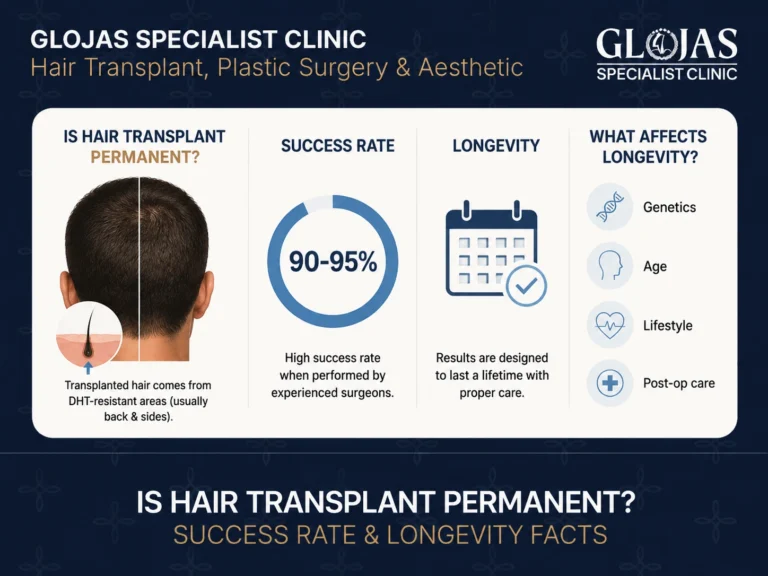
Is hair transplant permanent: Yes, transplanted hair is permanent because it is taken from DHT-resistant donor areas at the back of the scalp. The follicles keep their genetic resistance and continue growing for life. Success rate in Malaysia is 90–95% for FUE and FUT. Results last decades but do not stop future loss of non-transplanted hair.
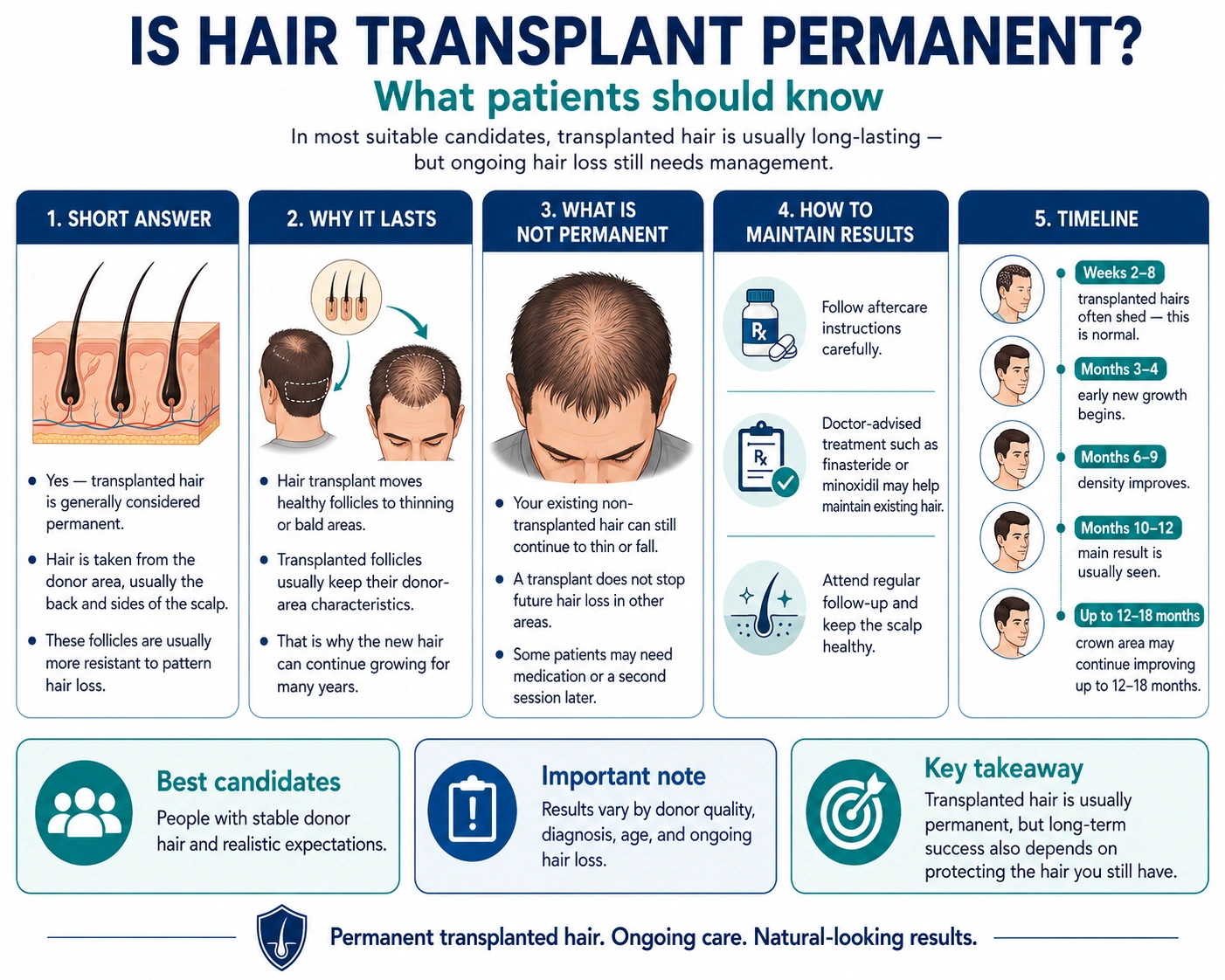
Is Hair Transplant Permanent
How Hair Transplant Permanence Works
A hair transplant works on the principle of donor dominance. Surgeons move hair follicles from the back and sides of the scalp, where hair is genetically resistant to dihydrotestosterone (DHT)—the hormone primarily responsible for pattern baldness. Once relocated, these follicles retain their original genetic characteristics. They continue to grow, shed, and regrow in normal cycles for life.
Why Transplanted Hair Does Not Fall Out
Transplanted follicles lack sensitivity to DHT. This explaining why individuals experiencing male pattern baldness on top still maintain permanent hair coverage at the back of the head. When those resilient follicles are moved to thinning areas, they continue producing hair even if the native hair surrounding them continues to thin. The hair permanently behaves exactly like it did in the donor zone.
Can Hair Transplant Fail Long Term
Yes, though it is rare. A hair transplant can fail if the grafts die due to poor surgical technique, localized infection, or smoking. Long-term failure typically happens if the patient continues losing their non-transplanted native hair, causing the overall result to look thin. While the transplanted hair itself remains, overall coverage drops if existing hair continues to recede around it.
Hair Transplant Success Rate In Malaysia
FUE Hair Transplant Success Rate
Follicular Unit Extraction (FUE) graft survival rates in Malaysia range from 90% to 95% in reputable clinics. Success means the grafts successfully grow and look completely natural. Key factors influencing this include surgeon experience, clinic protocol, and patient aftercare. FUE leaves tiny dot scars and offers faster donor healing, which improves overall patient satisfaction.
FUT Hair Transplant Success Rate
Follicular Unit Transplantation (FUT) shares a similar success rate of 90% to 95%. It allows for harvesting large graft numbers in a single session, making it highly useful for advanced stages of baldness. The linear scar left in the donor area is the main drawback. Graft survival depends entirely on how carefully the donor strip is dissected and implanted by the surgical team.
Factors That Affect Hair Transplant Success
Surgeon skill and team experience
Graft handling time outside the body
Patient health: conditions like diabetes, smoking habits, and scalp blood supply
Post-op aftercare and strict infection control
Realistic expectations and proper planning
Hair Transplant Longevity Facts
How Long Do Hair Transplant Results Last
Transplanted hair is lifelong. Once a follicle survives the first 12 months post-procedure, it enters normal growth cycles. Results are considered permanent and can last 20–30 years or more. The hair will age naturally with you and may turn grey or thin slightly with old age, just as the original donor hair would.
Hair Transplant Results After 10 Years
At the 10-year mark, 85–90% of patients retain good density from their transplanted grafts. The transplanted hair does not disappear. However, if native hair around it continues to fall due to untreated male pattern baldness, the overall look may eventually need a touch-up. Case photos from Malaysian clinics show stable hairlines 10–15 years post-op.
Will I Need A Second Hair Transplant
You may need a second session if your native hair loss progresses. A transplant does not stop new balding from occurring. Men who start the process young or have aggressive hair loss often undergo a second procedure 5–10 years later to add density or cover new thinning zones. Good planning and preventative medication reduce this need.
What Impacts Hair Transplant Permanence
Donor Hair Quality And Longevity
A strong donor area is essential for a permanent result. Surgeons thoroughly check donor density, hair calibre, and signs of miniaturization. If the donor hair is inherently weak or thinning, longevity drops. Patients with diffuse unpatterned alopecia (DUPA) are generally not good candidates because their donor area is not DHT-resistant.
Age And Hair Loss Progression After Transplant
Age plays a significant role. Men under the age of 25 may continue losing hair quickly, which can make a transplant look isolated later in life. Ideal candidates are typically 30+ with stabilized hair loss. Evaluating the Norwood scale and family history helps predict future loss, while medication helps slow the progression of native hair.
Surgeon Skill And Graft Survival Rate
Graft survival remains at 95%+ with expert teams. Poor angulation, improper placement depth, or graft dehydration during the procedure kills follicles. In Malaysia, clinics utilizing dedicated implanters and implanter pens report a higher yield. Always ask for before-after photos, clinic graft survival audits, and whether a qualified doctor performs the extraction.
Hair Transplant Maintenance For Longevity
Medications To Protect Non-Transplanted Hair
Transplants fix specific balding spots but do not stop ongoing genetic loss. Finasteride (1 mg daily) and Minoxidil (5%) help preserve existing native hair. These are routinely prescribed by doctors in Malaysia to protect your surgical investment. Platelet-Rich Plasma (PRP) and low-level laser therapy (LLLT) are common add-ons that support overall density.
Lifestyle Habits That Affect Hair Transplant Results
Smoking reduces graft survival by up to 30%. Alcohol, poor sleep patterns, and crash diets slow down the healing process. Chronic stress raises cortisol levels and speeds up native hair loss. Proper sun protection for the first 6 months prevents UV damage, while a high-protein diet rich in iron, zinc, and vitamin D supports healthy growth.
When To See A Doctor After Hair Transplant
You should see your doctor if you notice sudden shedding after month 6, patchy loss, persistent redness, pimples that do not heal, or rapid thinning of your native hair. An annual review is common in Malaysian clinics to monitor long-term results and adjust maintenance medications.
Hair Transplant Permanent Results FAQs Malaysia
Does Transplanted Hair Turn Grey
Yes. Transplanted hair ages normally. It will turn grey and thin at the exact same rate as your donor hair would have. If your back hair turns grey at age 50, your transplanted hairline will too. You can safely dye it once it is fully healed after month 6.
Can I Go Bald Again After Hair Transplant
You will not lose the transplanted hair itself, but you can look bald again if the native hair around it falls out. This is why surgeons design a mature hairline and strongly recommend finasteride. Without maintenance medication, a Norwood 3 pattern can progress to a Norwood 5 pattern over 10 years, requiring another surgical session.
Is Hair Transplant Permanent For Everyone
Not for everyone. Good candidates must have stable donor hair, realistic goals, and no uncontrolled medical issues. Patients with diffuse thinning, active autoimmune diseases, or unrealistic density expectations may be disappointed. A proper consultation in Malaysia includes a thorough scalp analysis and blood tests to confirm suitability.