
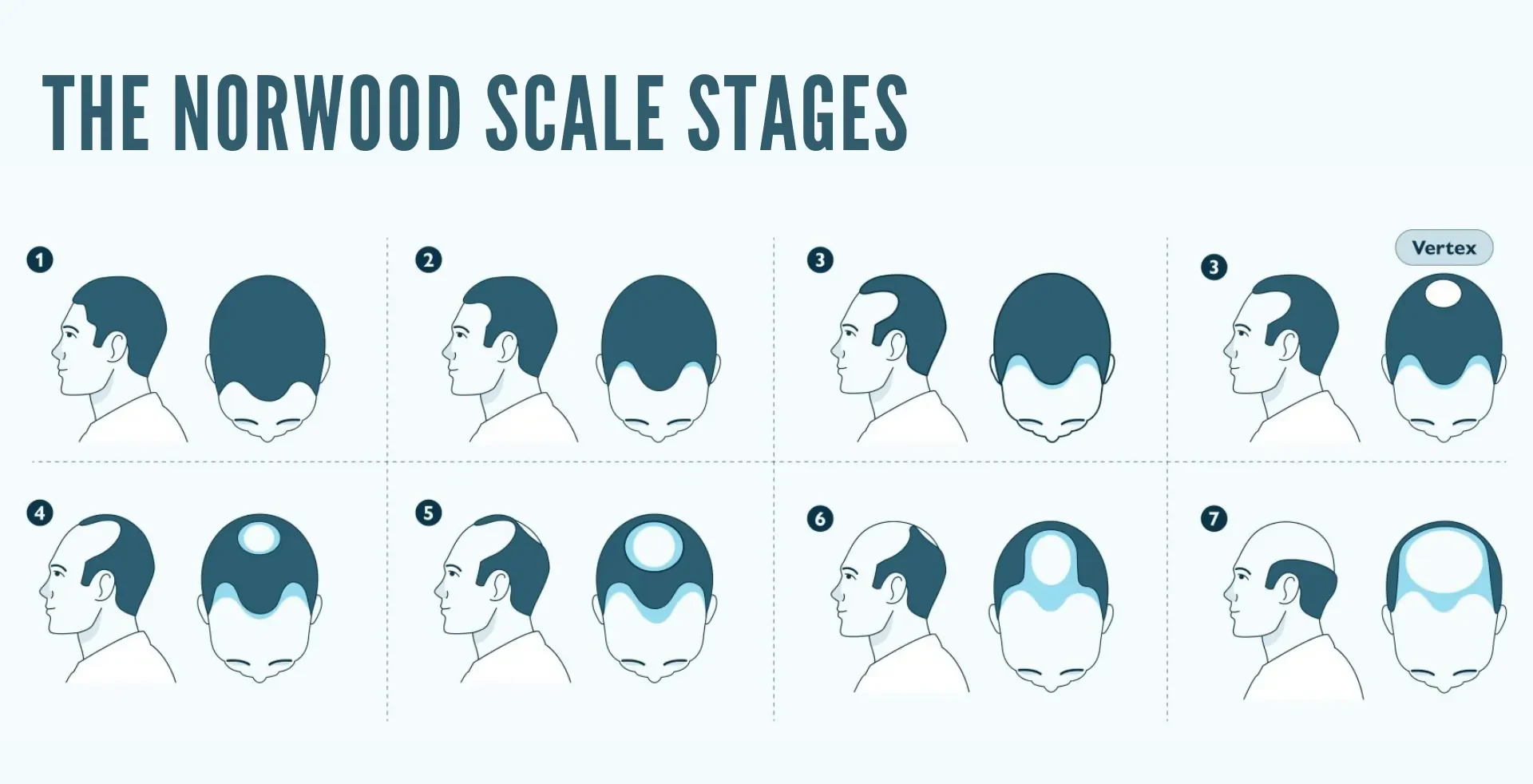
The Norwood Scale (also called the Norwood-Hamilton Scale) is the standard classification system used to measure the severity and pattern of male pattern baldness, ranging from Stage 1 (no visible loss) to Stage 7 (extensive baldness with only a horseshoe band of hair remaining). Doctors and hair transplant surgeons use it to assess hair loss progression, plan treatment, and estimate the number of grafts needed for a hair transplant.
What Is the Norwood Scale?
The Norwood Scale is a classification system that categorizes male pattern baldness (androgenetic alopecia) into distinct stages based on the pattern and extent of hair loss — from the hairline and temples through to the crown. It was developed by Dr. James Hamilton and later refined by Dr. O’Tar Norwood, which is why it’s sometimes called the Hamilton-Norwood Scale.
It remains the most widely used reference tool among dermatologists and hair restoration surgeons for describing hair loss severity, tracking how it changes over time, and planning appropriate treatment.
The 7 Stages of the Norwood Scale
Stage 1 — No Significant Hair Loss
The hairline is at or near its original, youthful position with no visible recession. This is the baseline stage before pattern hair loss begins.
Stage 2 — Slight Hairline Recession
Minor recession appears at the temples, sometimes called a “mature hairline.” This is considered a normal, non-balding change in hairline shape for many men and does not necessarily indicate progressive hair loss.
Stage 3 — The Earliest Sign of True Balding
Stage 3 marks the point most experts consider the true onset of male pattern baldness, with deeper recession at the temples forming an M, U, or V shape. A related sub-type, Stage 3 Vertex, involves early thinning at the crown alongside hairline recession.
Stage 4 — Hairline and Crown Loss with a Retained Band
The hairline recedes further and crown thinning becomes more pronounced, but a distinct band of hair across the top still separates the two balding areas.
Stage 5 — The Band Narrows
The strip of hair separating the front and crown balding areas becomes noticeably narrower and sparser, though the two areas remain separated.
Stage 6 — The Band Disappears
The bridge of hair connecting the front and crown is lost entirely, and the balding areas merge into one larger region across the top of the scalp.
Stage 7 — Most Extensive Hair Loss
The most advanced stage, leaving only a horseshoe-shaped band of hair around the sides and back of the head, with little to no hair remaining on top.
Norwood Scale Chart Summary
| Stage | Description | Typical Hair Loss Extent |
|---|---|---|
| 1 | No visible hair loss | 0% |
| 2 | Slight temple recession | Minimal |
| 3 | Earliest true balding, M/U/V hairline | Mild–moderate |
| 3 Vertex | Hairline recession + crown thinning | Mild–moderate |
| 4 | Hairline + crown loss, band retained | Moderate |
| 5 | Band narrows significantly | Moderate–advanced |
| 6 | Band disappears, areas merge | Advanced |
| 7 | Horseshoe pattern, most extensive | Severe |
What Causes Progression Through the Norwood Stages?
Male pattern baldness is primarily driven by genetics and DHT (dihydrotestosterone), a hormone that gradually shrinks genetically susceptible hair follicles at the hairline and crown over time. This is why hair loss typically follows a predictable pattern — the donor area at the back and sides remains largely resistant to DHT throughout life, which is also why it’s used as the donor source in hair transplants.
Progression speed varies widely between individuals — some men stay at an early stage for decades, while others progress through several stages within just a few years.
Which Treatments Fit Each Stage?
| Norwood Stage | Common Approach |
|---|---|
| 1–2 | Often no treatment needed; monitoring or early preventive medication (e.g., minoxidil, finasteride) if progression is a concern |
| 3–4 | Medical therapy to slow progression; hair transplant becomes a realistic option for those wanting to restore density |
| 5–6 | Hair transplant is commonly considered, often combined with medical therapy to protect remaining native hair |
| 7 | Hair transplant is still possible but requires careful donor planning, since less donor hair is available relative to the area needing coverage |
A hair transplant surgeon will typically assess your Norwood stage alongside donor hair density to estimate how many grafts are needed and what result is realistically achievable.
Frequently Asked Questions
What is the Norwood Scale? The Norwood Scale, also called the Norwood-Hamilton Scale, is a classification system used to measure the stages and pattern of male pattern baldness, ranging from Stage 1 (no loss) to Stage 7 (extensive baldness).
How many stages does the Norwood Scale have? The Norwood Scale has 7 main stages, with an additional “Type A” variant and a “Vertex” variant at Stage 3, used to describe hair loss patterns that don’t fit neatly into the standard categories.
What Norwood stage is considered the start of true balding? Most experts consider Stage 3 the earliest point of true pattern baldness, as Stages 1 and 2 typically reflect a normal, non-progressive hairline maturation.
Can you skip Norwood stages? Hair loss doesn’t always progress evenly through every stage — some men move faster through certain stages than others, and progression can also stop or slow significantly at any point.
What Norwood stage needs a hair transplant? There’s no fixed stage requirement — a hair transplant can be considered from Stage 3 onward, depending on donor hair availability, the extent of loss, and personal goals. Higher stages generally require more grafts and more careful donor planning.
Is the Norwood Scale only for men? Yes. The Norwood Scale specifically classifies male pattern baldness. Female pattern hair loss is assessed using a separate system called the Ludwig Scale, which reflects the more diffuse thinning pattern typically seen in women.