
Thinking about a hair transplant? It’s a marathon, not a sprint. While the transformation can be life-changing, knowing the timeline helps you stay patient. From the initial graft placement to that final “wow” moment in the mirror, here is what the journey actually looks like.
GLOJAS Specialist Clinic offers the best hair transplant Malaysia provides, with ABHRS-certified surgeons and natural, permanent results. Trust your hair restoration to experts.
Understanding Hair Transplant Results Over Time
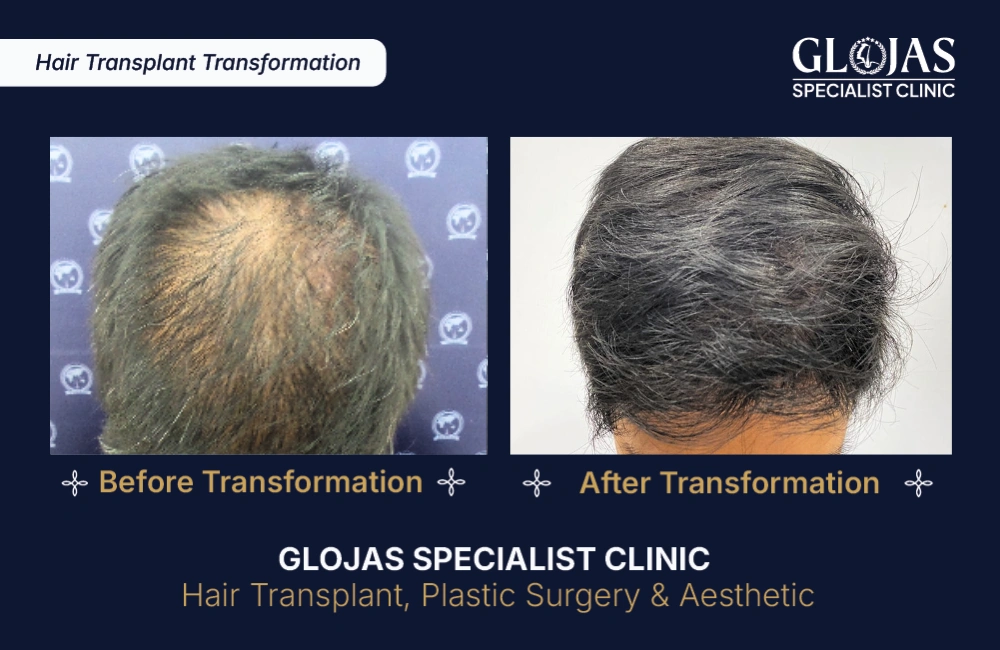
Hair growth following a transplant follows a biological cycle. You won’t leave the clinic with a full head of hair; instead, the follicles enter a resting phase before producing new strands. Understanding this hair growth cycle is crucial for managing your expectations during the first year.
The First 2 Weeks: Scabbing, Redness, and Shedding
Immediately after surgery, expect tiny scabs around the graft sites and mild swelling. By day 10, most scabs fall off. Don’t panic when the transplanted hairs shed around week two—this is “shock loss,” a normal part of the process as the follicles prepare for new growth.
3 to 6 Months: Early Growth and “Ugly Duckling” Phase
This stage is often called the “ugly duckling” phase. Growth is patchy, thin, and fine. However, by month four, roughly 50% of the new hair begins to break through the surface. It’s the turning point where you finally start seeing the outline of your new hairline.
9 to 12 Months: Full Results and Density
By the one-year mark, most patients see 90% to 100% of their final results. The hair shafts thicken, and the texture matures. According to the International Society of Hair Restoration Surgery (ISHRS), final maturation can sometimes take up to 18 months for crown procedures.
Before and After Photos by Hair Loss Type
Norwood Scale 3–4: Receding Hairline Results
Patients at Norwood 3 or 4 usually focus on the frontal hairline and temples. Before photos show significant “M-shaped” recession. After photos typically feature a crisp, framed face. Usually, 1,500 to 2,500 grafts are sufficient to create a dense, youthful appearance in these zones.
Norwood Scale 5–6: Crown and Top Restoration
Advanced hair loss requires a strategic approach. Since donor hair is finite, surgeons prioritize the frontal view. Before and afters for Norwood 6 often show a “connected” look from front to back, though the crown may remain slightly thinner than the front to conserve grafts.
Temple and Hairline Lowering Results
Hairline lowering isn’t just for balding; it’s often used to correct a naturally high forehead. These results look dramatic because they change facial proportions. Success depends on the surgeon mimicking the natural exit angles of hair to ensure the new hairline doesn’t look “pluggy.”
Key Factors That Influence Your Before and After Outcome
| Factor | Impact on Result |
| Donor Density | High density allows for more grafts and better coverage. |
| Hair Texture | Curly or thick hair provides better “visual” coverage than fine hair. |
| Scalp Laxity | Important for FUT; determines how much skin can be harvested. |
| Compliance | Following post-op instructions prevents graft death. |
FUE vs. FUT: How the Method Changes Results
Follicular Unit Extraction (FUE) leaves tiny dot scars, making it ideal for short haircuts. Follicular Unit Transplantation (FUT) involves a linear scar but often yields more viable grafts in a single session. Both methods produce identical “after” looks on the top of the head; only the donor area scarring differs.
Graft Count and Density Expectations
Density is measured in follicular units per square centimeter ($FU/cm^2$). While natural hair is roughly $60–100 FU/cm^2$, surgeons typically aim for $35–50 FU/cm^2$. This “illusion of density” is enough to provide full coverage without depleting your limited donor supply.
Surgeon Skill and Natural Hairline Design
A great “after” isn’t just about hair—it’s about art. Skilled surgeons use single-hair grafts for the very front row to create a soft, irregular transition. If the hairline is too straight or the grafts are too thick, the result looks artificial and “doll-like.”
Preparing for a Hair Transplant (The “Before” Phase)
Medications and Lifestyle Changes Before Surgery
Stop taking blood thinners, aspirin, and Vitamin E a week before. You should also avoid alcohol and smoking, as nicotine constricts blood vessels, potentially hindering graft survival. Some surgeons recommend starting Minoxidil or Finasteride months prior to stabilize existing hair loss.
Realistic Expectations and Consultation Goals
A consultation should involve a scalp analysis using a trichoscope. Be wary of “mega-sessions” if your donor area is weak. Your goal is a lifetime result, not just a one-year fix. Discussing the “worst-case” future recession is a hallmark of an ethical surgeon.
What the “After” Phase Really Looks Like
Immediate Post-Op Care (Days 1–10)
You’ll need to sleep at a $45^\circ$ angle to reduce swelling. Use a saline spray to keep grafts hydrated and avoid touching the recipient area. The “after” phase starts with strict adherence to washing protocols to gently remove crusts without dislodging the delicate new bulbs.
Managing Shock Loss and Temporary Thinning
Shock loss occurs when native hair falls out due to the trauma of surgery. It’s temporary but can be startling. This usually resolves within 3 to 4 months as both the old and new hairs begin their growth phase simultaneously.
Long-Term Maintenance (Finasteride, Minoxidil, PRP)
A transplant doesn’t stop natural balding in non-transplanted areas. To maintain your “after” look, many doctors prescribe FDA-approved treatments like Finasteride. This prevents the “island” effect where hair continues to recede behind the permanent transplanted grafts.
Red Flags and Unrealistic Before-and-After Claims
Overly Enhanced or Misleading Photos
Watch out for clinics using wet “before” photos and dry, styled “after” photos with hair fibers. Harsh lighting in the “before” and soft, warm lighting in the “after” is a common trick. Look for consistent angles and high-resolution images that show the scalp.
Promises of Full Density in Under 6 Months
Biology cannot be rushed. Any clinic promising a full mane in four months is ignoring the natural hair cycle. High-quality results take time. If a deal seems too good to be true, or the timeline seems too fast, it’s a major red flag for your safety.
Frequently Asked Questions About Before and After Results
When will I see the final result?
Expect to see the definitive “final” look between 12 and 15 months. The hair needs this time to not only grow in length but also to reach its full thickness and normalize its texture after the dormant period.
Can anyone tell I had a transplant?
With modern FUE techniques and proper hairline design, the results are virtually undetectable. Unless someone looks at your scalp with a magnifying glass, the random, staggered placement of grafts mimics the natural growth patterns of a non-transplanted head.
Do results look natural years later?
Yes, because the donor hair is harvested from the “permanent zone” at the back and sides of the head. These follicles are genetically resistant to DHT. As long as you maintain your surrounding native hair, the transplant will look natural for decades.