
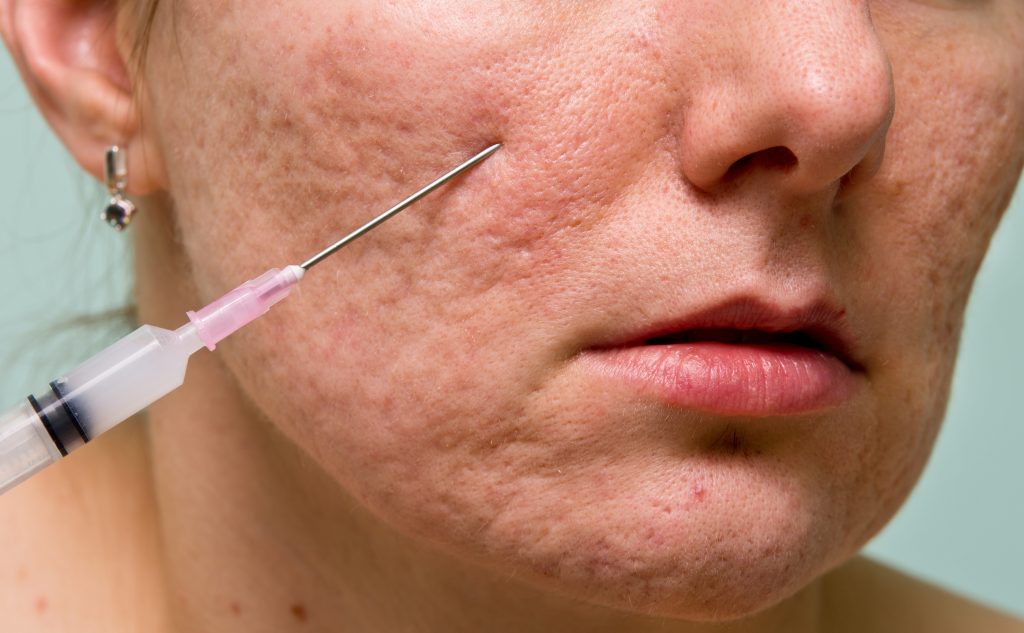
Types of scars include atrophic scars, hypertrophic scars, keloid scars, and contracture scars. Each type forms differently after acne, injury, or surgery and may require specific scar treatment for improvement.
A scar is a natural patch of fibrous tissue that replaces normal skin after the dermis layer is damaged by an injury, surgery, or inflammation. The body repairs the wound by rapidly producing collagen fibers; however, this new tissue lacks the uniform, flexible structure of healthy skin, leading to permanent structural and textural changes.
Quick Summary of Types of Scars
Structural Diversity: Scars range from indented craters (atrophic) to raised, overgrown tissue lumps (hypertrophic and keloids) depending on your body’s collagen response.
Permanency vs. Improvement: While deep scars are structurally permanent and cannot be deleted completely, advanced medical treatments can minimize their visibility by up to 80%.
Targeted Therapies: Successful treatment relies entirely on precise classification, ranging from subcision for deep acne indentations to steroid injections for raised keloids.
What Are Scars and How Do They Form?
Scars are the biological byproduct of the body’s natural cutaneous wound healing process. When a deep trauma compromises the integrity of the dermal layer (the skin’s deeper structural framework), it triggers a highly coordinated cascade of biochemical events:
[Hemostasis/Clotting] ➔ [Inflammation] ➔ [Proliferation (Collagen Build)] ➔ [Maturation/Remodeling]
During the proliferative phase, specialized cells called fibroblasts rush to synthesize extracellular matrix components, primarily Type I and Type III collagen alongside fibronectin. Because the priority is rapid skin closure to re-establish a barrier against pathogens, these new fibers lose the flexible, “basket-weave” structural pattern of healthy skin. Instead, they organize into rigid, densely packed parallel bundles, resulting in an area with altered elasticity, distinct pigmentation, and a lack of normal epidermal appendages like hair follicles or sebaceous glands.
Main Types of Scars in Malaysia
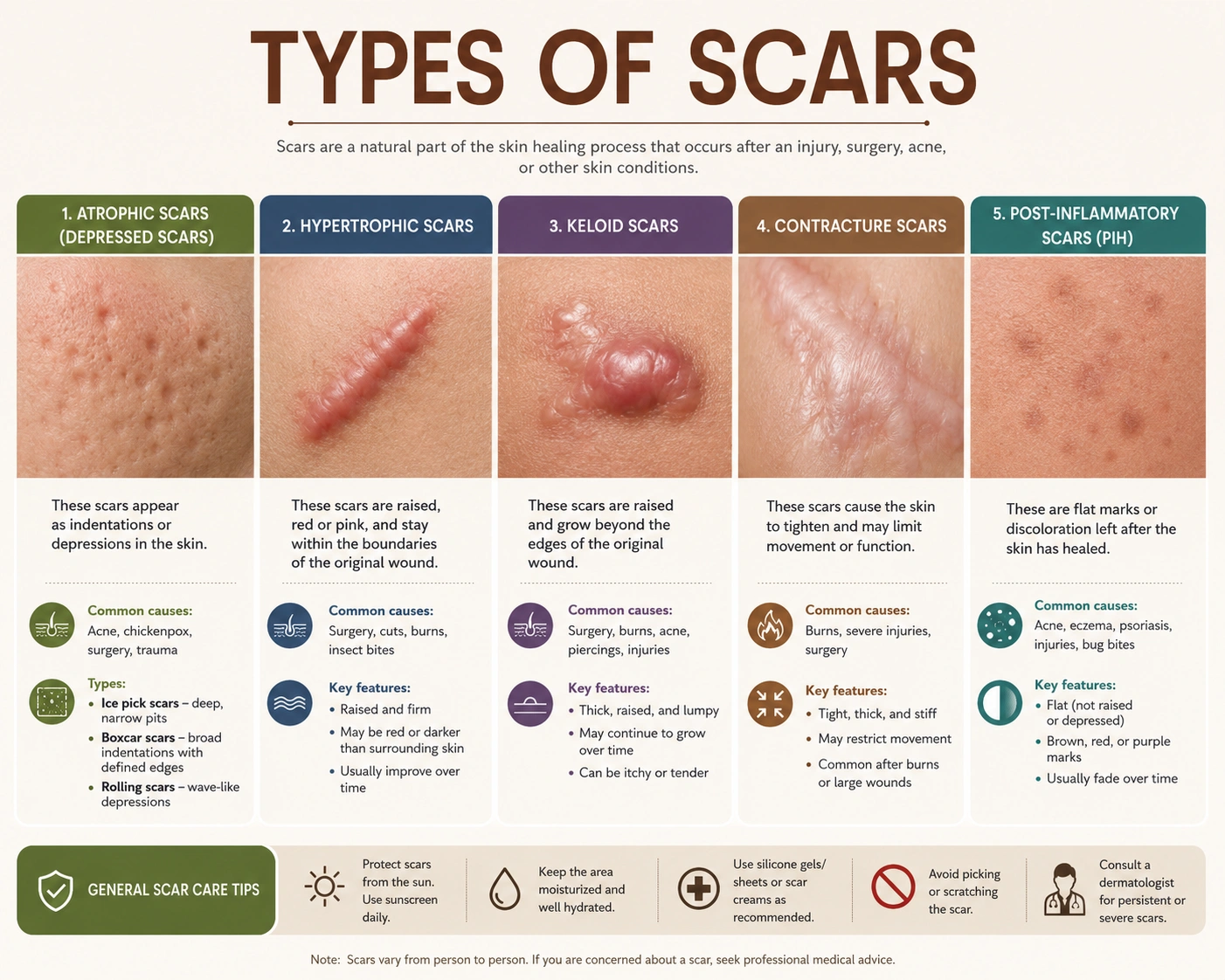
Not all tissue damage heals the same way. Scars are categorized based on whether the body experienced a collagen deficit or surplus during dermal remodeling.
Atrophic Scars (Indented Scars)
Atrophic scars form when the body fails to generate enough replacement collagen during the healing process, causing the skin to heal with an indented, sunken profile. These are most commonly triggered by severe cystic acne, chickenpox, or localized infections. They are further divided into three distinct sub-types:
Ice Pick Scars: Narrow, deep, and sharp punctures that look as though the skin was pierced with a miniature ice pick. They reach deep into the dermis layer.
Boxcar Scars: Round or oval depressions with steep, sharply defined vertical edges, resembling chickenpox scars.
Rolling Scars: Wide, shallow depressions that create an uneven, wave-like, or rolling texture across the skin surface due to fibrous bands pulling the dermis down.
Hypertrophic Scars
Hypertrophic scars occur when the body produces an excess amount of collagen at the wound site. These present as firm, raised, red or pink ridges that stay rigidly confined within the exact boundaries of the original injury or surgical incision. Over many months or years, they may naturally flatten out or fade slightly on their own.
Keloid Scars
Keloid scars are a more aggressive manifestation of excessive collagen production. Unlike hypertrophic scars, keloids grow aggressively and spread far beyond the original borders of the wound, invading healthy surrounding skin. They appear as thick, rubbery, shiny, or hyperpigmented nodules that can feel itchy or painful. Keloids are highly resistant to standard topical care, do not fade on their own, and carry a high rate of recurrence after surgical removal.
Contracture Scars
Contracture scars develop primarily after a severe burn injury. As the skin repairs itself, the new fibrous tissue tightens, contracts, and pulls the edges of the skin together. This tightening can restrict normal physical movement, especially when the scar forms over a joint or covers a large surface area.
Stretch Marks as a Type of Scar
Known medically as striae distensae, stretch marks are structurally a form of dermal scarring. They occur when rapid stretching of the skin (due to pregnancy, growth spurts, or sudden weight fluctuations) causes the internal structural mesh of collagen and elastin to rupture. They begin as red or purple lines (striae rubra) before maturing into permanent, silvery-white linear depressions (striae alba).
Differences Between Scar Types
Understanding how your scar behaves requires evaluating its structural position and overall texture.
Depth and Skin Structure Differences
Atrophic scars suffer from a structural deficit. The underlying fat and collagen support matrix are gone, leaving a hollow pocket under the epidermis.
Hypertrophic and keloid scars are structural surpluses. Dense, chaotic bundles of Type I and Type III collagen pile upward, pushing the skin surface outward.
Appearance and Texture Comparison
The following baseline grid outlines how these common variations compare visually and texturally:
| Scar Type | Visual Profiles | Texture | Common Triggers |
| Atrophic | Pit, crater, or depressed valley | Soft to touch or bound down | Cystic acne, chickenpox, accidents |
| Hypertrophic | Raised pink/red ridge; strictly localized | Firm and fibrous | Surgical incisions, deep cuts |
| Keloid | Large, raised, dark or purple nodule; oversized | Rubbery and rigid | Ear piercings, burns, minor cuts |
| Contracture | Tight, glossy, drawn-together skin | Hard and restrictive | Thermal or chemical burns |
What Causes Different Types of Scars?
The final shape, size, and classification of a scar are dictated by the specific mechanism of trauma, its location, and your genetic background:
Surgical Scars vs. Injury Scars: Surgical scars are typically clean, linear, and predictable because they are created using sterile equipment along natural skin tension lines (Langer’s lines). Injury scars (from falls or lacerations) are often jagged, contaminated with debris, and experience erratic healing, making severe scarring more likely.
Inflammation Level: Deep, unpopped cystic acne pockets destroy surrounding healthy tissue, making atrophic scarring highly likely.
Genetics and Melanin: Individuals with deeper skin tones (higher melanin levels) have an elevated genetic predisposition to developing keloids and post-inflammatory hyperpigmentation (PIH) following minor skin trauma.
Which Types of Scars Are Permanent?
Biologically speaking, all deep dermal scars are permanent. Once the original architecture of the dermis is damaged, the body can never replace it with completely identical, unscarred skin tissue.
However, mild epidermal marks—such as superficial scratches or Post-Inflammatory Erythema (PIE/red marks from minor acne)—will fade entirely over 3 to 6 months because they do not compromise the dermis. While deep atrophic valleys, keloids, and mature surgical marks are lifelong, modern medical aesthetics can remodel the underlying collagen to flatten, plump, or smooth them out so significantly that they become nearly unnoticeable to the naked eye.
Best Treatment Options for Each Scar Type
No single medical device can treat every type of scar. Effective revision requires selecting a treatment matched to the scar’s structural classification.
Laser Treatment for Scars
Ablative Lasers (CO2, Erbium:YAG): Remove the outer layers of damaged skin, vaporizing scar tissue and forcing the body to grow a smooth new surface layer. Highly effective for deep boxcar and rolling acne scars.
Non-Ablative Lasers: Heat up the deeper dermis without damaging the surface skin to trigger new collagen growth. Great for mild wrinkling, stretch marks, and early surgical lines.
Vascular Lasers (Vbeam/Pulsed Dye Laser): Specifically target blood vessels to eliminate the stubborn redness or purple discoloration found in fresh hypertrophic scars.
Microneedling and RF Microneedling
Traditional microneedling punctures the skin with tiny needles to stimulate a controlled healing response. Radiofrequency (RF) Microneedling goes a step further by emitting thermal energy directly into the tips of the needles once they reach deep into the dermis. This safely breaks apart stubborn scar tissue and tightens skin, making it an excellent option for shallow rolling scars, stretch marks, and surgical lines across all skin types.
Subcision and Fillers for Acne Scars
For bound-down rolling scars, a procedure called subcision is highly effective. The doctor inserts a specialized medical needle horizontally beneath the skin to slice through the tight fibrous bands that are pulling the skin down. Once these bands are released, the skin surface instantly lifts. Dermal fillers (such as hyaluronic acid) can then be injected into the empty pocket to hold the skin level while new collagen fills the space.
Steroid Treatment for Keloids
Because hypertrophic and keloid scars are caused by cellular overactivity, they respond best to intralesional corticosteroid injections. The steroid is injected directly into the tough scar tissue to shut down overactive fibroblasts, drastically reducing inflammation and flattening the raised mass over a series of treatments.
Surgical Scar Revision
For wide, jagged, or poorly positioned scars from past surgeries or accidents, a plastic surgeon can perform a surgical revision. The old, thick scar tissue is precisely excised, and the skin edges are re-stitched together using ultra-fine sutures in a cleaner, hidden fashion that blends seamlessly with natural skin folds.
How to Identify Your Scar Type
You can accurately identify your scar type by evaluating its texture and boundaries under natural light:
                          Is the scar raised or indented?
                                     |
                +--------------------+--------------------+
                |                                         |
             [Raised]                                 [Indented]
                |                                         |
 Does it stay within the wound?                 What shape is the pit?
        |                 |                        |        |        |
    (Yes)                (No)                  (Narrow)  (Boxy)  (Wavy)
      |                   |                        |        |        |
[Hypertrophic]        [Keloid]                 [Ice Pick] [Boxcar] [Rolling]
How to Prevent Severe Scarring
The best way to manage a scar is to optimize your healing habits immediately after an injury occurs:
Keep it Moist: Avoid letting a fresh wound dry up and form a hard, thick scab. Applying pure petroleum jelly (like Vaseline) keeps the wound hydrated, which helps new skin cells migrate across the surface faster.
Use Silicone Gel Sheets: Once the wound has completely closed and any stitches are removed, apply medical-grade silicone gel or sheets daily. This creates protective hydration that safely signals your body to slow down excess collagen production.
Sun Protection is Mandatory: Fresh healing tissue is highly sensitive to UV rays. Protect the scar with mineral sunscreen (SPF 30+) or keep it covered for the first year to prevent permanent dark brown staining (hyperpigmentation).
Do Not Pick: Picking at scabs or popping active pimples re-introduces bacteria, re-injures the dermis, and turns a temporary mark into a permanent atrophic scar.
When to See a Doctor for Scar Treatment

You should schedule a professional medical consultation if your scar:
Restricts your natural range of physical movement or causes significant tightness around joints.
Becomes increasingly painful, hyper-sensitive, or experiences intense, ongoing itchiness (signs of an active keloid).
Deeply impacts your psychological well-being, body image, or personal confidence.
For optimal therapeutic outcomes, seek care from a board-certified dermatologist or plastic surgeon. They can design a customized treatment plan combining multiple modalities to safely restore your skin’s health.
Notes From Doctors:
“At my clinic in Malaysia, I often explain types of scars as different ways the skin heals after acne, injury, or surgery. Some scars look sunken, some raised, and others thick or tight depending on healing. Understanding types of scars helps us choose the right treatment, whether it’s laser, injections, or minor procedures, to improve skin texture while keeping results natural and balanced.”
— Dr. Mohd Ali, NSR-Certified Plastic Surgeon in Malaysia