
Smile lines and nasolabial folds are the lines that run from the sides of your nose to the corners of your mouth. They deepen with age due to collagen loss, repeated facial expressions, sun exposure, genetics, and volume loss in the cheeks. In Malaysia, prevention includes daily SPF50+, retinoids, peptides, and hydration.
Non-surgical treatments available are dermal fillers, HIFU, RF microneedling, and thread lifts, with costs ranging from RM800 to RM4,500 depending on modality and clinic. Smile lines are normal and can’t be removed permanently, but their appearance can be significantly softened. Malaysia
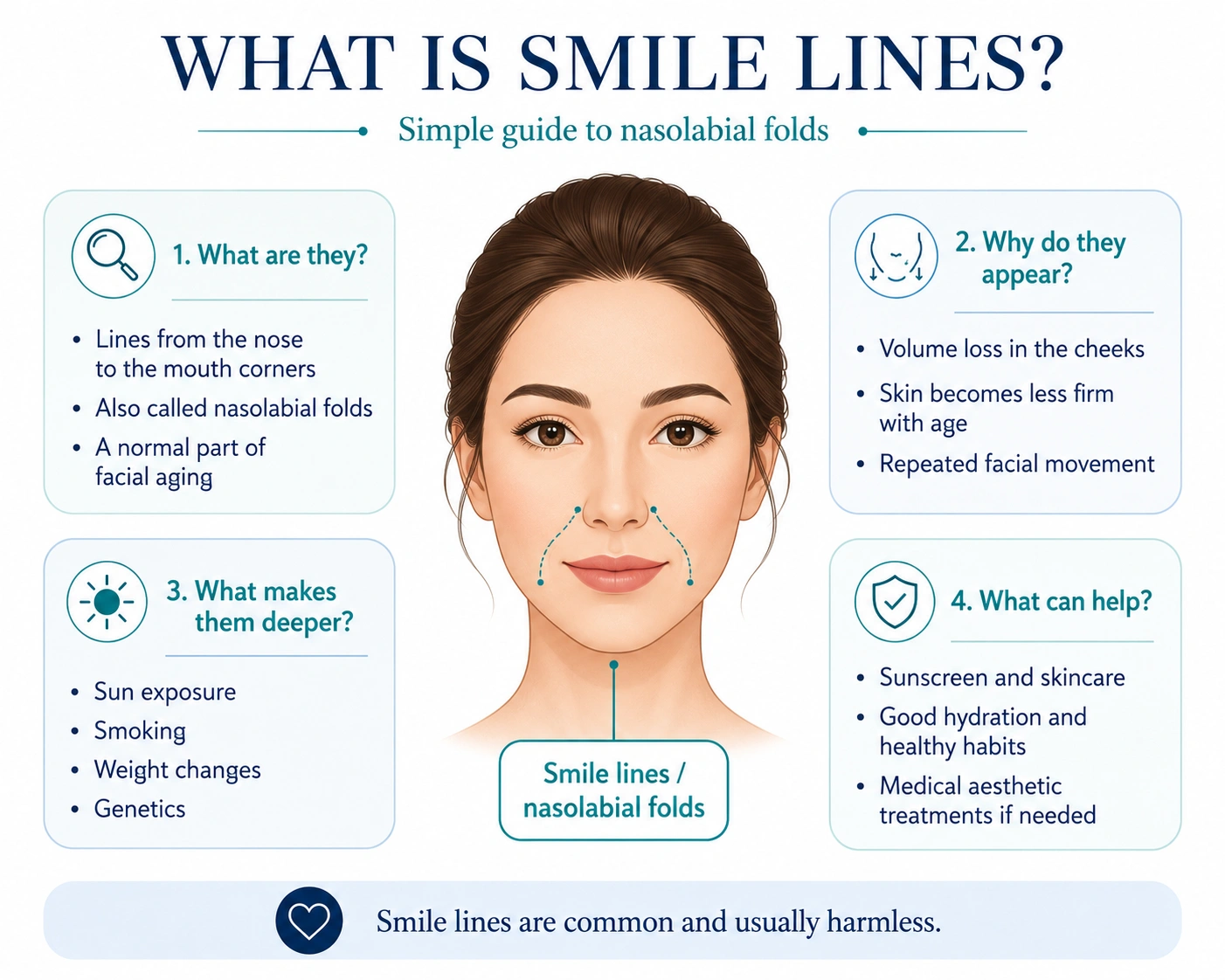
What Are Smile Lines And Nasolabial Folds
Smile lines and nasolabial folds refer to the natural creases that frame your mouth. Everyone has them to some degree, but they become more pronounced over time.
Difference Between Smile Lines And Nasolabial Folds
Nasolabial folds: The anatomical term for the creases from the ala of the nose to the oral commissure. They’re present even when your face is at rest.
Smile lines: The common name for nasolabial folds when they deepen during smiling or laughing. Some people also use “smile lines” for fine lines at the outer corners of the mouth.
How Nasolabial Folds Form With Age
Collagen & elastin decline: After age 25, collagen drops ~1% yearly. Skin loses structure and snap-back.
Fat pad descent: Mid-face fat pads slide down due to gravity, creating a shadow above the fold.
Bone resorption: Maxilla and cheekbones gradually recede, reducing support.
Repeated expression: Smiling, talking, and chewing etch the fold into skin over decades.
Are Smile Lines Normal
Yes. They’re a normal part of facial anatomy and expression. Even babies have shallow nasolabial folds. They only become a concern when volume loss and skin laxity make them appear deep, tired, or shadowed at rest.
Causes Of Smile Lines And Nasolabial Folds
Ageing And Collagen Loss
From your mid-20s, fibroblasts produce less collagen and hyaluronic acid. Elastin fibers fragment, so skin can’t rebound as easily. The result: folds that stay etched even without smiling.
Sun Exposure And Lifestyle Factors
Malaysia’s high UV index accelerates photoageing. UVA breaks down collagen and triggers pigmentation that makes folds look darker. Other accelerators: smoking, dehydration, high-sugar diets, side sleeping, and rapid weight loss.
Genetics And Facial Structure
If your parents had deep nasolabial folds early, you likely will too. People with high cheekbones and thicker skin often develop them later. A shorter mid-face or naturally flat cheeks can also make folds appear more prominent.
How To Prevent Deep Smile Lines
Skincare Ingredients For Nasolabial Folds
| Ingredient | What It Does | How To Use |
| Retinoids | Boosts collagen, speeds cell turnover | Pea-size at night, 3x/week to start |
| Peptides | Signals skin to make more collagen | AM/PM under moisturizer |
| Vitamin C | Antioxidant, supports collagen synthesis | AM, under sunscreen |
| Hyaluronic Acid | Binds water, plumps skin instantly | AM/PM on damp skin |
| Niacinamide | Strengthens barrier, reduces pigmentation | AM/PM, pairs with everything |
Daily Habits To Reduce Smile Lines
Sleep on your back to avoid “sleep lines” from pillow compression.
Stay hydrated: 2–3L water/day helps maintain skin turgor in Malaysia’s heat.
Stop smoking & limit alcohol: Both degrade collagen and dehydrate skin.
Facial posture: Avoid excessive gum chewing and straw-sucking which overuse nasolabial muscles.
Sun Protection For Nasolabial Folds
UV is the #1 preventable cause. Use broad-spectrum SPF50+ PA++++ daily, even indoors. Reapply every 2–3 hours if outdoors. Add a wide-brim hat and sunglasses. Look for sunscreens with iron oxides if your folds look pigmented.
Non-Surgical Treatments For Smile Lines In Malaysia
Dermal Fillers For Nasolabial Folds
Hyaluronic acid fillers like Juvederm, Restylane, or Teosyal are injected to replace lost volume and lift the fold indirectly. Malaysian clinics usually use 1–2ml per session.
Result: Immediate, lasts 9–18 months
Downtime: Mild swelling 2–3 days
Cost in Malaysia: RM1,200–RM2,500 per ml
HIFU And RF For Smile Lines
HIFU (Ultherapy, Ultraformer): Focused ultrasound heats SMAS layer to stimulate collagen, giving a lifting effect over 2–3 months.
RF Microneedling (Sylfirm X, Morpheus8): Radiofrequency + needles tightens skin and improves texture.
Result: Gradual, peaks at month 3, lasts ~1 year
Downtime: Mild redness 1–2 days
Cost in Malaysia: RM800–RM3,000 per session
Thread Lift For Nasolabial Folds
PDO or PLLA threads are inserted to mechanically lift sagging mid-face tissue and stimulate collagen around the threads. Best for mild–moderate sagging with good skin quality.
Result: Instant lift + collagen over 6 months, lasts 1–2 years
Downtime: Bruising/swelling 5–7 days
Cost in Malaysia: RM2,500–RM4,500
Home Remedies For Smile Lines
Facial Exercises For Nasolabial Folds
Evidence is mixed, but these may improve muscle tone:
The “O” exercise: Puff cheeks with air, transfer air side to side for 30s.
Cheek lifter: Smile without showing teeth, place fingers on folds, lift cheeks up, hold 10s.
Do 5 mins daily. Stop if you notice more etched lines from overuse.
Massage Techniques For Smile Lines
Use a facial oil and upward strokes to boost circulation and lymphatic drainage:
Place index fingers at corners of mouth.
Glide up along nasolabial fold to nose, then out toward cheekbones.
Repeat 10x daily. Gua sha or kansa wands can add gentle lift.
Do Creams Work For Nasolabial Folds
Topical creams can’t erase deep folds because the issue is volume + ligament laxity, not just surface skin. But retinoids, peptides, and AHAs will soften fine lines, improve texture, and prevent worsening. For real volume correction, in-clinic treatments are needed.
Smile Lines And Nasolabial Folds FAQs Malaysia
At What Age Do Smile Lines Appear
Most Malaysians notice nasolabial folds becoming “stuck” in their late 20s to early 30s. They deepen significantly after 40 due to faster collagen loss and mid-face descent. Heavy sun exposure can bring this forward by 5–10 years.
Can Smile Lines Be Removed Permanently
No treatment removes them permanently because you need your folds for normal expression. The goal is softening and rejuvenation, not erasure. Fillers dissolve, threads absorb, and HIFU collagen remodeling lasts 12–24 months. Maintenance every 9–18 months is standard.
Cost Of Nasolabial Folds Treatment In Malaysia
| Treatment | Price Range | Sessions Needed | Longevity |
| HA Filler | RM1,200–RM2,500/ml | 1 | 9–18 months |
| HIFU | RM800–RM3,000 | 1–2/year | 12 months |
| RF Microneedling | RM1,500–RM3,000 | 3 sessions | 12–15 months |
| Thread Lift | RM2,500–RM4,500 | 1 | 1–2 years |