
What are Polynucleotides (PN)?
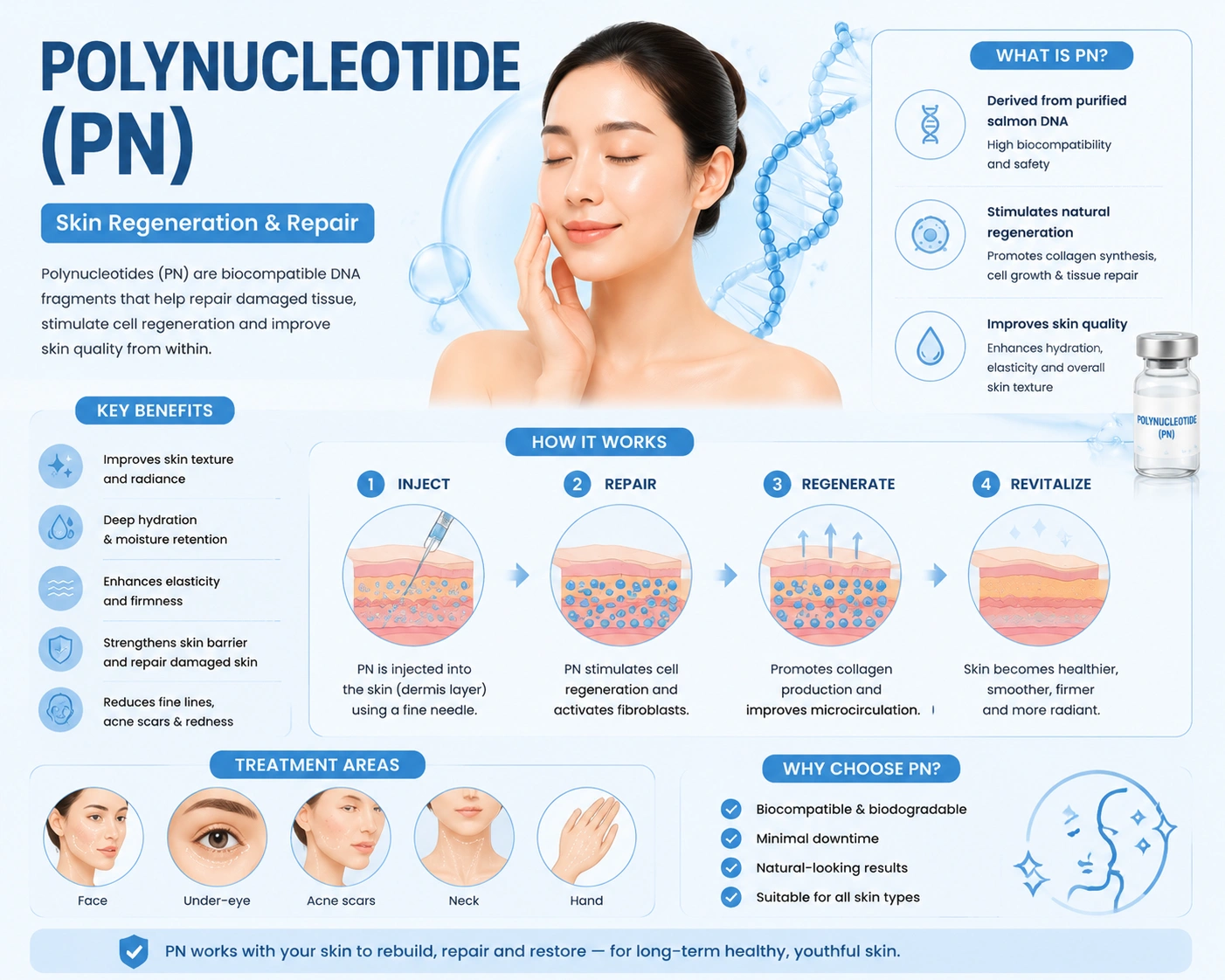
Polynucleotides (PN) represent a class of regenerative injectables designed to repair, restore, and rejuvenate the skin matrix at a fundamental cellular level. Derived from highly purified fragments of salmon DNA, polynucleotides are biopolymers composed of long-chain nucleotide monomers.
Unlike traditional aesthetic treatments that rely on mechanical volumizing or temporary hydration, PN injectables function as biostimulators. When introduced into the dermis, they actively signal cells to regenerate, offering a highly effective, bio-matched solution for tissue repair, anti-aging, and skin barrier correction.
The Biological Mechanism of Action
Polynucleotides initiate healing and rejuvenation through multiple synergistic, intracellular pathways within the dermis:
A2 Receptor Stimulation & Anti-inflammation: PN molecules bind to specific adenosine (A2A) receptors. This biological binding suppresses pro-inflammatory cytokines while boosting anti-inflammatory signals, rapidly calming chronic skin irritation and redness.
The Salvage Pathway: Cells require purines and pyrimidines to build DNA. Providing pre-cleaved PN chains allows skin cells to utilize a shortcut called the “salvage pathway.” This significantly accelerates DNA synthesis, speeding up cell division and overall structural tissue repair.
Fibroblast and Growth Factor Activation: PN stimulates fibroblasts (the architectural cells of our skin), sparking a surge in crucial growth factors. This leads to a substantial increase in type I collagen and elastin production.
Angiogenesis: The molecules promote micro-blood vessel formation (angiogenesis). Improved microcirculation means healthier, oxygenated tissue with an enhanced natural glow.
Key Benefits of Polynucleotides (PN) Skin Treatments
By rewriting the cellular environment, polynucleotide treatments deliver long-term structural changes rather than superficial patches:
Dermal Redensification: Noticeably thickens the dermal layer, rebuilding elasticity and erasing crepey, fine lines around delicate areas like the eyes and neck.
Advanced Scar Remodeling: Efficiently restructures damaged extracellular matrices, making it a gold standard for smoothing rolling or ice-pick acne scars.
Targeted Pigmentation Reduction: Calms hyperactive melanocytes (pigment-producing cells) to fade post-inflammatory hyperpigmentation (PIH) and balance uneven skin tone.
Deep Hydration: The long nucleotide chains act like tiny water magnets inside the skin matrix, sustaining long-term deep-tissue hydration.
Polynucleotides (PN) vs. Polydeoxyribonucleotide (PDRN)
While both molecules stem from salmon DNA and share regenerative roots, their molecular frameworks dictate how they behave in clinical applications:
| Feature | Polynucleotides (PN) | Polydeoxyribonucleotide (PDRN) |
| Molecular Weight & Size | Higher molecular weight; longer, more complex polymer chains. | Lower molecular weight; shorter, fragmented DNA sequences. |
| Physical Properties | Functions as a cohesive, long-lasting gel matrix. | Exists primarily as a thin, highly fluid aqueous solution. |
| Primary Clinical Focus | Long-term structural repair, dermal redensification, and anti-aging. | Rapid wound healing, acute tissue recovery, and inflammation control. |
| Dermal Longevity | Sustained presence inside the tissue, offering prolonged biostimulation. | Rapidly cleared and utilized by local tissue cells. |
Polynucleotides (PN) Treatment Protocol and Recovery Steps
A standard polynucleotide therapy follows a precise medical protocol to maximize cellular absorption and guarantee patient safety:
1.Aseptic Prep & Numbing:15 Minutes.
The skin is thoroughly sanitized. A clinical-strength topical numbing agent is applied across the treatment area to minimize discomfort.
2.Intradermal Micro-Droplet Delivery:15–20 Minutes.
Using fine, medical-grade needles or an automated mesotherapy device, the practitioner administers precise micro-droplets of the PN gel directly into the superficial-to-mid dermis.
3.Post-Injection Soothing:10 Minutes.
A cooling, sterile recovery wrap or specialized LED phototherapy is applied immediately to soothe localized erythema (redness) and ease early swelling.
4.Cellular Integration Phase:Days 1–3.
Tiny, localized bumps present at the injection sites flatten completely within 24 to 48 hours as the tissue absorbs the long nucleotide chains.
GLOJAS Specialist Clinic offers Rejuran Healer treatment in Kuala Lumpur. Polynucleotide (PN) skin booster repairs skin cells, stimulates collagen, reduces acne scars, minimizes pores, and improves elasticity and hydration. Treatment performed by certified doctors with minimal downtime.
Frequently Asked Questions (FAQs) of Polynucleotides (PN)
What makes polynucleotides different from standard hyaluronic acid fillers?
Dermal fillers use cross-linked hyaluronic acid to mechanically hold water and add physical, artificial volume to structural folds or hollows. Polynucleotides do not volumize or alter facial features; instead, they act as cellular messengers that stimulate your fibroblasts to organically produce your own new collagen, elastin, and healthy tissue.
Are polynucleotide injections safe for people with seafood allergies?
If you have a known, severe systemic anaphylactic allergy to salmon, trout, or seafood, you should avoid polynucleotide treatments. However, because the PN extraction process goes through rigorous ultra-purification to completely strip away all raw fish proteins and cellular debris, mild dietary fish sensitivities rarely cross-react. Always seek a clinical patch test if you are unsure.
How many treatments will I need before seeing a difference?
While initial hydration benefits can appear within two weeks, the true biological collagen-building process takes time. Clinical protocols generally require an initial loading phase of 3 sessions spaced 3 to 4 weeks apart. Peak therapeutic results typically solidify around 2 to 3 months after your final session.
Can polynucleotides be combined with other aesthetic treatments?
Yes, PN injectables pair excellently with other modalities. They are frequently used alongside microneedling, fractional lasers, or radiofrequency (RF) skin tightening. Injecting PN into the tissue provides cells with the raw structural materials needed to heal faster and build stronger collagen matrices in response to energy-based treatments.
What areas of the body benefit most from PN therapy?
Because PN molecules excel at restoring thin, fragile skin without causing unnatural swelling or puffiness, they are highly favored for delicate zones. The most common treatment areas include the periocular region (under-eye dark circles and hollows), the neck, the décolletage, the back of the hands, and full-face zones targeted by acne scarring.