
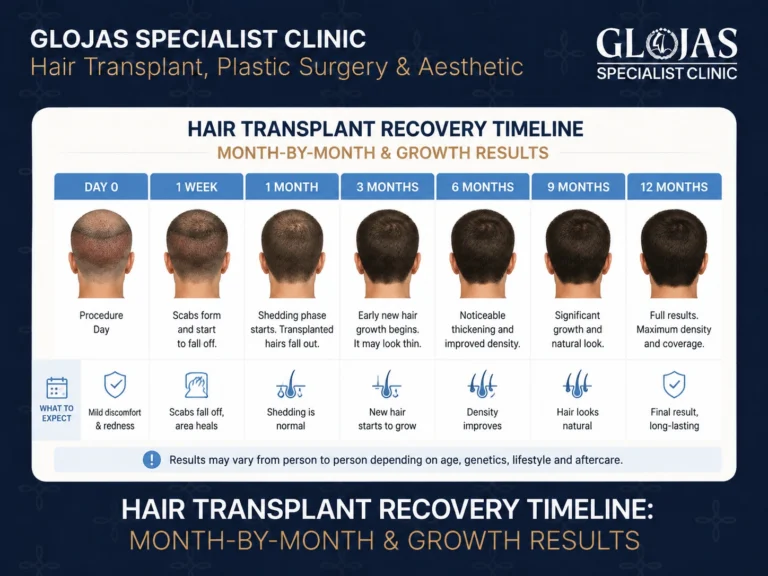
Hair transplant recovery timeline: Day 1-7 scabs form, week 2-4 scabs fall and shock loss starts, month 1-3 dormant phase, month 3-4 new growth begins, month 6 see 50-60% result, month 12 final density. FUE heals faster than FUT. Full results take 12-18 months.
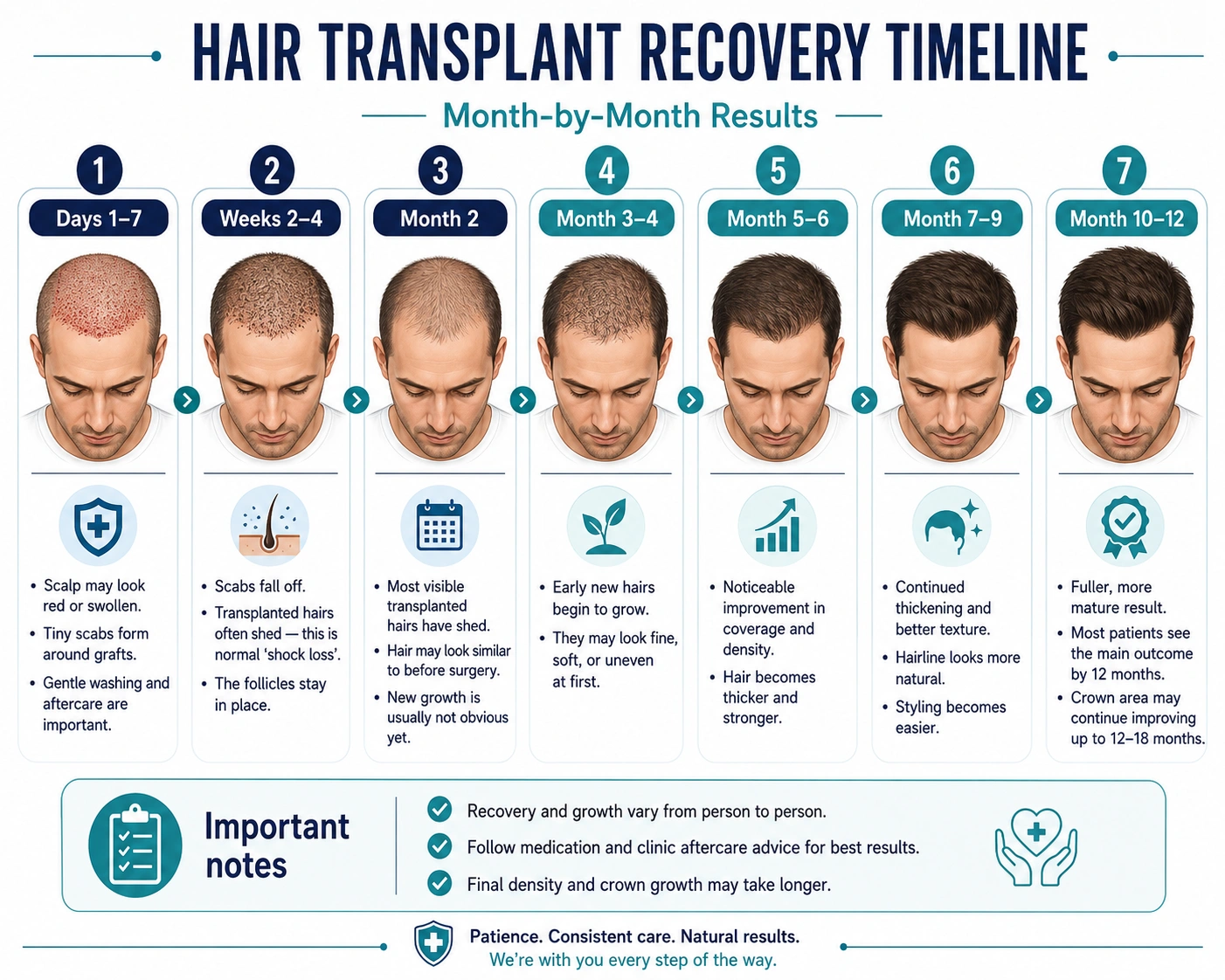
Day 1 to Day 7 Hair Transplant Recovery
Day 1-3: Scalp Tightness & Initial Healing
The scalp feels tight during these first few days. Small red dots appear where grafts were placed, and the donor area will feel sore. It is important to sleep with your head elevated at a 45-degree angle to reduce swelling. Some forehead swelling may begin to appear by day 3.
Day 4-7: Scab Formation & Itching
Tiny scabs form around each graft, and itching starts as the healing process begins. Light redness is completely normal. For FUE patients, the dot scars begin closing up. For FUT patients, stitches or staples will still be in place. Do not touch, scratch, or wash the area yet unless your clinic explicitly instructs you to do so.
Week 2 to Week 4 Hair Transplant Healing
Week 2: Initial Washing & Returning to Work
Most of the swelling is gone by this point, and you can begin to gently wash your hair. Donor area pain becomes minimal. FUE patients can typically return to non-strenuous work after 5–7 days, while FUT patients need about 10–14 days.
Week 3-4: The Shock Loss Phase
Shock loss begins during this window, meaning the transplanted hairs will start to shed. This is a normal and temporary part of the process—the follicles themselves stay safely under the skin. Your scalp will look similar to how it did pre-transplant, and numbness in the recipient area is common.
When Do Scabs Fall Off After Hair Transplant
Scabs usually dry and fall off between day 7 and day 14. Do not pick at them. Gentle washing after day 5 helps loosen them up naturally. By the end of week 2, the recipient area should be clean. If scabs remain after day 14, contact your surgeon, as forcing scabs off can accidentally dislodge the grafts.
Hair Transplant Growth Results Month-by-Month
Month 1: The Dormant Phase
Month 1 is considered the dormant phase. About 70–90% of the transplanted hairs shed due to shock loss, which can make the scalp look patchy. This is expected as the follicles are resting. The donor area is fully healed for FUE, and the FUT scar starts to fade. There is no visible new growth yet, and while redness may persist, it will continue to fade.
Month 3: Early Growth & Textural Changes
Early growth starts here, with roughly 10–20% of new hairs breaking through the skin. These new hairs are thin, wispy, and may look curly. Ingrown hairs or pimples can appear; you can use a warm compress to help soothe them. You will still look relatively bald, but progress has officially begun. Most patients in Malaysia can resume gym activities, swimming, and wear hats normally by this point.
Month 6: The Turning Point
This month brings a major visible change. You can expect to see 50–60% of your final result. The hair gets thicker and darker, and overall coverage improves—especially along the hairline and crown. You can now style and cut your hair, and friends will start noticing the difference. FUE and FUT timelines converge at this stage. If you had 3000+ grafts, the density will look decent but is not full yet.
Month 12: Final Growth Results
By month 12, about 80–90% of the final result is visible. The hair reaches its normal texture and length, and the hairline fully matures. The crown fills in last and may need until month 15–18 to finish. Final density is officially assessed between 12–18 months. You can now dye, perm, and treat it exactly like your natural hair. Most clinics in Malaysia perform their final review at the 12-month mark.
Hair Transplant Recovery Stages Explained
Shock Loss Phase After Hair Transplant
Shock loss starts between weeks 2–4 and lasts until month 2. Both transplanted and sometimes native hairs shed because the follicles enter the telogen (resting) phase from the surgical trauma. The area looks worse before it looks better, but this is not permanent. New growth will begin pushing out the old hair shafts starting from month 3.
New Hair Growth Stage Timeline
Month 3–4: Fine hairs emerge.
Month 4–6: Growth accelerates.
Month 6–9: Thickening and darkening of hair strands.
Month 9–12: Maturation phase. Each follicle grows 1–4 hairs at a growth rate of about 1 cm per month once active.
Thickening Phase Month-by-Month
Month 6–9: The hair shaft diameter increases, improving coverage monthly.
Month 9–12: Overall density boosts as more follicles activate.
Month 12–18: The final 10–20% of hairs mature, particularly in the crown area. You can use minoxidil or finasteride if prescribed to enhance this thickening.
Factors That Affect Hair Transplant Recovery Timeline
FUE vs FUT Recovery Timeline Differences
| Factor | FUE | FUT |
| Donor healing | 7–10 days, dot scars | 14–21 days, linear scar |
| Pain level | Mild, paracetamol enough | Moderate, may need stronger meds |
| Return to work | 3–7 days desk job | 10–14 days |
| Exercise | 14 days light, 1 month gym | 1 month light, 6 weeks gym |
| Growth timeline | Same after month 3 | Same after month 3 |
How Graft Number Impacts Growth Results
1000–2000 grafts: Targeted at the hairline or a small area. This results in a faster visible change by month 6.
3000–4000 grafts: Spans from the mid-scalp to the crown. This needs a full 12 months for comprehensive coverage.
5000+ grafts: Classed as a mega session. The crown area may take up to 18 months to fully mature. A higher graft count means more initial redness and a longer shock loss period, but the final density will be better.
Aftercare And Hair Transplant Healing Speed
Good aftercare equals faster healing. Key practices include: no smoking, keeping diabetes controlled, sleeping elevated, following the specific wash protocol, and avoiding direct sun exposure. Adjuvant treatments like PRP, low-level laser, and prescribed minoxidil can speed up growth by 1–2 months. Conversely, poor aftercare can cause infection, a poor graft yield, and prolonged redness.
Hair Transplant Recovery Tips For Best Results
What To Avoid During Hair Transplant Recovery
Week 1: Absolutely no touching, scratching, alcohol, smoking, aspirin, heavy lifting, direct sun, or sweating.
Month 1: No swimming, saunas, steam rooms, or hats that rub against the grafts.
Month 3: Avoid hair dyes and harsh chemical treatments.
Long-term: Avoid smoking entirely, as it can reduce graft survival rates by up to 30%.
When Can I Exercise After Hair Transplant
Day 1–7: Walking only.
Day 8–14: Light cardio is permitted, ensuring there is no sweating on the scalp.
Week 3–4: Jogging and cycling are allowed. No weightlifting yet.
After 1 month: Gym workouts, weights, and contact sports (with a helmet once cleared by your surgeon) are allowed. FUE patients can typically return to strenuous exercise faster than FUT patients due to zero risk of stretching a linear scar.
Hair Wash Timeline After Transplant
Day 1–2: No washing allowed at all.
Day 3–5: The first wash should take place at the clinic or at home using the cup-pour method with baby shampoo and absolutely no direct water pressure.
Day 6–14: Daily gentle washing to safely remove scabs. Always pat dry.
After 2 weeks: Normal shampooing and gentle scalp massaging are okay.
After 1 month: Hair salon washes are allowed. Always avoid strong water jets on the grafts for the first 10 days.
Hair Transplant Recovery Timeline FAQs
Is Hair Transplant Recovery Painful?
During days 1–3, expect mild to moderate soreness, typically rated around a 3/10 on the pain scale. This is easily controlled with paracetamol. The donor area generally hurts more than the recipient area, and FUT causes more discomfort than FUE. After day 5, most patients stop taking painkillers completely. Itching becomes much more common than pain during week 2.
When Can I Return To Work After Hair Transplant?
Desk job / WFH: 3–5 days for FUE if no swelling is visible. 7–10 days for FUT.
Outdoor work / Sales: 10–14 days to properly avoid sun exposure and dust.
Heavy labor: 2–4 weeks. Most Malaysian clinics will provide a Medical Certificate (MC) for 3–7 days. You can wear a loose cap after day 7 if you must go out.
How Long Until Hair Transplant Looks Natural?
Month 1–2: The transplant is obvious due to redness and shedding.
Month 3–4: The area will still look patchy.
Month 6: The hair looks natural to others, though you may still see thin spots yourself.
Month 9–12: The hair becomes completely indistinguishable from your native hair. The hairline softens and the crown blends seamlessly. If needed, you can use hair fibers temporarily between months 4–8 to mask the transition.