
Quick answer: A hair transplant in Singapore typically costs S$3 to S$12 per graft. Most patients pay about S$8,000 to S$12,000 for 2,000 grafts, and the final price depends on the technique, the graft count and the surgeon. In Malaysia, similar FUE work usually costs about RM6 to RM12 per graft.
Hair transplant pricing looks simple at first, because almost every clinic quotes a price per graft. However, the total bill changes a lot with the number of grafts, the method and the clinic. This guide explains what Singapore clinics charge, what is usually left out of a quote, and how the cost compares with Malaysia. Consequently, you can compare quotes on equal terms before you commit.
How much does a hair transplant cost in Singapore?
Singapore clinics charge mainly per graft, because the number of grafts decides how long the surgery takes. A graft is a natural group of one to four hairs. The total therefore depends on how many grafts you need. In addition, a larger session often earns a lower rate per graft.
However, published rates vary widely. Some clinics advertise promotional rates near S$3 to S$4 per graft for large, fully shaved sessions. Meanwhile, others list S$5 to S$10 for manual FUE, and robotic systems reach the top of the range. Therefore, the headline rate alone tells you very little. Always ask for the full quote for your own graft count.
Hair transplant cost by graft count in Singapore
The number of grafts is the biggest cost driver because every graft needs time and skill. It depends on how much hair you have lost, and surgeons often estimate it with the Norwood scale. Our guide to the Norwood scale shows each stage, and the hair graft calculator gives a rough graft estimate.
| Grafts | Typical area treated | Typical Singapore cost |
|---|---|---|
| 1,000 | Hairline touch-up, small temples | S$5,000 – S$8,000 |
| 2,000 | Receding hairline, front third | S$8,000 – S$12,000 |
| 3,000 | Hairline plus mid-scalp | S$12,000 – S$20,000 |
| 4,000 – 5,000 | Large area or crown | S$18,000 – S$30,000+ |
For instance, a man at Norwood stage 3 often needs about 1,500 to 2,500 grafts. As a result, his total usually lands in the S$8,000 to S$15,000 band.
Cost by technique: FUE, FUT, DHI and robotic
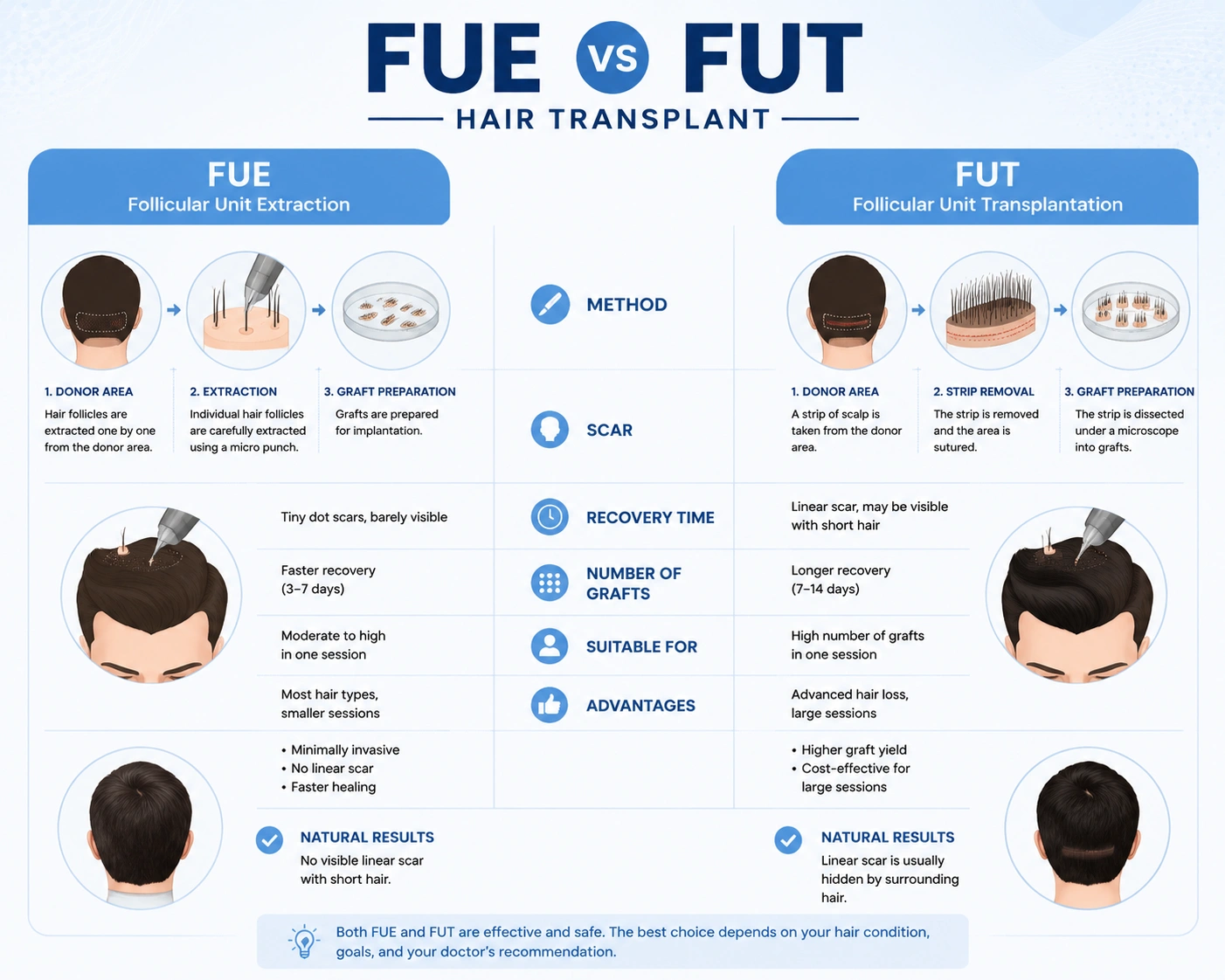
Besides graft count, the harvesting and placement method also changes the price. Our full comparison of FUE vs FUT explains the medical differences. This section covers cost only. For the clinical comparison, a 2020 Dermatologic Surgery review found both methods produce high-quality grafts.
| Technique | Typical cost per graft in Singapore | What to know |
|---|---|---|
| Manual FUE | S$4 – S$10 | Most common method, no linear scar, fast recovery |
| FUT (strip) | S$3 – S$8 | Lower cost per graft, leaves a linear scar |
| DHI (implanter pen) | S$6 – S$12 | Similar to FUE, pricing varies by clinic |
| Robotic FUE (ARTAS) | S$8 – S$14 | Premium technology, often double manual FUE |
Robotic does not automatically mean better. In fact, a skilled surgeon using manual FUE can match robotic results, and the surgeon’s design still decides the hairline. Similarly, ISHRS notes that marketing labels such as “Sapphire FUE” or “Gold FUE” are not recognised terms, so do not pay extra for a brand name alone.
What is usually not in the quote
Unfortunately, a low per-graft rate can hide extra charges. Ask whether any quote includes the items below:
- Consultation fee. Some clinics charge for it. Others deduct it from the surgery bill.
- Medication and aftercare. Painkillers, antibiotics and medicated shampoo can add a few hundred dollars.
- GST. Singapore GST is currently 9%, and some clinics quote prices excluding GST.
- PRP or add-on treatments. These are optional, but they are sometimes bundled into packages.
- Review visits. Ask how many follow-ups are included, and for how long.
- Minimum graft count. The lowest advertised rate often applies only above a minimum, such as 1,500 grafts.
Why does a hair transplant cost more in Singapore?
In short, several factors push prices up. Clinic rent and staff costs are high. Surgeon experience also matters, because an experienced surgeon designs a natural hairline and protects the donor area. In addition, regulation raises the standard: the Singapore Medical Council sets Guidelines on Aesthetic Practices for Doctors, which list the procedures doctors may perform and the training they need, and the Ministry of Health audits clinics against them.
However, price and quality are not the same thing. Moreover, a high transection rate means you pay for grafts that never grow, so cost per graft alone can mislead you. Therefore, ask each clinic for its graft survival and transection figures, and ask to see before-and-after photos of real patients.
Hair transplant cost: Singapore vs Malaysia
Many Singapore patients compare local quotes with clinics in Kuala Lumpur, which is about an hour away by air. Based on the ranges published on our own pages, Malaysian pricing is lower per graft.
| Singapore | Malaysia (Kuala Lumpur) | |
|---|---|---|
| Typical price per graft | S$3 – S$12 | RM6 – RM12 |
| Typical 2,000-graft FUE | S$8,000 – S$12,000 | RM8,000 – RM15,000 |
| 2,000 to 3,000 grafts | S$8,000 – S$20,000 | RM10,000 – RM20,000 |
| Currency | SGD | MYR (check today’s exchange rate) |
| Extra costs | None | Flights, hotel, time off work |
Please convert the Malaysian figures at today’s exchange rate for a fair comparison. Even so, the saving is usually larger on bigger sessions, where the per-graft rate drops further.
That said, travel changes the maths, because you need a flight, a hotel and a few days away. Likewise, you will want follow-up visits. Alternatively, many patients plan the surgery day, a short stay and a review visit within one trip, and book follow-up check-ups by video call and photos. Our guide to how to choose the right hair transplant clinic lists what to check about any clinic, wherever it is.
If you are also weighing Turkey, read hair transplant cost in Turkey and Turkey vs Malaysia. Cheap upfront prices can disappear after you add flights, hotels and the cost of fixing a poor result.
Is a cheaper hair transplant worth it?
Not always. The International Society of Hair Restoration Surgery (ISHRS) warns that some low-cost clinics leave patients with problems they never expected. For example, unskilled teams can overharvest the donor area or place the hairline unnaturally. Consequently, a repair can cost more than the original surgery. Our article on whether a cheap hair transplant is worth the risk covers the warning signs, and failed hair transplant repair explains how revisions work.
How to compare hair transplant quotes
Use the same checklist for every clinic:
- Who performs the surgery? Ask who designs the hairline and who makes the incisions. A doctor should do both.
- Check the doctor’s credentials. In Singapore, search the doctor’s registration with the Singapore Medical Council. In Malaysia, check the Malaysian Medical Council registration. For hair restoration specialists, you can also look up the ISHRS and ABHRS websites.
- Ask for the graft count in writing. The count should match your Norwood stage and donor supply.
- Ask about graft survival. Request figures, not slogans. Our page on hair transplant success rates shows what realistic numbers look like.
- Ask what happens if growth is poor. Find out whether a touch-up session is covered.
- See real results. Look at before-and-after photos with dates, such as our hair transplant results in Malaysia.
Recovery and results timeline
Cost is only part of the decision. It helps to know what you are paying for. Most patients return to desk work within about one to two weeks. In the first month the transplanted hairs shed, which is normal, and new growth starts at around three to four months. Finally, final density usually shows at about 12 months. Our recovery timeline and shedding timeline explain each stage.
Transplanted hair is generally permanent because it comes from the donor area, which resists hair loss. Nevertheless, native hair around the grafts can still thin. For this reason, many surgeons suggest medication alongside surgery. Read are hair transplants permanent? for the long-term picture.
Cheaper alternatives to surgery
Fortunately, surgery is not the only option. For early thinning, medication and PRP cost far less per month. For instance, compare finasteride, minoxidil and PRP hair treatment cost. Our article on hair transplant vs PRP helps you choose. Likewise, scalp micropigmentation vs hair transplant suits some patients who want a shaved look.
Why Singapore patients choose GLOJAS in Kuala Lumpur
GLOJAS Specialist Clinic offers FUE hair transplantation in Kuala Lumpur under Prof. Dato’ Dr. JasG, who has more than 30 years of experience. You can read the full procedure, pricing approach and candidacy details on our FUE hair transplant page. In addition, our hair transplant cost guide for Malaysia breaks down local pricing by hair loss stage.
If you would like a quote, send clear photos of your hairline, crown and donor area. Our team can estimate your graft range remotely. Contact GLOJAS to book a consultation.
Frequently asked questions
How much does a hair transplant cost in Singapore?
Singapore clinics typically charge S$3 to S$12 per graft. For most patients, 2,000 grafts costs about S$8,000 to S$12,000, although promotional offers can start lower.
What is the cost per graft for a hair transplant in Singapore?
Manual FUE usually costs about S$4 to S$10 per graft, FUT about S$3 to S$8, and robotic (ARTAS) FUE about S$8 to S$14. Larger sessions often earn a lower rate per graft because the surgeon can plan one long session.
How many grafts do I need?
It depends on the extent of hair loss. For example, a receding hairline often needs 1,500 to 2,500 grafts, while advanced baldness can need 4,000 or more. A surgeon confirms the number at your consultation.
Is a hair transplant cheaper in Malaysia than in Singapore?
Per graft, yes. Malaysian FUE usually costs about RM6 to RM12 per graft, and the saving is usually larger on bigger sessions. However, you should add flights, accommodation and time off work to the comparison.
Does the quoted price include GST?
Not always. Singapore GST is currently 9%, and some clinics quote excluding GST. Ask for the final price in writing.
Is robotic hair transplant worth the extra cost?
Not necessarily. Robotic systems help with graft harvesting, but the surgeon still designs the hairline and plants the grafts. In fact, many patients get excellent results with manual FUE at a lower price.
Is a hair transplant permanent?
Transplanted hair is generally permanent because it comes from the donor area, which resists DHT. Nonetheless, existing native hair can keep thinning, so some patients continue medication.
How long is recovery after a hair transplant?
Most people return to desk work in about one to two weeks. New growth starts at around three to four months, and final density shows at about 12 months.
Can I claim a hair transplant on insurance or MediSave in Singapore?
Hair transplants are usually cosmetic. Insurers and MediSave typically do not cover them, but please check your own policy with your insurer.
How do I avoid a bad hair transplant?
Check the surgeon’s registration, ask who performs each step, request graft survival data, and see real before-and-after photos. Above all, do not choose a clinic on price alone.