
An FUE hair transplant is a minimally invasive hair restoration procedure where individual hair follicles are extracted from a donor area (usually the back of the head) and transplanted into thinning or bald areas. It offers a permanent, natural-looking solution to hair loss with minimal scarring and a quick recovery.
TL;DR: Quick Takeaways
The Cost: Typically ranges from RM8,000 to RM30,000, heavily depending on the number of grafts needed and the surgeon’s expertise.
The Results: Highly successful (over 90% graft survival rate) and permanent, though full results take 6 to 12 months to materialize.
The Edge: Unlike older methods, FUE leaves tiny, virtually invisible dot scars instead of a linear scar, leading to a much faster, less painful recovery.
What is an FUE Hair Transplant?
Follicular Unit Extraction (FUE) has become the gold standard in hair restoration. Unlike traditional methods that require removing a large strip of scalp, FUE is a meticulous, micro-surgical technique that treats each hair follicle as an individual unit.
How the Follicular Unit Extraction Technique Works
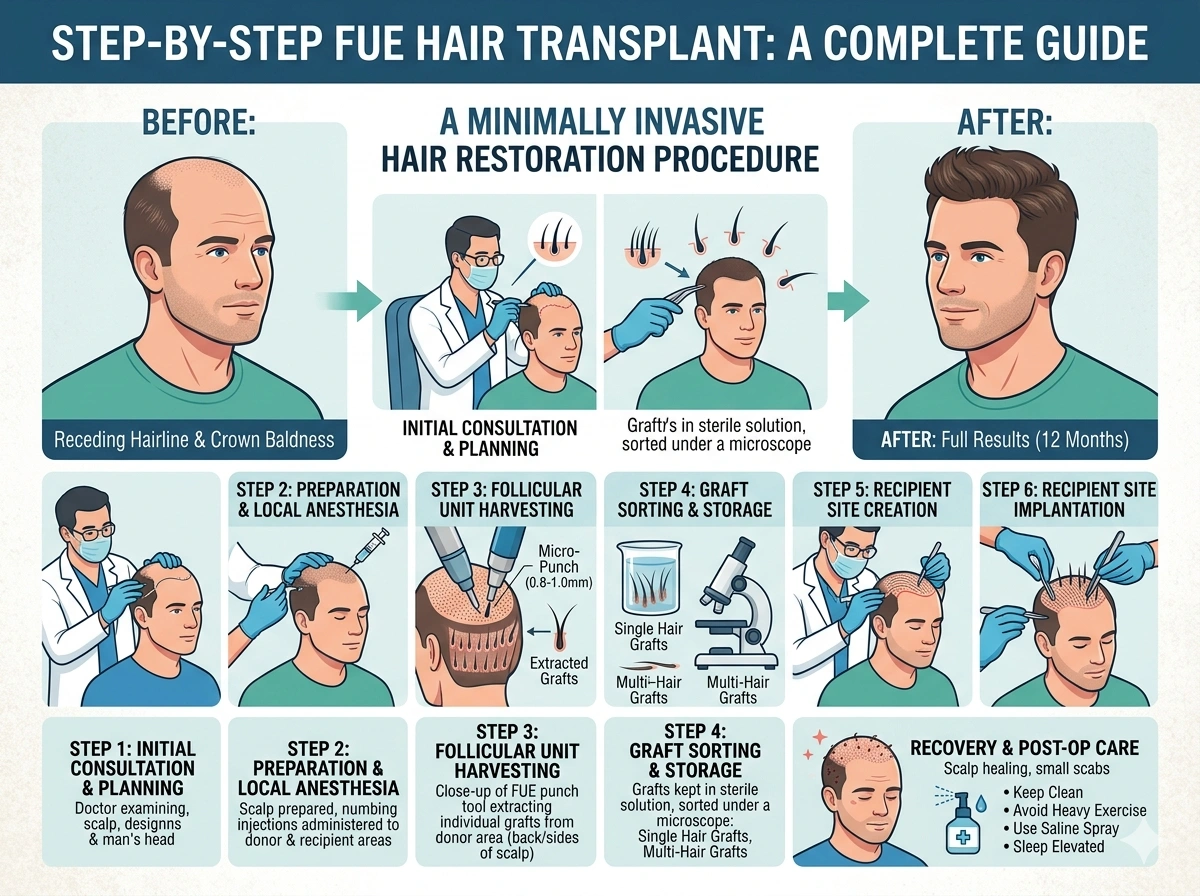
The procedure is performed under local anesthesia and generally follows four main steps:
Preparation: The donor area is shaved and numbed.
Extraction: The surgeon uses a specialized micro-punch tool (usually 0.7mm to 1.0mm in diameter, often upgraded with advanced Sapphire FUE blades for finer incisions) to make tiny circular incisions around individual follicular units (groups of 1–4 hairs) and gently removes them.
Site Creation: The surgeon creates microscopic recipient sites in the thinning areas, carefully angling them to match your natural hair growth pattern.
Implantation: The harvested grafts are precisely placed into these microscopic sites.
FUE vs. FUT: Which Hair Restoration Method is Best for You?
When researching hair transplants, you will inevitably compare FUE with FUT (Follicular Unit Transplantation), often called the “strip method,” or newer variations like DHI (Direct Hair Implantation).
| Feature | FUE (Follicular Unit Extraction) | FUT (Follicular Unit Transplantation) | DHI (Direct Hair Implantation) |
| Scarring | Tiny, scattered dot scars (easily hidden by short hair) | A single, linear scar across the back of the head | Tiny dot scars (similar to FUE) |
| Recovery Time | Fast (usually 3 to 7 days) | Longer (10 to 14 days; requires suture removal) | Very fast (minimal downtime) |
| Implantation Tool | Manual forceps/micro-blades | Manual forceps into pre-cut slits | Specialized Choi Implanter Pen |
| Average Cost (MYR) | RM6 to RM12 per graft | RM5 to RM10 per graft | RM12 to RM18 per graft |
The Benefits of Choosing an FUE Transplant
Natural-Looking Results and Minimal Scarring
Because hairs are implanted individually following the exact angle, direction, and density of your existing hair, the results are virtually indistinguishable from your natural hair. Furthermore, because it does not involve scalpel strips or stitches, you won’t have to worry about a visible linear scar—allowing you to wear your hair very short if you choose.
Quick Recovery Time and Less Post-Op Discomfort
Most patients report feeling minimal pain during and after the procedure. Because the puncture wounds are so small, they heal within just a few days. Many individuals return to light work and daily routines within 48 to 72 hours, experiencing far less post-op discomfort than with a strip transplant.
How Much Does an FUE Hair Transplant Cost?
The cost of an FUE hair transplant in Malaysia is rarely a flat rate. On average, you can expect to pay anywhere from RM8,000 to RM30,000. Most clinics price the procedure using a pay-per-graft model, typically ranging from RM6 to RM12 per graft.
Key Factors That Influence Your Total Price
Number of Grafts Needed: Minor hairline touch-ups (1,000 grafts) will cost significantly less than extensive crown restoration (3,000+ grafts).
Surgeon’s Experience: Highly sought-after, board-certified hair restoration specialists or members of ABHRS (American Board of Hair Restoration Surgery) command higher fees but offer lower graft failure rates.
Geographic Location & Clinic Reputation: Top-tier clinics in major metropolitan hubs like Kuala Lumpur, Petaling Jaya (Selangor), or Johor Bahru feature premium pricing but provide advanced medical tech.
Bundled Package Deals: Premium packages often include PRP (Platelet-Rich Plasma) therapy, post-op medications, specialized shampoos, and follow-up care, which can increase upfront costs but offer better long-term value.
Financing: Many clinics offer 0% interest installment plans through major Malaysian banks (like Maybank or CIMB) to make the upfront cost more manageable.
What to Expect: The FUE Recovery Timeline
Patience is key. Hair restoration is a journey, and understanding the timeline helps prevent unnecessary anxiety.
First 7 Days: Immediate Post-Op Care
During the first few days, minor swelling around the forehead and tiny scabs around the graft sites are completely normal. You must wash your scalp gently using a specialized technique provided by your clinic and avoid touching, scratching, or rubbing the newly implanted grafts.
1 to 3 Months: The “Shock Loss” Phase
Do not panic if your newly transplanted hair starts falling out around week 3 to 4. This is a normal condition called shock loss. The hair shafts shed, but the underlying hair root remains alive and enters a temporary resting phase before generating new hair.
6 to 12 Months: Seeing Your Final Results
By month 6, you will notice fine, new hairs sprouting. Between months 9 and 12, these hairs thicken, mature, and blend seamlessly with your surrounding hair, revealing the final, dense transformation.
FUE Hair Transplant Side Effects and Risks
While FUE is an incredibly safe, minimally invasive surgical procedure, it carries minor potential side effects:
Temporary swelling and bruising around the forehead or eyes.
Mild itching, tightness, or temporary numbness as the nerves in the scalp heal.
Folliculitis (minor inflammation or pimple-like bumps) as new hair shafts break through the skin.
Bleeding or minor infection (rare, usually minimized by proper donor area hygiene).
Risk of transection (accidental damage to the hair bulb during extraction), which is minimized by choosing an experienced surgeon rather than a budget clinic.
Frequently Asked Questions About FUE
Is an FUE hair transplant permanent?
Yes. The hair follicles harvested from the donor area (back and sides of the head) are genetically resistant to the hormone DHT (dihydrotestosterone), which causes male pattern baldness. Once transplanted, they retain this resistance, meaning they will continue to grow for a lifetime.
How many grafts will I need?
This depends entirely on your stage of hair loss (measured on the Norwood Scale). Generally, a receding hairline or minor temple touch-up requires 1,000 to 1,500 grafts (RM8,000 – RM15,000), moderate frontal balding requires 2,000 grafts (RM12,000 – RM22,000), while advanced thinning or crown area restoration can require 3,000 to 4,000+ grafts (RM18,000 – RM30,000+). A personal scalp assessment and consultation with a specialist is required to get an accurate estimate.
Are You a Good Candidate for FUE Hair Restoration?
FUE is an excellent option for many, but it isn’t for everyone. You are likely an ideal candidate if:
You have a sufficient supply of healthy donor hair on the back or sides of your head.
Your hair loss has stabilized (younger patients experiencing early male pattern baldness may be advised to stabilize hair fall using medical treatments like Minoxidil or Finasteride first).
You want to fix localized areas like a receding hairline, a thinning crown, or even sparse areas in eyebrows and beards.
You prefer wearing short hairstyles and want to avoid a linear scar.
You are in good overall health and have realistic expectations about what a transplant can achieve.
Notes from doctors:
“Think of an FUE Hair Transplant like neatly replanting paddy fields. We gently harvest healthy roots from the dense area at the back of your head and precisely relocate them to the front where things are thinning out. It’s a delicate, micro-surgical process done under local anesthesia. There’s no linear cutting, minimal downtime, and the best part? The results are permanent and look entirely natural.” – Professor Dato’ Dr. JasG, ABHRS-Certified Hair Transplant Doctor in Malaysia