
What Are Small Breasts?
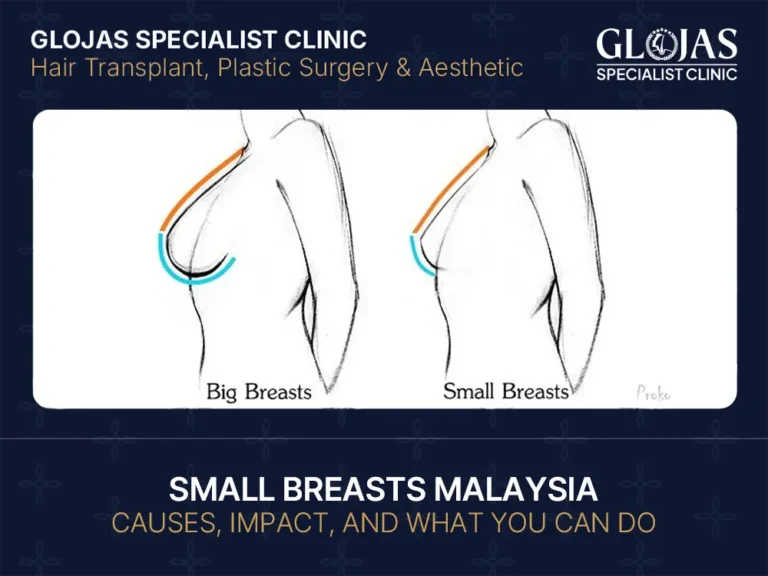
Small breasts, medically referred to as micromastia or hypomastia, describe a condition where there is a lack of breast tissue volume relative to a person’s chest wall and body frame. In many cases, this is purely an aesthetic preference rather than a medical pathology, but for some, it can be a source of significant self-consciousness.
Breast Size Variation and Normal Anatomy
The human breast is composed primarily of fatty (adipose) tissue and glandular tissue (lobules and ducts) supported by the Cooper’s ligaments.
“Normal” anatomy varies wildly; some women have a higher ratio of dense glandular tissue, while others have more soft fat, which determines how the breasts feel and sit.
In Malaysia, the average cup size typically falls around an A or B cup, which is perfectly normal for the smaller skeletal frames common in the region.
Size can also be influenced by the width of the chest wall—the broader the chest, the smaller a specific volume of tissue may appear.
How Breast Size Differs Among Women
Individual size is determined by the number of estrogen receptors in the breast tissue during the developmental years of puberty.
Fluctuations in weight significantly impact size, as the fat cells in the breast are often the first to shrink during weight loss.
Hormonal cycles play a role; many women notice their breasts feel “fuller” or tender just before menstruation due to fluid retention.
Age-related changes, such as the drop in estrogen during menopause, can cause the glandular tissue to shrink, making the breasts look smaller or deflated.
Causes of Small Breasts
Genetics and Hormonal Factors
Genetic heritage is the most influential factor; if your mother or sisters have smaller breasts, you are biologically programmed to likely follow suit.
Estrogen and progesterone are the “engineers” of breast growth; a lack of these hormones during puberty can result in less development.
In rare medical cases, conditions like Turner Syndrome or certain adrenal disorders can inhibit full breast development.
Thyroid imbalances, such as hypothyroidism, can sometimes delay puberty and affect how much breast tissue grows during the teen years.
Body Fat Percentage and Nutrition
Since breasts are largely made of fat, women with a very low Body Mass Index (BMI) or high muscle mass (like athletes) typically have smaller breasts.
Severe nutritional deficiencies during the critical growth years of 12 to 18 can stunt the development of secondary sexual characteristics.
Rapid weight loss often leads to “breast involution,” where the fat cells disappear, leaving behind loose skin and less volume.
Interestingly, hormonal imbalances caused by diet can also play a minor role in how fat is distributed across the body.
Developmental Factors
Early exposure to certain environmental toxins or medications can sometimes interfere with the endocrine system during puberty.
Physical trauma to the chest area or chest wall surgery during childhood can occasionally hinder the symmetry or growth of the breast buds.
Congenital conditions like Poland Syndrome can lead to the underdevelopment or total absence of a breast on one side of the body.
Most women find their breasts continue to change until their early 20s, as final fat deposition concludes.
Can Small Breasts Be Increased?
Natural Limitations of Breast Growth
While exercises like chest presses and push-ups can strengthen the pectoral muscles, they do not actually increase the glandular or fatty volume of the breast itself.
Over-the-counter “enlargement creams” or herbal supplements often lack clinical evidence and are not recommended by the National Pharmaceutical Regulatory Agency (NPRA).
Weight gain can increase size, but you cannot “spot-gain” fat specifically in the breasts; it will distribute according to your genetic pattern.
Temporary increases occur during pregnancy and breastfeeding, though the breasts often return to a smaller size once nursing ends.
Medical Breast Enlargement Options
Modern aesthetic medicine in Malaysia offers safe, long-term solutions that provide predictable and measurable increases in volume.
Breast Augmentation Surgery remains the gold standard for those wanting a significant jump in cup size (e.g., from an A to a C cup).
Fat Transfer (Autologous Fat Grafting) is a popular “natural” alternative that uses your own body fat to enhance the breasts.
Injectable fillers for the breast are generally discouraged by major medical boards due to the risk of complications and interference with mammogram screenings.
Treatment Options for Small Breasts in Malaysia
Breast Augmentation Surgery
This procedure involves placing high-quality silicone or saline implants either over or under the pectoral muscle.
In Malaysia, surgeons use NPRA-approved implant brands like Motiva or Mentor to ensure patient safety and longevity.
It is the most effective way to address severe volume loss or cases where a patient desires a very specific, rounder shape.
The surgery is typically performed under general anesthesia and requires a few weeks of recovery for the implants to “settle.”
Fat Transfer Breast Enlargement
This “2-in-1” procedure involves performing liposuction on areas like the thighs or abdomen and processing that fat to be injected into the breasts.
It is ideal for women looking for a subtle 0.5 to 1 cup size increase with a completely natural feel.
Because it uses your own tissue, there is no risk of implant rupture or capsular contracture (scar tissue hardening).
A portion of the transferred fat (about 30-40%) may be reabsorbed by the body, so surgeons often slightly “over-fill” during the session.
Breast Augmentation for Small Breasts
Implant Types and Selection
Silicone Gummy Bear Implants: These are the most popular in Malaysia as they maintain their shape and have a natural, soft feel.
Round vs. Teardrop: Round implants provide more “upper pole” fullness (push-up look), while teardrop (anatomical) shapes mimic the natural slope of a breast.
Texture Options: Smooth implants move more naturally within the breast pocket, while textured ones are designed to stay firmly in place.
Your surgeon will use 3D imaging technology to show you how different sizes will look on your specific frame before you commit.
Surgical Procedure Overview
The procedure usually takes 1.5 to 3 hours and involves a small incision—most commonly in the fold under the breast (inframammary) to hide scars.
The “dual-plane” technique is often used, where the top half of the implant is under the muscle for a natural transition and the bottom is under the gland.
Post-surgery, you will wear a specialized surgical bra for 4 to 6 weeks to support the new weight and minimize swelling.
Most Malaysian clinics provide comprehensive aftercare, including scar management gels and follow-up ultrasounds to monitor the implants.
Fat Transfer Breast Enlargement
How Fat Transfer Works
The fat is harvested using gentle “water-jet” or manual liposuction to keep the fat cells alive and healthy.
The harvested fat is then centrifuged to separate pure fat cells from oil, blood, and local anesthetic fluids.
Using a fine cannula, the doctor “threads” the fat into the breast tissue in tiny droplets to ensure each cell has a blood supply to survive.
This natural breast enlargement technique leaves virtually no scarring on the breasts, only tiny dots where the fat was harvested.
Suitable Candidates and Limitations
You must have enough “donor fat” in other areas; very thin women may not have enough fat to achieve a noticeable result.
It is not suitable for those wanting a dramatic change (e.g., jumping 3 cup sizes), as there is a limit to how much fat the breast skin can hold at once.
Candidates should have stable weight and realistic expectations regarding the softening and settling of the fat over the first 3 months.
Women with a high risk of breast cancer should discuss this with their oncologist, though current studies show no link between fat transfer and cancer risk.
Results and Expectations
Natural Appearance Outcomes
Modern techniques in 2026 prioritize a “natural-looking” result where the transition from the chest to the breast is smooth and gradual.
With fat transfer, the results are permanent (once the fat has survived the first 3 months) and the breasts will age, sag, and change weight naturally with you.
Implant technology has advanced so that “rippling” or visible edges are now extremely rare, even in very petite women.
The goal of breast augmentation is to enhance your existing silhouette, not just to make the breasts as large as possible.
Timeline for Final Results
1 Week: Initial swelling and bruising are present; movement is slightly restricted.
1 Month: Most swelling has subsided, and you can return to light exercise.
3-6 Months: This is the “drop and fluff” period where implants settle into their final position and fat transfer results stabilize.
1 Year: Scars have usually faded to thin, pale lines, and the breasts feel fully integrated into your body.
Cost of Breast Enlargement in Malaysia
Price Comparison Table
| Procedure Type | Price Range (RM) | Best For |
| Breast Augmentation (Implants) | RM 15,000 – RM 30,000 | 2+ Cup Size Increase |
| Fat Transfer Enlargement | RM 18,000 – RM 35,000 | Natural 1 Cup Increase + Liposuction |
| Hybrid (Implant + Fat) | RM 25,000 – RM 45,000 | Lean Women wanting high volume |
Factors Affecting Price
Implant Brand: Premium brands like Motiva (especially the Ergonomix line) tend to be on the higher end due to advanced safety sensors and materials.
Surgeon Experience: Board-certified plastic surgeons with extensive portfolios often have higher professional fees but offer greater safety.
Facility Fees: Procedures in major private hospitals in Kuala Lumpur generally cost more than those in boutique ambulatory care centers.
Anesthesia: The cost includes the presence of a specialist anesthesiologist to monitor your safety throughout the surgery.
Small Breasts FAQs
Is it normal to have small breasts?
Absolutely. Breast size is a secondary sexual characteristic that varies based on genetics, BMI, and ethnicity. In Malaysia, many women naturally have smaller frames and proportionally smaller breasts, which is completely healthy.
Can small breasts be increased?
Yes, while natural methods like exercise only improve the underlying muscle, medical treatments like breast implants or fat transfer can measurably and permanently increase the volume of the breast tissue.
What is the best treatment for small breasts?
It depends on your goals. If you want a significant increase in size and a specific shape, implants are best. If you prefer a 100% natural feel and want to slim down another area of your body simultaneously, fat transfer is the ideal choice.
Is breast augmentation safe?
When performed by a qualified surgeon using NPRA-approved materials, breast augmentation is very safe. Modern implants are designed to be durable, with a very low risk of rupture or complications like BIA-ALCL.
Does breast size affect breastfeeding?
No. Breast size is determined by fatty tissue, while breastfeeding relies on glandular tissue. Women with small breasts can typically produce just as much milk as those with larger breasts, provided there are no underlying medical issues.