- Glomac Galeria Hartamas, Kuala Lumpur
- +60123426370
- info@glojasaesthetic.com
Subcision is a non-surgical treatment that fixes deep, pitted acne scars by breaking the tight tissue bands pulling your skin downward. A doctor inserts a tiny needle beneath the scar, moving it to cut these bands. This releases the pull, allowing your skin to lift and smooth out naturally.
At GLOJAS Specialist Clinic, our LCP-certified doctors specialize in advanced subcision, laser, and microneedling therapies tailored for Asian skin. We prioritize your comfort and safety, delivering visible, permanent results with very little downtime. Contact GLOJAS today to schedule your expert consultation for smooth, confident skin.
Subcision is a minimally invasive, in-clinic surgical procedure used to treat depressed skin scars and wrinkles. By using a specialized medical needle or cannula inserted under the skin surface, it cuts the fibrous bands that pull the skin downward, allowing the skin to lift and flatten.
Subcision is highly effective for scars that are bound down to deeper tissues. By untethering these bands, the body triggers a natural healing response that fills the underlying space with new collagen.
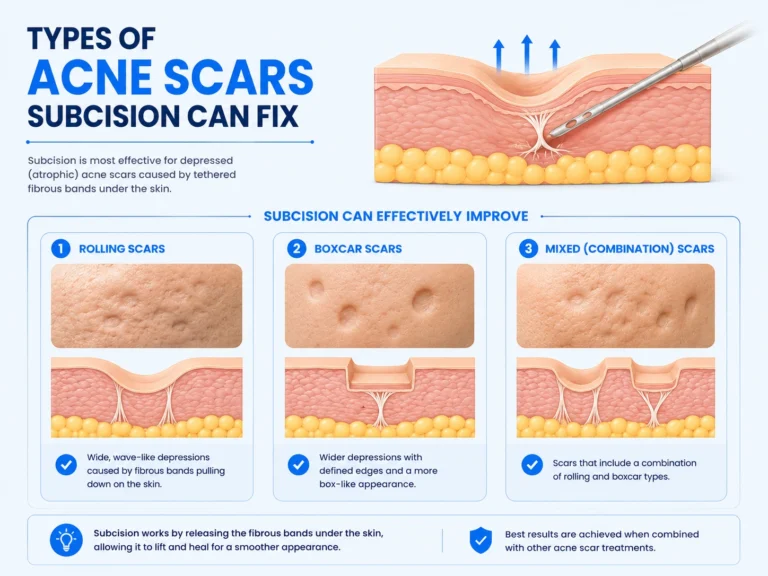
Depressed acne scars, particularly rolling scars, are often caused by bands of fibrous tissue that form during the inflammation and healing phase of severe acne.
The Problem: These fibrous bands attach the surface skin layer (epidermis) to the deeper subcutaneous tissue, acting like an anchor that pulls the skin downward and creates a pitted, wavy appearance.
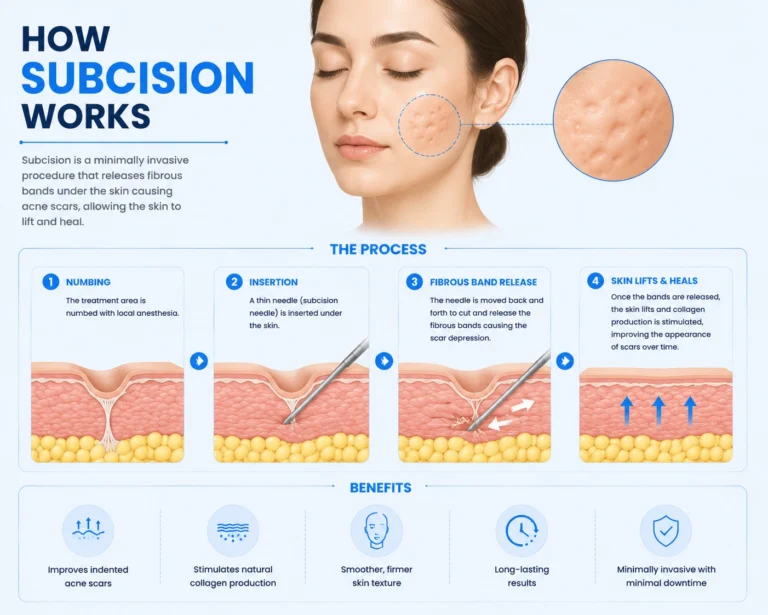
The Release: During subcision, a practitioner moves a needle horizontally underneath the scar plane. This mechanical action severs the tight strands.
The Lift: Once released, the skin immediately springs upward. The pocket created beneath the scar fills with a small blood clot, which releases growth factors and stimulates neocollagenesis (the creation of new collagen) to permanently build up the tissue bed.
Dermatologists and plastic surgeons select specific subcision tools depending on the scar depth, type, and the patient’s budget or skin vulnerability.
| Technique | Tool Used | How It Works & Best For |
| Nokor Needle | A specialized needle with a tiny, sharp scalpel-like tip. | The sharp blade cuts through tough, dense fibrous bands with high precision. Best for severe, deeply anchored rolling scars, though it carries a slightly higher risk of bruising and swelling. |
| Cannula Subcision | A long, blunt-tipped tube that requires a tiny entry puncture. | The blunt tip pushes past blood vessels and nerves without cutting them, making it much safer. It relies on a “fanning” motion to tear the fibrous bands. Best for treating large, broad areas with minimal bruising. |
| Standard Hypodermic Needle | A regular medical needle (often 18G to 22G). | Accessible and effective for localized, individual scars. The practitioner uses the sharp, beveled edge to slice through the anchoring bands. |
The ideal candidate for subcision is an individual with depressed rolling acne scars, deep wrinkles, or tethered surgical scars who has realistic expectations and does not have active acne or skin infections in the treatment area.
Good Candidates: Individuals with rolling scars (scars with smooth, sloped edges), boxcar scars, or puckered surgical lines.
Poor Candidates: Individuals with active cystic acne, keloid or hypertrophic scarring tendencies, blood clotting disorders, or those currently taking blood thinners. It is also poorly suited for icepick scars, which are narrow and deep rather than tethered from below.
Average Cost in Malaysia: A single session of subcision typically ranges from RM600 to RM1,500.
Cost Variables: The final price depends heavily on the size of the treatment area (e.g., individual scars vs. full cheeks), the technique used (cannula subcision often costs more due to the specialized equipment), and whether it is combined with other modalities like dermal fillers or platelet-rich plasma (PRP).
Subcision is an outpatient procedure performed under local numbing.
Step 1: Cleansing & Marking: The physician cleanses the skin and uses a surgical marker under overhead lighting to map out the shadows of the tethered scars.
Step 2: Local Anesthesia: A local anesthetic, often tumescent anesthesia (a mixture of lidocaine and epinephrine), is injected into the treatment zones to completely numb the area and minimize bleeding.
Step 3: Execution: The doctor inserts the needle or cannula horizontally under the skin. You may hear or feel a “snapping” or “popping” sound as the fibrous bands are successfully severed.
Step 4: Pressure & Dressing: The doctor applies firm pressure to limit bruising, cleanses the skin, and applies an antibiotic ointment. The entire process takes about 20 to 45 minutes.
Recovery is relatively straightforward, with swelling and bruising being the primary side effects.
Days 1–3: Expect noticeable swelling, redness, and mild tenderness. Firm bruising (ecchymosis) will develop around the insertion points and treated scar sites. You can camouflage this with makeup after 48 hours.
Days 4–7: Swelling rapidly subsides. Bruises turn from purple-blue to yellow-green. Most patients comfortably return to normal work and social activities.
Weeks 2–4: The surface skin looks completely normal. Beneath the skin, the remodeling process begins as new collagen slowly starts replacing the blood pocket.
When performed by an experienced practitioner, major complications are rare. However, potential risks include:
Hematoma: A localized collection of blood under the skin, which feels like a firm lump. These usually resolve naturally but can take a few weeks.
Infection: Rare if proper sterile techniques and aftercare are followed.
Hypertrophic Scarring: In very rare cases, the body overproduces collagen in the healing pocket, leading to a raised bump instead of a flat surface.
Temporary Numbness: Occurs if a local nerve branch is irritated, typically resolving within a few weeks.
Number of Sessions: Most patients require 2 to 4 sessions, spaced roughly 4 to 6 weeks apart, to achieve optimal results. The exact number depends on the depth and stubbornness of the scars.
Permanence: The results of subcision are permanent. Once a fibrous band is cut and the skin rises, it cannot re-tether. The new collagen laid down beneath the scar remains a permanent part of your skin structure.
Subcision targets the root mechanical cause of tethered scars, making it fundamentally different from superficial skin treatments.
Subcision vs. Lasers (CO2/Frac): Lasers resurface the skin from the top down by burning away damaged layers to smooth out boundaries. Subcision works from the bottom up. For tethered rolling scars, lasers will fail unless subcision is performed first to release the downward pull.
Subcision vs. Dermal Fillers: Fillers physically plump up a depressed scar instantly. However, if the scar is tied down, the filler will simply spill into the surrounding tissue, causing a donut effect. Subcision cuts the tie first; fillers are then frequently injected immediately afterward to keep the skin from reattaching.
Subcision vs. Microneedling / RF Microneedling: Microneedling punctures the upper dermis to stimulate overall collagen production. It is excellent for shallow boxcar scars and texture but lacks the mechanical strength required to sever thick, deep fibrous anchor bands.
Proper aftercare ensures rapid healing and protects your investment.
Infection Prevention: Do not touch your face or wash the treated area for at least 12 to 24 hours. Apply prescribed antibiotic ointment to entry points as directed.
Manage Swelling: Apply a clean, wrapped cold compress to the area for 10–15 minutes at a time during the first 48 hours. Sleep with your head elevated on an extra pillow.
Avoid Blood Thinners: Steer clear of alcohol, aspirin, ibuprofen, and supplements like Vitamin E or ginkgo biloba for 3 to 5 days post-treatment to minimize bruising.
Sun Protection: Protect the healing, bruised skin from direct sunlight by wearing a broad-spectrum SPF 50+ sunscreen daily to prevent post-inflammatory hyperpigmentation (PIH).
LCP-Certified Scar Revision Specialists
LCP-certified doctors are specially trained to treat rolling acne scars with precision and care. Hundreds of patients have achieved smoother skin using gentle, evidence-based techniques.
Medical-Grade Technology & MOH-Approved Protocols
Safety is the priority. Sterile, single-use equipment and strict Ministry of Health Malaysia protocols are followed at every step. You can trust the process completely.
Personalized Treatment Plans for Every Scar Type
No two scars are identical. Every treatment plan is customized based on your scar type, skin condition, and aesthetic goals.
Proven Results with Structured Aftercare
Care continues after your session. Complete follow-up, collagen support, and optional add-ons (PRP, microneedling) help your skin look and feel its best long-term.









With over 30 years of compassionate care, GLOJAS Specialist Clinic’s MOH and LCP-certified doctors use advanced techniques to gently release tethered scars. Your safety is our priority. We help you achieve smoother, healthier skin safely, effectively, and confidently.