
Case Study: Hairline Transplant – 2,500 Grafts, 2-Year Result (Female with Thin Hairline)

A thinning hairline can be emotionally distressing, especially for women. Unlike men, female hair loss is often diffuse, making the appearance of a sparse or receding hairline more noticeable and harder to conceal. This case study highlights the transformative journey of a 36-year-old woman who restored her thinning hairline using the advanced SMART™ FUE Hair Transplant technique. With 2,500 grafts, she achieved permanent, natural-looking density and shape, with continuous growth for more than 2 years. Patient Background Age: 36 Gender: Female Issue: Naturally thin and uneven frontal hairline Hair Characteristics: Straight, fine texture, dark brown Goal: Lower the hairline slightly and increase density without changing facial proportions Lifestyle: Health-conscious, no underlying scalp conditions, nonsmoker She felt self-conscious about her hairline, especially when tying her hair back. Previous attempts with topical products and hair fibers were temporary and unreliable. Initial Consultation & Evaluation – Hairline Transplant During the consultation, the medical team performed a digital trichoscopy and density analysis. Observations: Weak density at the frontal scalp Miniaturized follicles are visible — early signs of female-pattern hair thinning Healthy donor density at the occipital (back of the head) region Diagnosis: Frontal fibrosing alopecia was ruled out Classified as Ludwig Type I female pattern hair loss Ideal candidate for hairline-focused SMART™ FUE Treatment Planning After an in-depth discussion, the hairline design was customized to: Preserve natural facial harmony Gently lower the hairline by 0.5 to 1 cm Create soft, rounded temple angles (no sharp masculine shapes) Use single-hair grafts at the front line for natural feathering Graft Breakdown: Total grafts: 2,500 Donor area: Occipital region Recipient area: Entire frontal hairline + temple zone Average graft density: 40–45 grafts/cm² Procedure: SMART™ FUE Hairline Transplant SMART™ FUE (Scalp Micro Advanced Restoration Technique) is a next-gen hair transplant method designed for high precision and graft survival. It is especially suited for delicate zones such as the female hairline. Procedure Summary: Punch size: 0.7mm Duration: 8 hours Anesthesia: Local Healing time: 7–10 days Post-op support: 6 PRP booster sessions over 12 months 2-Year Timeline & Results Time Frame Progress Week 1 Redness & scabbing around grafts (fully healed in 10 days) Month 2 Shock loss phase: Transplanted hairs shed temporarily Month 4 Early regrowth begins — fine vellus hair is visible Month 6 60% coverage, increased density, visible change in shape Month 12 Full coverage achieved; natural texture & blending Month 24 Matured, stable growth with consistent thickness Before & After (Visual Summary) Before: Receding edges, sparse frontal hair, high forehead After 2 Years: Balanced frame, thicker line, no visible gaps Natural hair parting and styling options are fully restored Patient Testimonial “This wasn’t just a cosmetic procedure — it changed how I see myself. I used to avoid certain hairstyles or bright lights. Now I wear my hair back confidently. Nobody believes it’s a transplant!” Post-Care Routine Gentle hair washing from Day 3 Avoid heat styling for 2 weeks PRP sessions at Month 1, 3, 6, 9, 12 Daily supplements (biotin, iron, zinc) Optional low-light laser therapy at home Key Benefits for Women Soft, undetectable hairline restoration No linear scarring Safe, minimally invasive outpatient procedure Preserves femininity and facial balance Permanent and natural result 5 Frequently Asked Questions (FAQ) 1. Is SMART™ FUE suitable for women? Yes. SMART™ FUE is highly effective for women, especially for correcting thin hairlines, temple recession, or patchy areas. It’s tailored for minimal trauma and refined hairline design. 2. Will the hair look natural? Absolutely. Single-hair grafts are used at the front edge of the hairline to mimic natural growth. The result blends seamlessly with existing hair. 3. How long does it take to see full results? You will begin to see visible improvement by Month 6, but final results are typically achieved between 12 and 18 months. In this case, the 2-year mark reflects maximum maturity and stability. 4. Are there any risks or side effects? When done by a qualified surgeon, the risks are minimal. Temporary redness, swelling, or mild itchiness are common in the first week. 5. Will I need more sessions in the future? If hair thinning continues, a follow-up session may be considered after a few years. However, most women with mild to moderate hairline issues typically require only one session. Conclusion This case study highlights the long-term success of a SMART FUE Hairline Transplant in a female patient with a thin, uneven hairline. Using 2,500 grafts, we achieved a natural, soft density that has remained stable for 2 years — a testament to proper technique, planning, and post-care. For women seeking a discreet, effective solution to hairline thinning, SMART™ FUE provides a reliable path toward lasting confidence and beauty.
Case Study: FUE Hair Transplant with 2,000 Grafts – 1-Year Result for Male Pattern Hair Loss Level 3
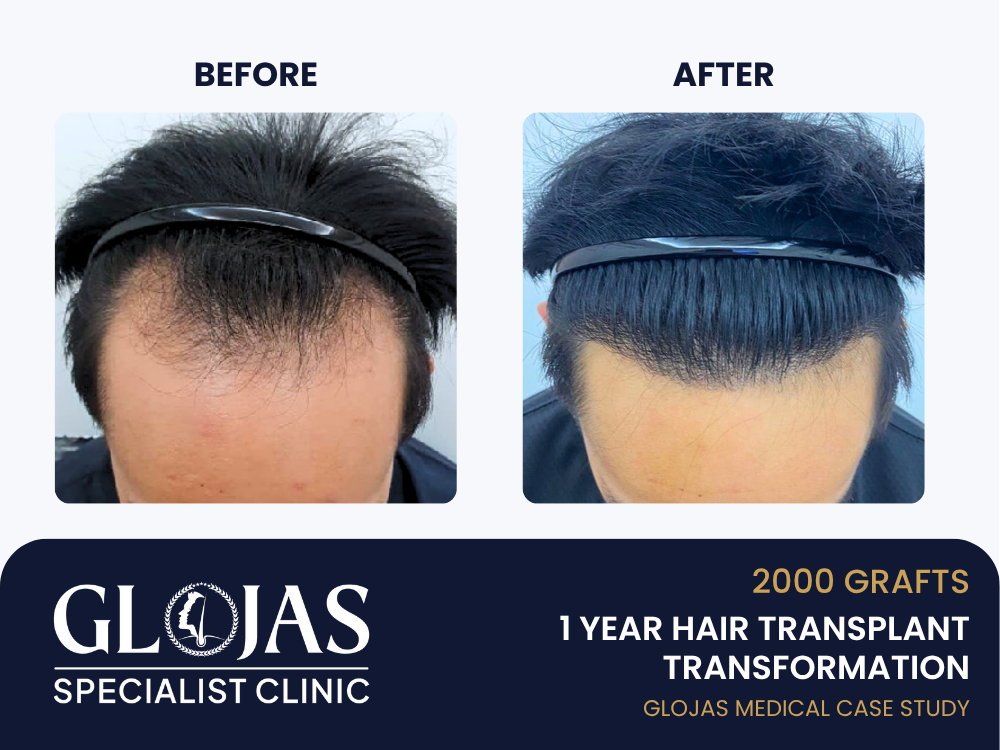
Male pattern baldness (MPB), also known as androgenetic alopecia, is one of the most common types of hair loss, affecting nearly 50% of men by the age of 50. For those experiencing early stages like Norwood-Hamilton Level 3, a well-executed FUE Hair Transplant can make a significant difference, restoring not only the hairline but also confidence. In this case study, we follow a 32-year-old male patient who underwent an FUE hair transplant using 2,000 grafts to address recession in the temples and frontal hairline, achieving natural and dense results within 12 months. Patient Overview Age: 32 Hair Loss Classification: Norwood-Hamilton Level 3 Concern: Receding temples forming an M-shaped hairline Hair Type: Wavy, thick, black hair Lifestyle: Active, non-smoker, no prior hair loss treatments Goal: Rebuild natural hairline and close temple recession Diagnosis & Planning – Hair Transplant The patient’s hair loss pattern was symmetrical with clear temple recession but a still-intact mid-frontal zone. During consultation: Scalp and donor zone assessment was performed using trichoscopy Donor density found to be 85 follicular units/cm² – ideal for extraction No history of rapid hair loss or family history of aggressive baldness Surgical Plan: Total grafts: 2,000 Area covered: Front third of scalp and bilateral temples Density goal: 35–40 grafts/cm² for natural fullness Procedure Details Technique: FUE (Follicular Unit Extraction) Punch size: 0.8mm Duration: 6 hours Anesthesia: Local anesthesia Graft distribution: 1,200 grafts for the frontal zone 800 grafts to restore temple peaks The surgeon carefully followed the patient’s natural hair angles and directions to achieve a soft and realistic result, especially at the hairline edges. Post-Transplant Timeline Timeline Progress Week 1 Minor redness and swelling; scabbing resolves in 7–10 days Week 3–6 Shock loss phase: transplanted hairs fall out temporarily Month 3 Early signs of regrowth (fine hair sprouting) Month 6 Noticeable growth and improved density Month 9 Fuller appearance, shaping up well Month 12 Final result: mature, natural-looking hairline Before & After Comparison Before After 12 Months Receding temples, visible scalp Balanced, youthful hairline M-shaped pattern Natural contour, filled-in temple areas Lack of styling options Hair styled freely, no thinning visible Patient Testimonial “I was always wearing hats or styling my hair forward to hide the corners. After the FUE transplant, I don’t even think about it anymore. My hairline looks like it did in my early 20s — and no one can tell it’s a transplant.” Aftercare & Recovery Tips Avoid direct sun exposure for 14 days Use saline spray and gentle shampoo from Day 3 No scratching or rubbing the scalp during healing Avoid strenuous activity for 7 days Optional PRP booster at Month 3 (patient opted out) Benefits of FUE Hair Transplant for Level 3 Baldness Minimally invasive: No stitches or linear scarring Natural results: Custom-designed hairline with single follicle grafts Quick recovery: Most patients resume light activities in 48 hours Permanent solution: DHT-resistant donor hair remains for life 5 Frequently Asked Questions (FAQs) 1. Is 2,000 grafts enough for a natural look? Yes. For Norwood Level 3 hair loss, 2,000 grafts can provide excellent coverage, especially when focusing on the frontal zone and temples. 2. Will the transplanted hair fall out? Transplanted hairs will initially shed after 2–3 weeks — this is normal. The roots remain, and hair will regrow permanently within 3–4 months. 3. Are FUE results permanent? Yes. FUE uses DHT-resistant hairs from the donor area, typically at the back of the scalp. These hairs are genetically resistant to future hair loss. 4. Does the procedure hurt? The procedure is done under local anesthesia, so most patients feel no pain. Some report mild discomfort or tightness during healing. 5. Can I go back to work the next day? Many patients return to desk jobs within 2–3 days. Redness may last a few days, but can be covered with a cap after Day 5. Conclusion This case demonstrates how FUE Hair Transplant using 2,000 grafts can effectively restore a natural, youthful hairline in men with male pattern hair loss level 3. With precision planning, expert technique, and proper aftercare, the results are long-lasting and undetectable. Whether you’re in the early stages of hair loss or looking for a permanent solution, FUE offers a safe, proven pathway to regaining your hair — and your confidence.
Case Study: Scar Hair Transplant – 500 Grafts to Treat Burn Scar on Female Scalp (7-Month Result)
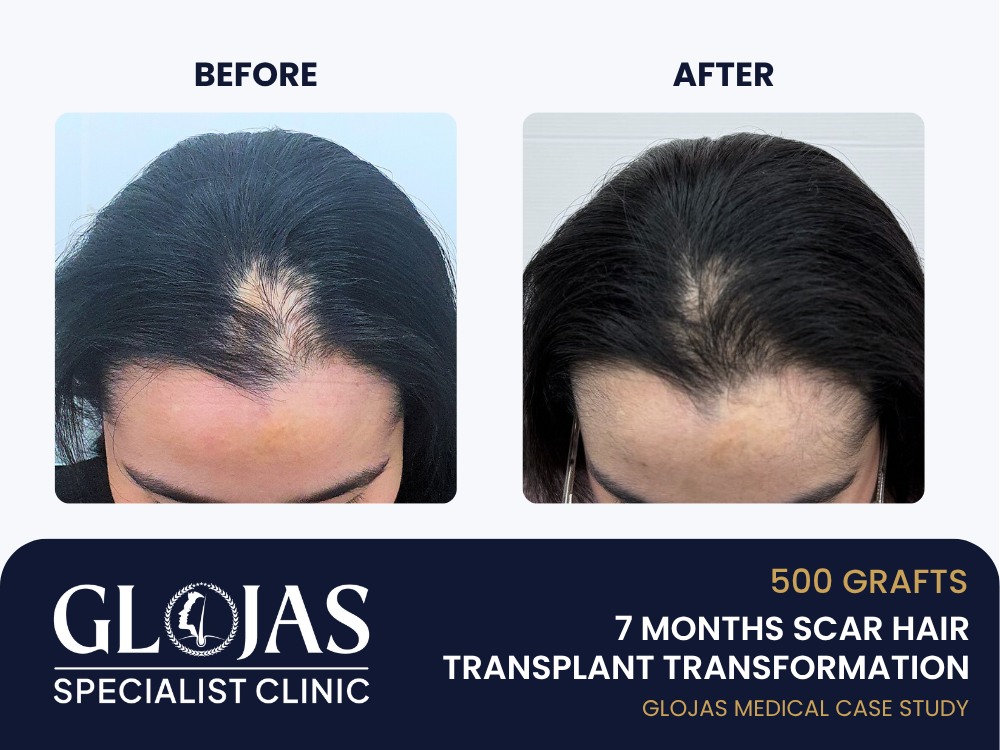
Hair loss caused by scarring can be one of the most emotionally difficult conditions to treat, especially for women. While traditional baldness often comes from genetic causes, trauma like burns or surgery can leave areas of the scalp permanently bare, unable to grow hair. But advancements like scar hair transplant technology have created solutions. This case study details how a female patient successfully restored hair growth in a burn-scarred area of her scalp using the SMART™ FUE Scar Hair Transplant method, with visible, natural-looking results in just 7 months. Patient Profile Age: 28 Gender: Female Issue: Second-degree burn scar (size: approx. 4cm x 3cm) on right parietal scalp due to childhood accident Hair Type: Fine, straight, dark brown Scar Type: Mature, stable, non-hypertrophic Concerns: Aesthetic impact when tying hair up, thinning look around the scar Her main goal was to blend the scarred area with the surrounding hair, so that the patch was no longer visible in daily hairstyles. Consultation & Assessment – Scar Hair Transplant At the initial consultation, the scar tissue was evaluated to confirm suitability for transplant. Using scalp microscopy and physical testing, doctors confirmed: The scar was mature and had an adequate blood supply There was no hypertrophic or keloid formation Surrounding hair density was high enough for blending Plan: Use 500 grafts to fill and camouflage the scar Focus on natural angling and low-density blending for realism Use the SMART™ FUE technique to minimize trauma and increase graft survival in scar tissue Procedure Overview Technique Used: SMART™ FUE (Scalp Micro Advanced Restoration Technique) Grafts Placed: 500 Punch Size: 0.7 mm Donor Site: Occipital scalp (back of head) Anesthesia: Local Procedure Time: Approx. 4 hours Recovery Time: 5–7 days Scar tissue is often more challenging than healthy scalp skin. However, the SMART™ FUE system allows for ultra-precise placement of grafts, ensuring improved oxygenation and survival rate in lower-blood-supply areas like scars. Growth Timeline (7 Months) Timeline Progress Week 1 Mild redness and crusting at the implant site Week 4 Temporary hair shedding (shock loss) Month 3 First visible new growth — thin and baby-fine hairs Month 5 Density increases, and the scar begins to blend into the surrounding hair Month 7 Approx. 80% full result, no visible scarring when hair is styled normally Before & After Before After 7 Months Smooth, shiny burn scar on parietal scalp Camouflaged area with natural hair covering the scar Visible bald spot when hair was parted or tied Confident styling with parting or ponytail Psychological discomfort in social settings Improved self-image and restored confidence Patient Testimonial “I’ve been hiding this scar for years. I never thought hair could grow there again. But after just a few months, I could part my hair like normal — the scar is almost invisible. It’s been such a boost to my confidence.” Why Choose SMART™ FUE for Scar Repair? Scarred scalp areas have lower blood circulation and higher risks of graft rejection. The SMART™ FUE technique utilizes finer punches and strategic angling to maximize graft survival in areas with compromised blood supply. Advantages: Minimal trauma to scar tissue Higher graft survival even in fibrotic skin No stitches or linear scarring Short downtime and natural finish Aftercare & Maintenance Gentle shampoo after 48 hours Avoid pressure on scar area (e.g., tight ponytails) for 2 weeks No direct sun exposure for 14 days PRP therapy at 3 months (optional, recommended for scar tissue) Normal styling resumed by week 3 5 Frequently Asked Questions (FAQ) 1. Can hair grow on a scar? Yes, with the right technique and scar condition. If the scar has healed fully, has sufficient blood flow, and is non-hypertrophic, an FUE transplant can achieve successful growth. 2. Will the scar completely disappear? The scar won’t vanish, but with a successful transplant, it can become visually invisible, camouflaged by new hair growing through it. 3. How long do the results last? The transplanted hairs are permanent and resistant to hair loss. Once they grow, they stay for life unless impacted by other trauma. 4. Is this painful? The procedure uses local anesthesia, making it virtually painless. Most patients report only minor discomfort during recovery. 5. Is 500 grafts enough? For a small to medium scar (under 15cm²), 500 grafts are typically sufficient to blend and conceal the area effectively, depending on scar depth and hair density goals. Conclusion This case highlights the effectiveness of SMART™ FUE Scar Hair Transplant for restoring hair over burn scars. Using just 500 grafts, this female patient regained her ability to confidently wear any hairstyle within 7 months, with no visible signs of the old trauma. For women affected by scalp scarring from burns or injury, this solution offers a life-changing restoration, both physically and emotionally.
Case Study: Hairline Lowering Transplant – 1,800 Grafts for Wide Forehead (5-Month Result)
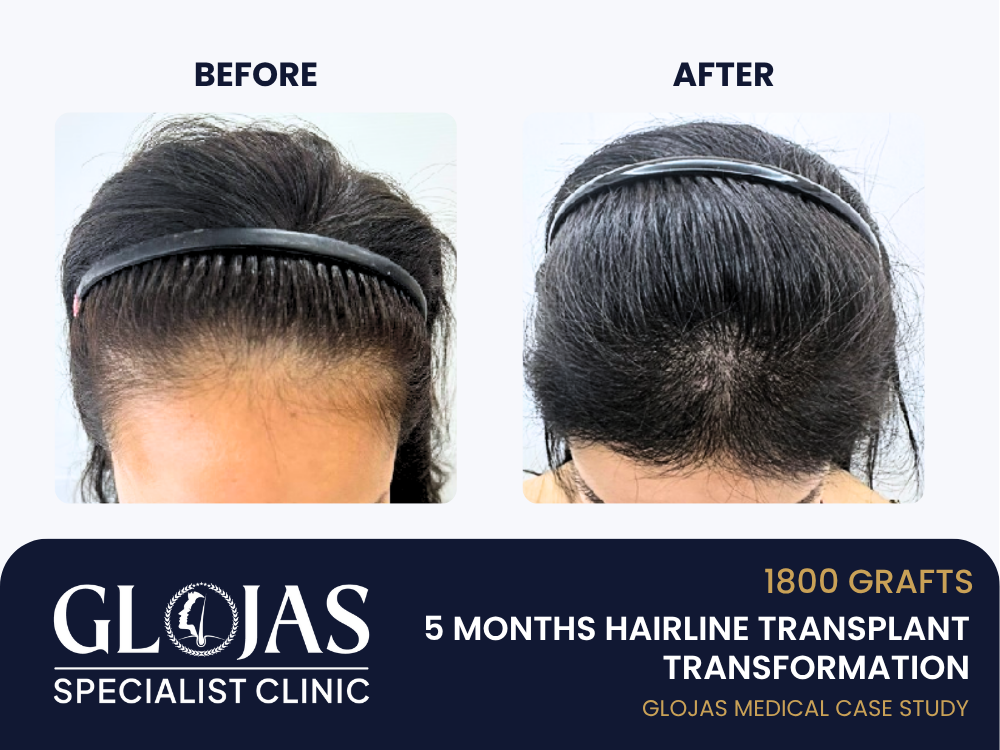
A high or wide forehead can affect facial proportions and lead to self-consciousness, especially in women. Many individuals seek ways to balance their facial aesthetics, and one of the most effective solutions is hairline lowering via hair transplant. This case study follows a 30-year-old female patient who underwent a SMART™ FUE Hairline Lowering Transplant using 1,800 grafts. In just 5 months, she experienced a dramatic yet natural improvement in her facial appearance. Patient Profile Age: 30 Gender: Female Concern: Naturally wide forehead; high hairline since teenage years Previous Attempts: Bangs/fringes to hide forehead; no prior surgical/cosmetic procedures Hair Type: Straight, thick, black Skin Type: Fitzpatrick IV Goal: Achieve a more proportionate and feminine hairline with a lower natural curve Consultation & Design – Hairline Lowering During her consultation, a full facial analysis was performed. The goal was to create a softer, rounder hairline that would complement her natural features and reduce the vertical height of her forehead by 2–2.5 cm. Key considerations: Natural density and angling of hair Avoiding unnatural straight lines Preservation of future styling options (e.g., tying hair up) Decision: Lower hairline by 2.3 cm using 1,800 grafts Procedure Overview Technique Used: SMART™ FUE Grafts Transplanted: 1,800 Duration: ~6 hours Anesthesia: Local Donor Area: Occipital scalp Recovery Time: 7–10 days Graft Placement: Frontal Hairline Zone: 1000 grafts Temporal Zones (sides): 800 grafts for natural frame and blending Why SMART™ FUE? SMART™ FUE is an advanced, minimally invasive hair transplant malaysia method designed for high-precision follicle extraction and placement. It’s especially ideal for delicate aesthetic areas like the female frontal hairline, where direction, angle, and density are critical. Benefits include: No linear scar Natural curvature and direction Faster healing with minimal downtime High graft survival rate Recovery & Growth Timeline Timeline Progress Week 1 Mild redness and scabbing in the transplanted area Week 3–4 Shock loss (temporary shedding of transplanted hair) Month 2 Early new hair growth, thin and soft baby hairs Month 4 Noticeable increase in density; new hairlines take shape Month 5 70–80% visible result; natural-looking lowered hairline achieved Before & After (5-Month Result) Before After 5 Months High hairline with broad upper forehead Reduced forehead height with smooth, rounded hairline Reliance on bangs to cover the forehead Comfortable wearing hair back confidently Uneven facial proportions Improved harmony and softer, more feminine features Patient Feedback “I always hated how high my forehead looked. It made me insecure and I would never go out without bangs. After the transplant, my whole face looks more balanced. I can tie my hair up now without feeling self-conscious — it’s honestly life-changing.” Aftercare Routine Sleep elevated for 3 nights post-procedure No direct sun exposure for 2 weeks Avoid sweating, tight headbands, or hats initially Mild shampoo after Day 3 No hairstyling products or heat tools for the first month Optional: PRP booster session at Month 3 (patient opted in) 5 Frequently Asked Questions (FAQ) 1. How is a female hairline lowering different from a typical hair transplant? Female hairline lowering focuses on aesthetics — it requires softer curves, dense packing, and smaller grafts for a natural look. The procedure is designed more for framing the face than covering baldness. 2. Can the hairline be shaped as per personal preference? Yes, to an extent. The surgeon designs a natural-looking hairline based on the patient’s facial structure, symmetry, and anticipated future aging. While input is welcome, the final design should provide aesthetic proportions and long-term results. 3. Are the results permanent? Yes. The transplanted hairs are taken from the back of the scalp (DHT-resistant) and are permanently rooted in the new location. They grow and behave like natural hair. 4. When can I resume normal activities? Most patients return to light activity in 3–5 days. Full scalp healing takes 7–10 days. Hair styling, coloring, and heat treatments can resume after 4 to 6 weeks. 5. How natural will the result look? With SMART™ FUE, the result is indistinguishable from natural hair. The density, angle, and curl pattern are matched during graft placement to blend perfectly. ✅ Conclusion This case proves how SMART™ FUE Hairline Lowering using 1,800 grafts can significantly improve facial harmony for women with naturally wide foreheads. In just 5 months, the patient achieved a softer, well-framed appearance that elevated her confidence and styling freedom. For women seeking a subtle, elegant transformation without scarring or downtime, SMART™ FUE hairline lowering offers one of the most effective solutions available today.
Case Study: Hair Transplant – 3,000 Grafts for Male Pattern Hair Loss (7-Month Result)
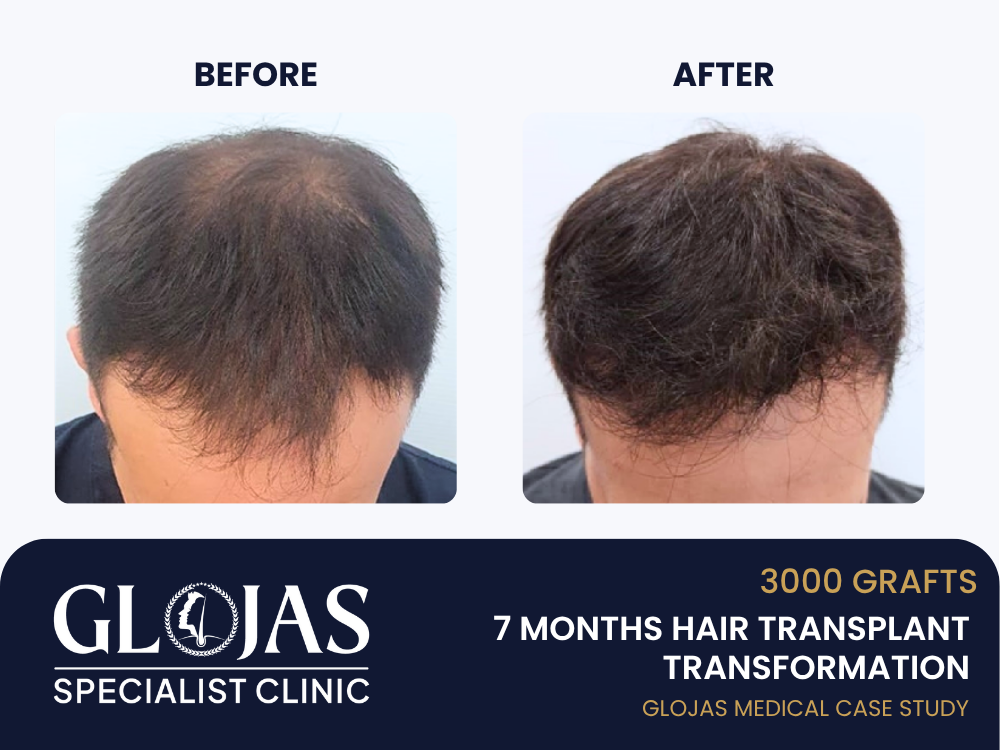
Male pattern hair loss is one of the most common types of hair thinning, affecting over 50% of men by the age of 50. Characterized by a receding hairline and vertex (crown) thinning, it can significantly impact confidence and appearance. In this case study, we explore how a 37-year-old patient addressed Norwood Level 3–4 vertex hair loss using the SMART™ FUE Hair Transplant technique — and the visible changes he achieved within 7 months. Patient Overview Age: 37 Hair Type: Straight, medium density, dark brown Hair Loss Pattern: Receding frontal hairline and noticeable thinning at the vertex Norwood Classification: Level 3–4 Previous Treatments: Minoxidil and anti-DHT shampoo (mild effect) Lifestyle: Active, non-smoker The patient wants a more youthful appearance by rebuilding the frontal hairline and improving density at the crown (vertex) with a hair transplant. Consultation & Planning – Hair Transplant The initial consultation focused on analyzing donor density, scalp health, and the ideal hairline shape. Trichoscopy confirmed stable donor areas with sufficient density for a 3,000-graft transplant. Hairline Goals: Restore mid-frontal zone with a soft, natural curvature Fill the crown (vertex) thinning for uniform coverage Match density to native hair growth patterns Procedure Summary Technique Used: SMART™ FUE (Scalp Micro Advanced Restoration Technique) Grafts Extracted: 3,000 Punch Size: 0.7 mm Anesthesia: Local Procedure Time: ~8 hours Team: Lead surgeon + 3 technicians Graft Distribution: Frontal Zone: 1,600 grafts Mid-scalp: 400 grafts Crown (Vertex): 1,000 grafts Why SMART™ FUE? The SMART™ FUE technique offers a minimally invasive solution with high graft survival and natural-looking results. It’s designed for precision, with careful angle and direction control, especially critical in areas like the vertex where hair whorls are complex. Benefits: Minimal scarring Quick recovery Natural density and angles Better graft survival Recovery Timeline & Results (7 Months) Timeline Progress Week 1 Mild swelling, scabbing in the recipient area Month 1–2 Temporary shedding of transplanted hairs (shock loss phase) Month 3 New growth begins, and fine baby hairs are visible Month 5 Increased thickness in the hairline and crown Month 7 80% of results are visible; dramatic improvement in density Before & After (7-Month Progress) Before Transplant After 7 Months Receding front hairline and visibly thinning crown Defined hairline, thicker mid-scalp, filled-in crown Difficulty with styling due to uneven volume Fuller look and flexibility with various hairstyles Prematurely aged appearance More youthful, confident, and balanced facial structure Patient Feedback “I started seeing baby hairs within 3 months, and by month 7, the transformation was obvious. My hairline looks so natural that even close friends didn’t realize I had anything done—they just thought I changed my hairstyle.” Aftercare & Maintenance Avoid washing hair for 48 hours Gentle shampoo starting Day 3 Avoid sun exposure and intense sweat for 10 days Resume normal styling after 2 weeks Minoxidil and biotin are recommended for ongoing support Optional PRP session at 3 months (patient opted in) 5 Frequently Asked Questions (FAQ) 1. How long will the results last? SMART™ FUE results are permanent. Transplanted follicles are resistant to DHT (the hormone responsible for male pattern baldness). 2. Can I see full results after 7 months? At 7 months, most patients see 70–80% of their final result. Full maturation typically happens by 12 months. 3. Is 3,000 grafts enough for Norwood Level 3–4? Yes. For this classification, 3,000 grafts can effectively rebuild the hairline and provide significant crown coverage, if donor density is adequate. 4. Does SMART™ FUE leave scars? No linear scar is left. Only tiny dot scars are created, which are virtually invisible even with short hairstyles. 5. Can I style or dye my hair post-op? Yes. After 3–4 weeks, you can resume normal grooming, including hair dye, styling gel, and heat tools, just like natural hair. Conclusion This case demonstrates how SMART™ FUE Hair Transplant with 3,000 grafts can successfully restore a receding hairline and thinning crown, especially in men with Norwood 3–4 hair loss. Within just 7 months, this patient experienced remarkable density improvements and regained control over his appearance, with no noticeable scarring or downtime. For those hesitant about surgical options, SMART™ FUE offers a discreet and natural-looking solution that boosts both hair and confidence.
Case Study: 1-Year Hair Thinning Treatment Journey – 4 Sessions to Reverse Male Thinning Hair
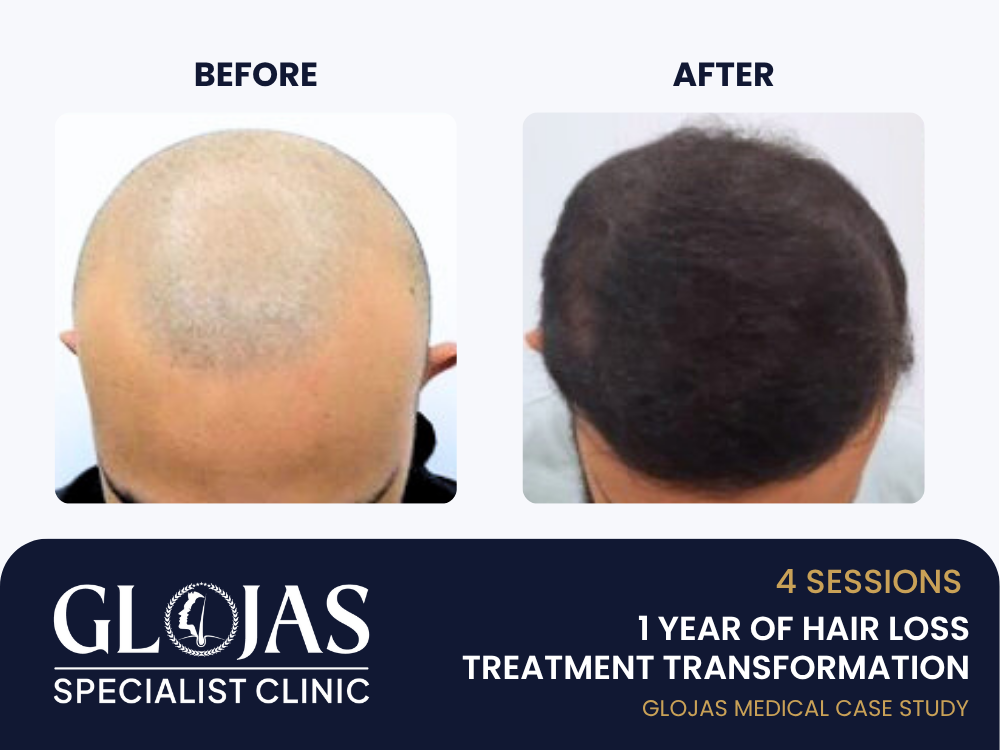
Hair thinning is one of the most common concerns among men aged 25 and above. Whether caused by genetics, hormones, or lifestyle, early intervention can often reverse or significantly slow the progression of hair loss. In this case study, we follow a 34-year-old male patient who underwent a non-surgical hair loss treatment program consisting of 4 targeted sessions over one year. The goal was to improve overall hair density, reduce shedding, and restore confidence, without undergoing hair transplant surgery. Patient Background Age: 34 Gender: Male Concern: Progressive hair thinning, especially at the crown and temples Diagnosis: Male pattern hair loss – Norwood Stage II-III Medical History: No underlying conditions, non-smoker Previous Solutions Tried: Minoxidil (topical), DHT-blocking shampoo Hair Type: Straight, medium-fine density, dark brown Consultation & Assessment During the consultation, a trichoscopy analysis was performed to assess scalp health, follicle density, and active miniaturization zones. The scalp showed reduced density in the frontal region and crown, with early signs of follicular shrinkage due to DHT sensitivity. Treatment options discussed: Platelet-Rich Plasma (PRP) Growth Factor Therapy Laser Light Therapy Oral finasteride (optional, declined by patient) The patient opted for a 4-session PRP-based therapy, spaced 6–8 weeks apart, supported with topical and nutritional boosters. Hair Loss Treatment Protocol: 4 Sessions Technique: PRP (Platelet-Rich Plasma) TherapySessions: 4Interval: Every 6–8 weeksDuration per Session: ~60 minutesAdditional Care: Scalp microneedling, biotin supplement, hair serum (topical) Step-by-Step Breakdown: Blood Draw – 10–15 ml of the patient’s blood extracted Centrifugation – Platelets isolated and concentrated Microneedling – Stimulates the scalp for better absorption PRP Injection – Delivered directly into thinning areas (crown, hairline) Post-Treatment Care – No washing for 24 hours, avoid sun & sweat exposure Progress Timeline Time Frame Visible Progress Week 1–2 Mild soreness, slight redness on the scalp Month 2 Decrease in hair shedding, scalp feels healthier Month 4 New baby hair starts sprouting, especially at the crown Month 6 Noticeable thickening in temple areas and improved hair texture Month 9 Increased density across front and crown, the patient resumes normal styling Month 12 Full visible result – thicker, healthier hairline and crown Before & After Comparison Before After (1 Year) Visible thinning on the crown & temples Crown and temples filled in with new, thicker hair Difficulty styling hair Improved texture, volume, and flexibility in hairstyles Loss of confidence Improved self-image and comfort in social & professional life Patient Feedback “I was close to giving up and almost went for a transplant. But after just 4 sessions, I started seeing baby hairs again! By the 9th month, even my barber noticed the difference. The results are natural, and I feel younger.” Maintenance & Aftercare Continue topical minoxidil daily Biotin and zinc supplementation Monthly scalp massage (optional) Annual PRP top-up (recommended for long-term results) 5 Frequently Asked Questions (FAQ) 1. Is 4 sessions enough for hair regrowth? For early-stage hair thinning, 4 well-spaced PRP sessions are often sufficient to trigger regrowth and improve scalp health. Maintenance sessions may be advised annually. 2. Does PRP therapy hurt? Most patients report only mild discomfort. A numbing cream is applied before injections, and any soreness usually subsides within 24–48 hours. 3. How soon can I see results? Initial results, reduced shedding and minor regrowth, appear within 2–3 months. Full results usually develop by 9–12 months. 4. Will I need a hair transplant? If treated early, many patients delay or avoid the need for a transplant. However, if hair loss continues, PRP can also complement future transplant procedures. 5. Is PRP therapy safe? Yes, PRP uses your blood components, so the risk of allergic reaction is nearly zero. It’s safe when performed by trained medical professionals. Conclusion This case demonstrates that non-surgical hair loss treatments, such as PRP, can deliver visible, lasting results—even with just four sessions. For men facing thinning hair, especially in the early stages, PRP offers a minimally invasive, cost-effective, and natural solution. Whether used as a standalone treatment or part of a comprehensive hair restoration plan, PRP remains a trusted option for patients seeking thicker, healthier hair without the need for surgery.
Case Study: Facial Hair Transplant – 1,600 Grafts for Fuller Moustache & Goatee (1-Year Result)
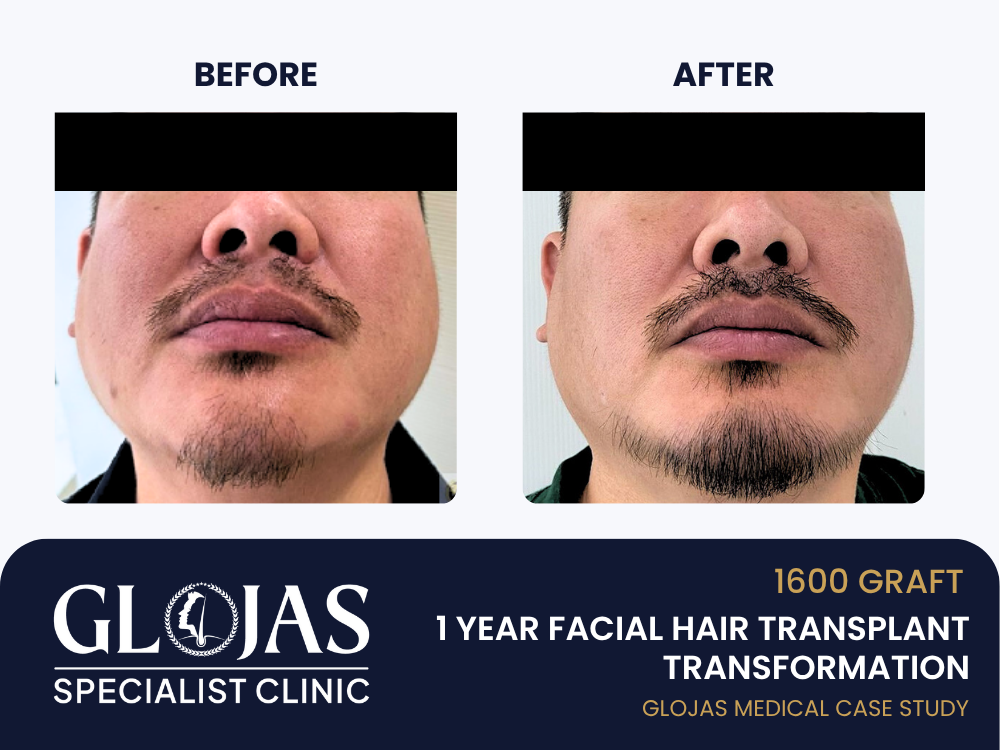
Facial hair is a defining element of masculinity, identity, and style. For many men, a well-shaped moustache or goatee enhances confidence and self-expression. However, not everyone is genetically gifted with dense or uniform facial hair. This is where a facial hair transplant, particularly using the SMART™ FUE technique, becomes a reliable and effective solution. In this case study, we explore how a 29-year-old male patient successfully achieved a fuller moustache and goatee with a SMART FUE Facial Hair Transplant, utilising 1,600 grafts, and how the transformation progressed over 12 months. Patient Profile Age: 29 Gender: Male Issue: Sparse facial hair, particularly in the upper lip and chin area Desired Outcome: Well-defined moustache and goatee style with natural density Hair Type: Straight, coarse, black Donor Area: Occipital scalp (back of the head) Consultation & Goals During the initial consultation, the patient expressed dissatisfaction with his patchy facial hair growth. He had tried topical treatments such as minoxidil and biotin, with little to no success. His goal was clear — a fuller, symmetrical moustache and goatee, styled in a natural and masculine contour. The consultation involved: Facial hair pattern analysis Density mapping and graft estimation Medical history screening Designing the desired facial hair outline Matching donor hair texture with facial hair After assessment, 1,600 grafts were deemed ideal: 700 grafts for the moustache 900 grafts for the goatee and chin region Procedure Overview Technique Used: SMART™ FUE (Scalp Micro Advanced Restoration Technique)Procedure Time: ~6 hoursGrafts Extracted: 1,600Anaesthesia: LocalDowntime: 2–4 days Why SMART™ FUE? SMART™ FUE offers ultra-refined, scar-free extraction with excellent precision — ideal for facial areas that require detail, direction, and angle control. Benefits: Smaller punches (0.6–0.8 mm) reduce scarring Natural angling of grafts to mimic facial hair growth High survival rate of transplanted follicles Minimal downtime Quick healing with undetectable results Recovery & Growth Timeline Timeline Progress Days 1–5 Mild redness, scabbing in the recipient area Week 2–3 Initial shedding of transplanted hairs (normal phase) Month 2 New growth begins; thin, light strands are visible Month 4 Noticeable thickening and improved shape Month 6 60–70% of results visible, moustache taking form Month 12 Full result: thick, even growth, well-blended with natural hair Before & After Before After (1 Year) Sparse and uneven moustache Full, thick moustache with symmetrical shape Patchy goatee with gaps Defined goatee with natural density and smooth edges Lack of facial framing Masculine, structured look with enhanced facial features Patient Testimonial “I always wanted a strong goatee and moustache, but nothing worked until this. The transplant changed everything — it looks and feels like it’s always been there. I finally feel complete when I look in the mirror.” Aftercare & Post-Treatment Tips Avoid touching or shaving transplanted areas for 10–14 days Use a mild cleanser and moisturiser during recovery Avoid sun exposure for 1 month Resume shaving/trimming after 4–6 weeks PRP booster sessions recommended for enhanced growth (optional) 5 Frequently Asked Questions (FAQ) 1. Is a facial hair transplant permanent? Yes. The transplanted follicles are taken from the scalp and are genetically resistant to hair loss, ensuring permanent facial hair growth. 2. Will the transplanted hair match my facial hair texture? Absolutely. Grafts are selected to closely match the natural coarseness and direction of your existing facial hair. 3. Can I shave and style the transplanted beard or moustache? Yes. Once healed, you can shave, trim, and style your facial hair as you would normally. It behaves just like natural facial hair. 4. Will there be visible scars? No. SMART™ FUE uses ultra-fine punches that leave no visible scarring, making it ideal for aesthetic zones like the face. 5. How long before I see full results? While new growth starts as early as 2–3 months, full results are typically seen between 9–12 months, depending on individual healing and hair growth cycles. Final Thoughts A well-groomed moustache and goatee can greatly enhance one’s appearance and confidence. For this patient, a SMART FUE Facial Hair Transplant using 1,600 grafts provided a permanent solution to sparse growth and patchy areas. One year later, his facial hair not only looks natural and masculine, but also reflects a major boost in self-esteem. With minimal downtime, no scarring, and a high satisfaction rate, SMART™ FUE continues to be a leading choice for modern facial hair restoration.
Kajian Kes: Tanam Garisan Rambut – 3,400 Graft untuk Wanita dengan Dahi Lebar & Garisan Rambut Menipis (Hasil 1 Tahun)
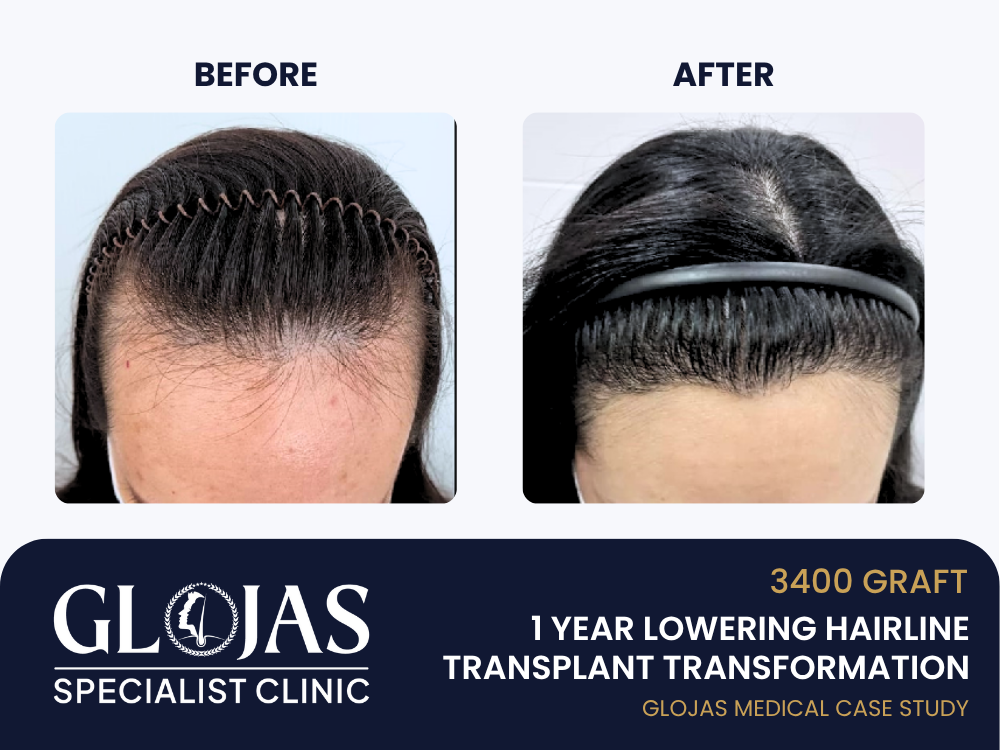
Garisan rambut yang menipis atau dahi yang luas boleh menjejaskan keyakinan diri wanita, terutamanya apabila perubahan ini mula mengubah bentuk semula jadi wajah. Walaupun tanam rambut sering dikaitkan dengan lelaki, semakin ramai wanita kini memilih teknik moden seperti Tanam Garisan Rambut SMART™ FUE untuk mengembalikan kontur feminin dan keyakinan diri mereka. Dalam kajian kes ini, kita lihat bagaimana seorang wanita berusia 36 tahun menjalani Tanam Garisan Rambut SMART™ FUE dengan 3,400 graft untuk menurunkan garisan rambut dan mendapatkan perkadaran wajah yang lebih seimbang. Hasil selepas 1 tahun menunjukkan transformasi yang padat, semula jadi dan kelihatan muda. Profil Pesakit Umur: 36 tahun Masalah: Dahi secara semula jadi lebar, penipisan progresif di bahagian hadapan Jenis Rambut: Halus, sedikit bergelombang, coklat gelap Kawasan Penderma: Bahagian belakang kepala (oksipital) Matlamat: Menurunkan garisan rambut ±2 cm dan mengembalikan bentuk melengkung feminin Gaya Hidup: Profesional bekerja, mengelak ikatan ketat kerana mudah putus Kenapa Pilih SMART™ FUE? SMART™ FUE (Scalp Micro Advanced Restoration Technique) memberikan ketepatan tinggi dan hasil yang lebih semula jadi berbanding teknik FUE biasa. Ia amat sesuai untuk wanita kerana reka bentuk garisan rambut perlu halus, seimbang dan realistik. Kelebihan Untuk Wanita: Saiz punch kecil (0.6 mm) untuk parut minimum Kadar kelangsungan graft tinggi Reka bentuk disesuaikan mengikut ciri wajah Sudut tanam mengikut arah pertumbuhan semula jadi Tiada parut garis seperti dalam teknik FUT Konsultasi & Reka Bentuk Tanam Garisan Rambut Pesakit menginginkan garisan rambut yang lebih lembut dan membulat, menurunkan paras depan sekitar 2 cm dan mengisi kawasan menipis di kedua-dua belah pelipis. Penilaian Utama: Rambut penderma padat dan sihat Reka bentuk “U” lembut untuk membingkai wajah 3,400 graft dirancang (kebanyakan graft tunggal dan berganda) Butiran Prosedur Teknik Digunakan: SMART™ FUE Jumlah Graft: 3,400 Tempoh Prosedur: ±8 jam Bius: Bius tempatan Pasukan: 1 doktor utama, 2 juruteknik Pemulihan: Bengkak ringan 2–3 hari, boleh kembali bekerja selepas 1 minggu Pengagihan Graft: 800 graft untuk menurunkan garisan depan 1,200 graft untuk sudut pelipis kiri & kanan 1,400 graft untuk ketumpatan bahagian tengah hadapan Garis Masa & Hasil 1 Tahun Tempoh Perkembangan Minggu 1 Bengkak ringan, pembentukan keruping Bulan 1–2 “Shock loss” – rambut tertanam gugur sementara Bulan 3–4 Rambut baru mula tumbuh, pesakit mula trim ringan Bulan 6 60–70% ketumpatan kelihatan, pelipis mula dipenuhi semula Bulan 12 Hasil penuh tercapai: garisan rambut lembut, padat dan semula jadi Sebelum & Selepas Sebelum Selepas 1 Tahun Garisan rambut menipis, dahi kelihatan luas Garisan rambut lebih rendah dengan lengkung semula jadi Wajah tampak terbuka tanpa bingkai rambut Wajah kelihatan lebih harmoni dan muda Gaya rambut terhad Kini boleh ikat rambut dan ubah gaya dengan yakin Testimoni Pesakit “Saya bertahun-tahun menutup dahi dengan fringe atau headband. Selepas tanam rambut SMART™ FUE, saya akhirnya yakin untuk ikat rambut ke belakang. Ia nampak sangat semula jadi, dan tiada siapa perasan saya buat rawatan ini. Terbaik!” Penjagaan Selepas Prosedur Elak basuh rambut 48 jam pertama Guna syampu lembut selepas hari ke-3 Elak ikatan ketat untuk 2 bulan Serum pertumbuhan bermula bulan ke-2 Sesi PRP booster opsyenal bulan ke-4 (pesakit memilih untuk ambil) 5 Soalan Lazim (FAQ) 1. Adakah wanita boleh buat tanam rambut untuk dahi lebar? Ya, tanam rambut SMART™ FUE sangat sesuai untuk wanita yang ingin menurunkan garisan rambut atau mengisi kawasan pelipis menipis. 2. Adakah hasilnya kelihatan semula jadi? Pasti. Graft ditanam mengikut arah dan sudut semula jadi rambut wanita — halus di hadapan, lebih padat di belakang. 3. Adakah pemulihan menyakitkan? Kebanyakan pesakit hanya mengalami ketidakselesaan ringan. Bengkak hilang dalam 2–3 hari, dan boleh kembali bekerja dalam 1 minggu. 4. Adakah hasil ini kekal? Ya. Rambut yang dipindahkan adalah kekal kerana ia diambil dari kawasan tahan botak di kulit kepala. 5. Boleh warnakan atau bentuk rambut selepas rawatan? Boleh, selepas 3–4 bulan apabila kawasan telah sembuh sepenuhnya. Rambut boleh dirawat seperti biasa — termasuk warnakan, kerinting atau diikat. Penutup Keguguran rambut dan garisan rambut menipis dalam kalangan wanita sering dipandang ringan, tetapi teknik seperti Tanam Garisan Rambut SMART™ FUE memberikan solusi yang selamat, kekal dan semula jadi. Pesakit ini berjaya melalui transformasi yang menyerlah hanya dalam 12 bulan dengan 3,400 graft — memberikan rupa yang lebih muda, feminin dan yakin.
Case Study: Hairline Lowering Transplant – 3,400 Grafts for Female with Wide Forehead (1-Year Result)
For many women, a balanced hairline is not just about aesthetics — it impacts confidence, hairstyle options, and facial harmony. A wide forehead or receding hairline can make one appear older or overly self-conscious in social and professional settings. Traditional surgical hairline lowering carries risks like scarring and stiffness. That’s where SMART™ FUE Hairline Transplant offers a minimally invasive, natural-looking solution. In this case study, we share the journey of a 29-year-old woman who underwent a SMART™ FUE hairline transplant using 3,400 grafts to create a lower, more feminine hairline. One year post-procedure, her transformation is both natural and confidence-boosting. Patient Profile Age: 29 Concern: Naturally wide forehead, slight hairline recession since the early 20s Goal: Lower and feminize the hairline while maintaining a soft, natural look Donor Area: Occipital scalp (back of the head) Hair Type: Fine, slightly wavy, dark brown Motivation: Cosmetic enhancement for personal confidence, a better frame for the face Why SMART™ FUE for Hairline Transplant? Unlike surgical scalp advancement, SMART™ FUE provides a non-invasive, precise method of redesigning the frontal hairline. Benefits include: No major linear scarring Individual hair direction control Natural density and shape, especially for women High graft survival rate Customizable to suit face shape and forehead dimensions In this patient’s case, her forehead height was approximately 7 cm above the ideal range of 5–6 cm for female proportions. She desired to reduce this by about 1.5–2 cm and round out the corners for a more oval, youthful face. Consultation & Planning Key Evaluations: Healthy donor hair supply No underlying scalp conditions or autoimmune issues Clear hairline design preferences (curved vs straight) Realistic expectations on hair density and growth rate Design Plan: New hairline placed 1.8 cm lower centrally Rounded temporal peaks for a softer contour Natural density with irregularities to mimic a real hairline Total Grafts Required: 3,400 (mainly single follicles in front rows) Procedure Overview Technique Used: SMART™ FUE (0.7 mm punch size) Duration: Full-day session (approximately 9 hours) Grafts Extracted: 3,400 Anesthesia: Local anesthesia Implantation Tools: Choi implanter pens for directional accuracy Procedure Steps: Hair trimmed in the donor zone Grafts harvested with minimal trauma Sorted into singles, doubles, and triples Hairline outlined with fine markings Grafts are implanted front-to-back with natural angulation Recovery Timeline Timeline Progress Day 1–3 Mild swelling, redness along the frontal scalp Week 1 Small crusts form and fall off by the end of the week Week 3–4 Temporary shedding phase (“shock loss”) Month 3 First signs of new growth, soft baby hairs, emerge Month 6 60–70% of grafts showing growth; visible improvement Month 12 Full density and contour visible; patient styling freely 1-Year Results At 12 months, the patient’s hairline was naturally blended and perfectly shaped to suit her face. Before After (12 Months) Forehead height: 7 cm Forehead height reduced to ~5.2 cm The hairline is thin at the corners Soft, rounded edges framing the face Hair pulled back, exposing a wide area Now, they can wear ponytails and partings confidently Patient Testimonial “This changed how I feel about myself. I no longer hide behind bangs or avoid photos. The results are so natural, even my hairstylist didn’t realize I had a transplant!” Aftercare Summary Sleep upright for the first 3 nights Avoid touching, scratching, or washing the hairline for 5 days Use saline spray and mild shampoo as directed Avoid strenuous exercise and sun exposure for 2 weeks PRP booster is optional at 3–6 months to support growth 5 Frequently Asked Questions (FAQ) 1. Is SMART™ FUE hairline transplant suitable for women? Yes, it’s particularly effective for women with high foreheads, naturally receding hairlines, or those wanting to improve facial balance without invasive surgery. 2. How long do the results last? The transplanted hair is permanent and will continue to grow like natural hair. Occasional maintenance (e.g., trimming or shaping) is all that’s required. 3. Will the new hairline look obvious? No. With SMART FUE, the design is tailored to feature irregular and natural density patterns, ensuring a completely natural appearance, even under close inspection. 4. Is there scarring? Tiny dot scars may appear in the donor zone but are typically hidden under your existing hair and barely visible, especially with fine punches used in SMART™ FUE. 5. Can I style my hair as usual after the transplant? Absolutely. After 3–4 months, you can style, dye, curl, or part your hair just like normal. Many patients enjoy wearing their hair pulled back confidently. Conclusion This case is a perfect example of how SMART™ FUE Hairline Lowering Transplant can restore balance, boost confidence, and offer natural, long-term solutions to women dealing with a wide forehead or receding hairline. With 3,400 grafts carefully implanted, the patient now enjoys styling freedom, enhanced beauty, and a rejuvenated sense of self, proving that modern hairline restoration is not just for men but a powerful option for women too.
Kajian Kes: Tanam Bulu Dada – 5,000 Graft untuk Rupa Maskulin (Hasil 1 Tahun)

Bagi ramai lelaki, bulu dada merupakan simbol maskuliniti, keyakinan dan kematangan seksual. Namun, tidak semua lelaki dikurniakan dengan bulu dada yang tebal dan sekata secara semula jadi. Sama ada disebabkan genetik, cukuran berulang, parut atau faktor hormon, kekurangan bulu dada boleh memberi kesan kepada imej diri — terutamanya dalam gaya hidup di mana rambut badan dikaitkan dengan penampilan maskulin. Dalam kajian kes ini, kita lihat bagaimana Tanam Bulu Dada SMART™ FUE menggunakan 5,000 graft membantu seorang lelaki berusia 34 tahun mencapai rupa dada yang lebih penuh dan semula jadi. Selepas 1 tahun, hasilnya sangat ketara — padat, sekata dan memberi keyakinan baharu kepada pesakit. Profil Pesakit Umur: 34 tahun Masalah: Dada licin, hampir tiada bulu dada semula jadi Matlamat: Rupa dada yang maskulin dan berisi Kawasan Penderma: Kulit kepala (zon oksipital dan parietal) Sejarah Perubatan: Tiada masalah hormon atau kulit; bukan perokok Motivasi: Keyakinan sosial dan penampilan diri Kenapa Pilih Tanam Bulu Dada? Seperti tanam rambut dan jambang, tanam bulu dada ialah penyelesaian kekal untuk lelaki yang ingin menambah bulu badan secara estetik. Ia boleh: Mengisi kawasan yang licin Menambah ketumpatan dan keseragaman Menutup parut Membentuk corak dada maskulin yang semula jadi Pesakit ini mengalami pertumbuhan bulu yang sangat minimum dan ingin mencipta bentuk dada yang menggambarkan fizikal idealnya. Kenapa Teknik SMART™ FUE? SMART™ FUE (Scalp Micro Advanced Restoration Technique) ialah pendekatan moden yang amat sesuai untuk zon seperti dada, di mana sudut dan arah penanaman sangat penting. Kelebihannya termasuk: Parut minimum dengan mikro punch (0.6–0.8 mm) Penempatan graft yang tepat mengikut sudut semula jadi Kadar kelangsungan hidup graft yang tinggi Hasil semula jadi walaupun di permukaan kulit yang melengkung Konsultasi & Reka Bentuk Pesakit mahukan corak berbentuk V bermula dari tengah dada hingga ke kawasan pektoral kiri dan kanan, dengan pudar ringan ke arah abdomen atas. Beliau inginkan rupa “semula jadi tetapi padat” seperti model kecergasan atau fizikal Mediterranean. Penilaian: Rambut penderma padat, bertekstur kasar (sesuai untuk dada) Kulit anjal dan sihat, sesuai untuk penanaman Tiada sejarah parut keloid Perancangan Graft: Jumlah: 5,000 graft Agihan: Sternum (1,500), pektoral kiri & kanan (2,000), zon pudar/tepi (1,500) Jenis Graft: Ganda (2–3 helai) untuk ketumpatan, tunggal untuk sempadan halus Butiran Prosedur Teknik Digunakan: SMART™ FUE Durasi: 2 hari (2,500 graft sehari) Bius: Bius tempatan Alat: Mikro punch & pen implan Tempoh Rehat Disyorkan: 3–5 hari Langkah Prosedur: Kawasan penderma dicukur dan dibersihkan Graft diekstrak menggunakan alat mikro Graft disusun dan diklasifikasi Reka bentuk dada ditanda mengikut kontur badan Penanaman dijalankan mengikut arah dan sudut semula jadi Garis Masa Pemulihan Tempoh Perkembangan Hari 1–3 Kemerahan dan sedikit bengkak pada dada Minggu 1 Keruping terbentuk di sekitar graft Minggu 3–4 Fasa “shock loss” – rambut transplant gugur sementara Bulan 2–3 Rambut baru mula tumbuh, halus dan lembut Bulan 6 60–70% ketumpatan tercapai, transformasi ketara Bulan 12 Hasil penuh – bulu dada padat, sekata dan semula jadi Pesakit mula bersenam ringan selepas 2 minggu dan tidak mengalami sebarang komplikasi. Hasil Selepas 1 Tahun Transformasi selepas 12 bulan sangat ketara: Sebelum Selepas 1 Tahun Dada licin tanpa definisi Corak bulu dada berbentuk V, padat dan semula jadi Tiada bulu di kawasan pektoral Bahagian pektoral kelihatan lebih maskulin Malu untuk tidak berbaju Kini yakin ke gim dan pantai tanpa baju Testimoni Pesakit “Saya rasa macam baru dapat semula keyakinan diri. Saya tak pernah ada bulu dada sebelum ni, dan sekarang saya nampak lebih maskulin — seperti yang saya idamkan sejak muda.” Penjagaan Selepas Rawatan Jangan cukur selama 4–6 minggu Guna pelembap setiap hari Elakkan bersenam berat atau berpeluh untuk 1 minggu Elakkan cahaya matahari terus selama 1 bulan Pakai pakaian longgar dan bernafas Booster PRP digalakkan pada bulan ke-3 dan ke-6 5 Soalan Lazim (FAQ) 1. Adakah tanam bulu dada kekal? Ya. Folikel rambut diambil dari kulit kepala yang tahan botak, jadi ia akan terus tumbuh secara kekal di dada. 2. Adakah hasilnya kelihatan semula jadi? Dengan teknik SMART™ FUE, setiap graft ditanam mengikut sudut semula jadi dada, menjadikan hasilnya sangat realistik. 3. Boleh cukur atau trim bulu dada selepas rawatan? Ya. Boleh mula trim selepas 6 minggu, dan cukur penuh selepas penyembuhan lengkap (sekitar 3 bulan). 4. Adakah rambut terasa seperti bulu dada semula jadi? Pada awalnya, rambut mungkin terasa seperti rambut kepala, tetapi akan menyesuaikan diri dan menjadi lebih kasar dari masa ke masa — hampir seperti bulu dada sebenar. 5. Adakah terdapat risiko atau kesan sampingan? Risiko sangat minimum jika dilakukan oleh profesional. Kemerahan, bengkak ringan atau folikulitis mungkin berlaku tetapi boleh dikawal. Penutup Tanam Bulu Dada SMART™ FUE ialah prosedur moden yang boleh memberi impak besar kepada imej diri seorang lelaki. Bagi mereka yang ingin tampil lebih maskulin dan lengkap, kaedah ini menawarkan hasil kekal, semula jadi dan bergaya. Dengan 5,000 graft, pesakit ini berjaya berubah daripada dada kosong kepada penampilan penuh dan maskulin dalam masa hanya 12 bulan — satu transformasi yang nyata dan mengagumkan.