
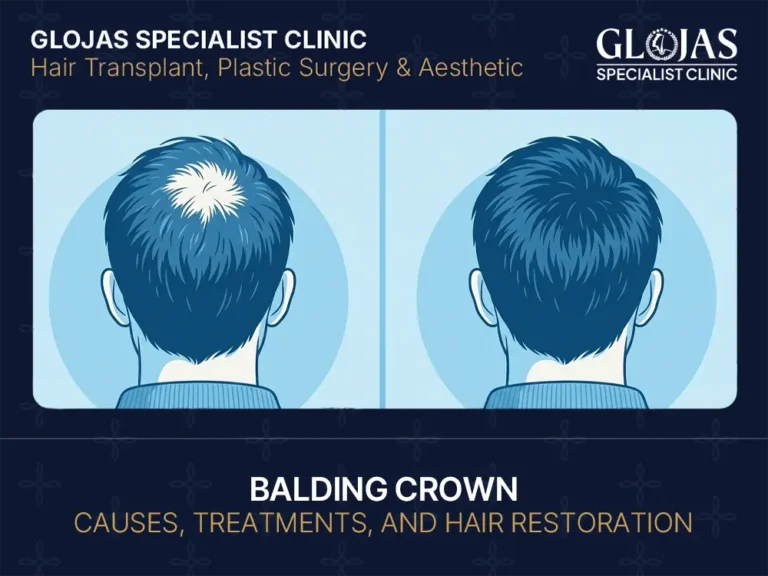
If you’ve spotted a thinning patch at your crown in a photo or mirror, you’re likely dealing with balding crown. In Malaysia’s humidity, this is common. The good news? It’s not permanent. From clinical treatments to topical routines, you can reclaim your coverage.
GLOJAS Specialist Clinic offers advanced treatments for balding crown, including medications and best hair transplant in Malaysia, helping patients restore hair and improve crown density safely and effectively.
Understanding Balding Crown
Definition and Characteristics
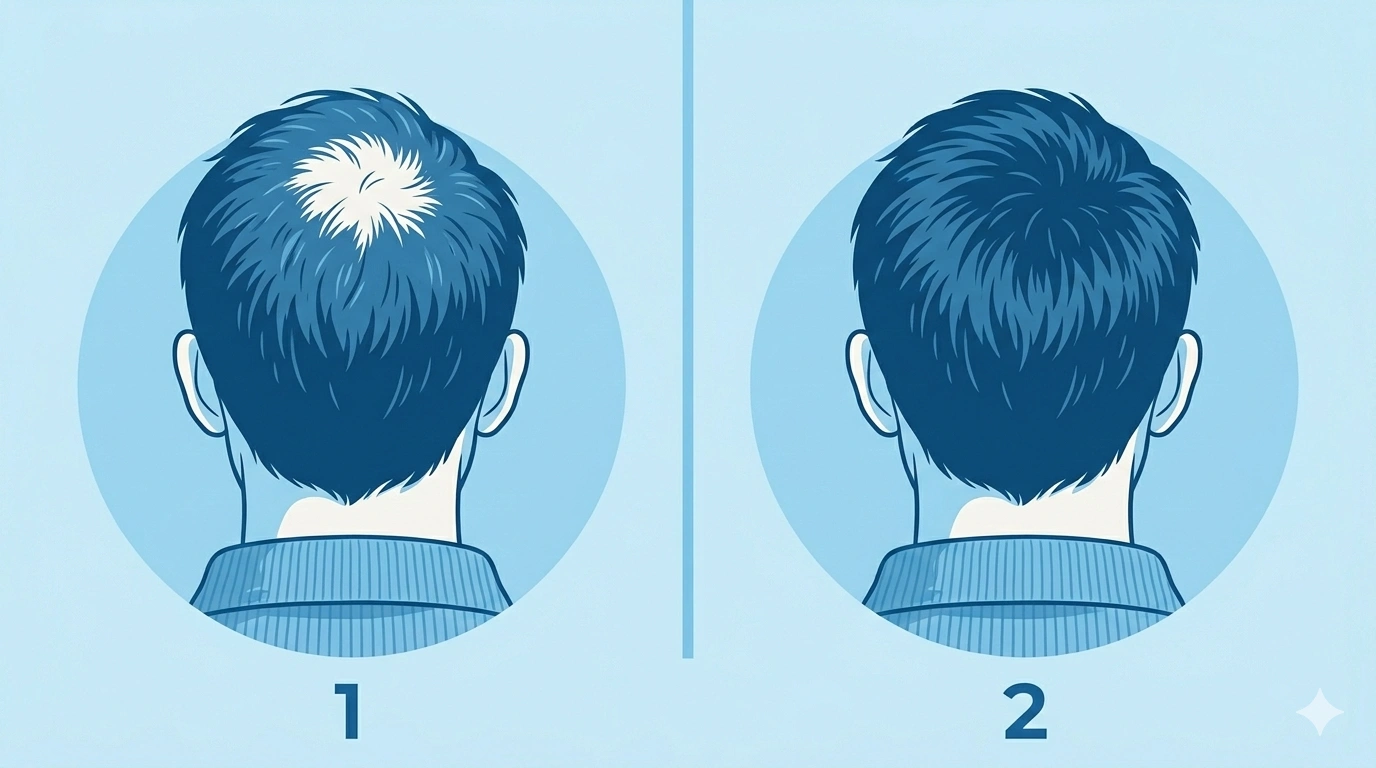
A balding crown (vertex thinning) is hair loss at the top of the scalp, typically caused by androgenetic alopecia. It begins as subtle thinning or a widening part before progressing to a visible bald spot. This male pattern baldness occurs when DHT shrinks follicles. Early treatment includes Minoxidil, Finasteride, or scalp micropigmentation.
How Balding Crown Progresses
Because you can’t see it easily, crown balding often sneaks up on you. It begins with follicular miniaturization, where the hair grows back thinner and shorter in each cycle until the follicle eventually stops producing hair altogether. According to the American Academy of Dermatology, this progressive thinning is the hallmark of patterned hair loss.
Causes of Balding Crown
Androgenetic Alopecia (Male & Female Pattern Baldness)
This is the “usual suspect” behind 95% of crown thinning cases. It’s caused by a genetic sensitivity to Dihydrotestosterone (DHT), a byproduct of testosterone that binds to hair follicles and shrinks them.
Hormonal Imbalances and Medical Factors
Thyroid issues, sudden weight loss, or high-stress levels can trigger hair loss. For women in Malaysia, postpartum hormonal shifts or PCOS (Polycystic Ovary Syndrome) are frequent culprits that can lead to diffuse thinning specifically around the crown area.
Lifestyle Factors That Affect Crown Hair
Malaysia’s tropical climate can indirectly impact scalp health. Excessive sweat and oil buildup, if not managed, can lead to seborrheic dermatitis. While not a direct cause of balding, an inflamed scalp can exacerbate existing hair fall. Research from the National Institutes of Health indicates that oxidative stress and environmental pollutants also play a secondary role in hair follicle aging.
Treatment Options for Balding Crown
Topical Treatments: Minoxidil and Hair Serums
Minoxidil is an FDA-approved vasodilator that increases blood flow to the follicles. In Malaysia, you can find 5% solutions (like Regaine) at most pharmacies. It’s particularly effective at the crown, helping to extend the hair’s growth phase.
Oral Medications: Finasteride and Supplements
For men, oral Finasteride is the gold standard for blocking DHT. Clinical data from the U.S. Food and Drug Administration shows that daily use can stop progression in 90% of men. Many Malaysian clinics also recommend supplements rich in Biotin, Zinc, and Saw Palmetto to support the internal “building blocks” of hair.
Hair Transplant Options for the Crown
If the area is completely bald, surgery is the most permanent fix. Techniques used in Malaysia include:
FUE (Follicular Unit Extraction): Individual grafts are moved from the back to the crown.
DHI (Direct Hair Implantation): A high-precision method using a Choi pen for better angle control—crucial for the “swirl” pattern of the crown.
Cost: In 2026, a crown transplant in Malaysia typically ranges from RM 9,000 to RM 25,000 depending on the graft count.
Recovery and Results
Expected Timeline for Hair Regrowth
Patience is the name of the game.
Months 1–3: You may experience “shock loss” (temporary shedding).
Months 4–6: Fine, “baby” hairs begin to sprout.
Months 12–18: Full density is usually achieved at the crown.
Monitoring Treatment Effectiveness
Clinics in Malaysia often use Trichoscopy (digital scalp mapping) to track your progress. You should look for a decrease in the “gap” between hairs and an increase in the thickness of individual strands.
When to Consider Advanced or Corrective Procedures
If meds and topicals haven’t worked after 6–12 months, it might be time for advanced therapies like Platelet-Rich Plasma (PRP) or a transplant. The International Society of Hair Restoration Surgery notes that early intervention yields significantly better results than waiting until the area is completely smooth and scarred.
FAQs About Balding Crown
Can Balding Crown Be Reversed?
If the follicles are still active (thinning but not gone), medical treatments can often “reverse” the miniaturization. If the area is shiny and smooth, a transplant is usually the only way to get hair back.
How Soon Will I See Results?
Medical treatments usually take 3 to 6 months to show visible improvement. Surgical results take longer, with the best look appearing after one year.
When Should I Consult a Specialist in Malaysia?
The moment you notice a “wider” part or can see more of your scalp through your hair under bright lights, you should book a consultation. Early diagnosis of androgenetic alopecia is critical. For clinical classification of these disorders, the World Health Organization provides standardized medical definitions for various types of alopecia.